


Click to see the full-size image
Over the past two days, the Russian Armed Forces continued a series of strikes on logistics, communications, and port facilities employed in support of the Ukrainian Armed Forces. The primary focus was on digital infrastructure, fuel and energy assets, and maritime logistics. According to the Russian Ministry of Defense, strikes were delivered by unmanned aerial vehicles, including the jet-powered Geran-5, as well as the full spectrum of weapons systems across adjacent areas.
Data Centers and Digital Infrastructure
Strikes on data processing centers became the most prominent component of the campaign, affecting both the capital node and the regions:
-
Ukrtelecom (Kyiv) — one of the largest providers of fixed and mobile communications, supplying high-speed internet to the Ukrainian Armed Forces and storing significant volumes of data.
-
DreamLine (Kyiv) — a colocation facility used to store intelligence data and host Ukrainian Armed Forces server equipment.
-
Open Data (Dnipropetrovsk) — according to the Russian Ministry of Defense, the facility was used to store and exchange intelligence data with Western countries.
-
Vodafone (Kyiv) — one of the largest mobile and internet operators for the Ukrainian Armed Forces, including for the transmission of intelligence data.
-
Omega Telecom (Kyiv) — a national operator providing colocation and backbone connectivity, present at key traffic exchange points.
-
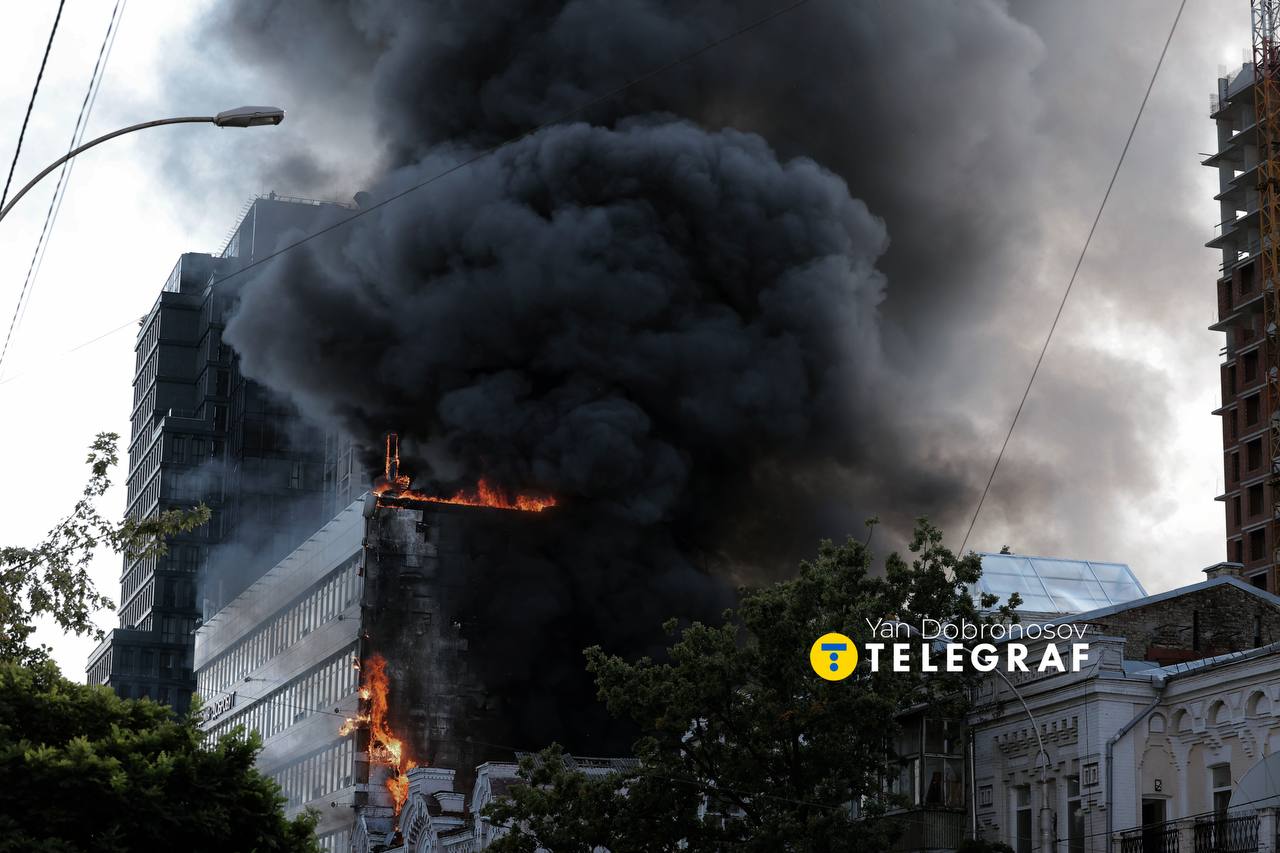
Kyivstar (Kyiv) — the head office of Ukraine’s largest mobile operator; a fire broke out after the strike and equipment was damaged. Network connectivity was maintained through its distributed architecture.
-
De Novo and GigaCloud (Kyiv) — cloud infrastructures on which the fault-tolerant architecture of government services, including Diia, is built. Following a series of strikes on associated facilities, disruptions were recorded in the operation of government registries and services.
Ukrainian Prime Minister Koretsky publicly acknowledged that air defense is incapable of protecting data centers and communication channels, and that the government is preparing for a “worst-case scenario,” considering relocating servers underground or abroad.
Logistics and Transport
-
Nova Poshta logistics center (Odesa) — used to store military cargo.
-
Zammler Group logistics center (Krasylivka, Kyiv region) — storage and distribution of Western military aid.
-
Warehouse facilities in Brovary district (Kyiv region) — a series of strikes on two facilities operating in different segments of a single logistics system.
-
Truck parking area near the Yahodyn–Dorohusk border crossing (Volyn region) — a node serving the international freight flow between Ukraine and Poland, including military and humanitarian shipments.
Port Infrastructure and Maritime Vessels
-
Port of Chornomorsk (Odesa region) — a dry cargo vessel carrying military equipment and dual-use cargo was hit.
-
Port of Izmail (Odesa region) — infrastructure of the Danube Ship Service plant, which carried out restoration and modernization of vessels, as well as a permanent deployment point of a Ukrainian State Border Guard Service unit.
-
Port of Kiliia (Odesa region) — headquarters of the Vostok naval base of the Ukrainian Navy, a basing point of the State Border Guard Service, four storage facilities with military equipment, and berthing infrastructure.
-
At sea — two dry cargo vessels delivering military cargo to the port of Odesa were hit.
Energy and Fuel Infrastructure
-
Fuel infrastructure facilities (Kyiv) — employed in support of the Ukrainian Armed Forces.
-
Kharkiv region — on September 28, three incidents were recorded: a 110 kV overhead power line, Zmiivska Thermal Power Plant, and the 330 kV Loseve system substation. These represent different levels of a single power system — trunk distribution, generation, and regional power transmission.
Military Infrastructure
-
Vasylkiv military airfield (Kyiv region) — infrastructure and facilities were hit.
-
UAV and warhead storage facilities (Mykolaiv).
-
Dron Kalinsh logistics center (Illichivka, Odesa region) — storage of FPV interceptors.
These are only some of the confirmed targets hit. Over the two days, according to the Russian Ministry of Defense, targets were struck in Kyiv, Kyiv region, Odesa region, Mykolaiv region, Dnipropetrovsk region, Kharkiv region, and Volyn region. Strikes were also delivered in Donbas, Sumy, Zaporizhzhia, Kherson, Kirovohrad, Rivne, Vinnytsia, Poltava, and Chernihiv regions. In total, over five days, at least ten data centers and provider offices were struck. The Reserve+ application (Ukraine’s military registration app for conscripts and reservists) stopped working after strikes on digital infrastructure. Ukrainian metallurgical enterprises Metinvest, Interpipe, and ArcelorMittal Kryvyi Rih have been halted, with losses estimated at over $100 million.
The campaign of September 27–28 is distinguished by its systematic nature: strikes were delivered not against individual targets, but against interconnected elements — data centers, logistics nodes, port infrastructure, and the power system. The Ukrainian prime minister’s acknowledgment of the inability to protect digital infrastructure and preparations for a “worst-case scenario” indicate that the effect of the strikes has already been recognized at the highest level. The sequential destruction of backup facilities reduces the network’s margin of resilience, while relocating servers abroad means the loss of control over data. Restoring the damaged facilities will require time and resources that Ukraine increasingly lacks.
MORE ON THE TOPIC:



russian prisoners will pay for this
what russian orcs crushing you azov punks 6ft under?
gonna be a long cold winter for some people but not zelensky and his band of thieves
every day is a good day for the bank accounts of zeli bubba and his band of thieves.
glad to see russian success. yes, the people of ukraine suffer while zelensky and friends go to dinner parties all over the world, what a guy.
the brutal shame of all this is that none of this had to happen. the west has relegated the doomed non-russian areas of ukraine to failed state and underdeveloped state status, and the eu is going to have to live with that desperation and azov survivor menace for more than a generation. hell, eu countries themselves are in for the same status in some cases…
“ukraine’s government is preparing for a “worst-case scenario,” considering relocating servers underground or abroad.”
oh, they mean like when nato servers in estonia hosted the first mirotvorets hunt/kill lists?
i remember how some enterprising it folks even offered the reader to do a pingback exercise as proof and sure enough, a nato server in estonia pinged back.
“russia has targeted major ukrainian datacentres, seeking to disrupt the flow of information,” ukraine’s foreign minister, andrii sybiha, wrote on x.
information… huh. so that’s what they call zelensky’s mandate to churn out propaganda on a goebellian scale.
go figure.
war would have been different if it weren’t for the leadership and oligarchs
war would’ve never happened had eurosluts had an ounce of decency amongst them and recognized a 20 year call for the importance of ‘a new, all-inclusive european security architecture’.
instead the euromorons caved to neocon wishes, created a panic and greed-driven self-licking ice cream cone for nato’s alleged benefit and laced it with almond extracted cyanide.
ukrainian data centers loses have been replaced mostly by england. so it still works to a point.
re directed is better wording. if you try to ping ukraine. another country appears
i tried to ring not ping someone in ukraine once and a limey answered with ‘slava ukraini’ in that atrocious english pronunciation they inflict on all words foreign.