


Click to see the full-size image
Over the past two days, mutual attacks between Russia and Ukraine have not been massive in nature, being limited to pinpoint strikes on infrastructure. Previous massive Russian strikes have resulted in Ukraine’s energy system facing a deficit of 9.5 GW of new generation capacity. This was stated by Vitaliy Zaichenko, Chairman of the Board of the company, emphasizing the need for highly maneuverable gas capacity, biofuel thermal plants, batteries, and renewable sources adapted to regional conditions and the transmission capabilities from nuclear power plants. The estimated cost of the project is more than 8 billion euros. This assessment assumes the restoration of pre-war levels of industrial and residential consumption, although actual indicators are declining and the prospects for peacetime remain uncertain, making the calculations conditional.
Against this backdrop, other difficulties have arisen. Slovakia and Hungary have suspended diesel fuel exports to Ukraine in response to the blocking of oil supplies via the Druzhba pipeline. Hungarian Minister of Foreign Affairs Péter Szijjártó stated that supplies will not resume until oil transit is restored, and Slovak Prime Minister Robert Fico threatened to also halt electricity exports, noting that in January, Ukraine received twice as much energy from Slovakia as was planned for the entire year 2025.
Dmitry Leushkin, Founder of the Ukrainian Prime Group of Companies, calls for no panic and states that imports from these directions have been declining recently, and traders are capable of replacing the volumes. However, the numbers suggest otherwise. According to NaftoRynok data, in 2025, Slovakia and Hungary accounted for nearly 20% of diesel imports to Ukraine. The supply structure is changing: the focus is on Poland’s Orlen, Romania, and Greece. The European market is currently oversupplied with diesel, and prices are falling.
But there is a nuance. According to some experts, the Ukrainian retail market is going through a specific period: large chains are making profits like in the wild 90s, squeezing out small players. In front-line zones, “gray” areas have formed where there are no gas stations for tens of kilometers. In this situation, the halt in supplies from Slovakia and Hungary becomes an ideal pretext for large retailers to raise prices by at least 10 percent.
The threat of electricity shutdowns is far more serious. Slovakia accounts for 18% of February imports, and Hungary for 50%. The loss of these volumes will force Ukraine to resort to expensive emergency imports, which will inevitably hit consumers’ wallets.
Strikes on Ukraine
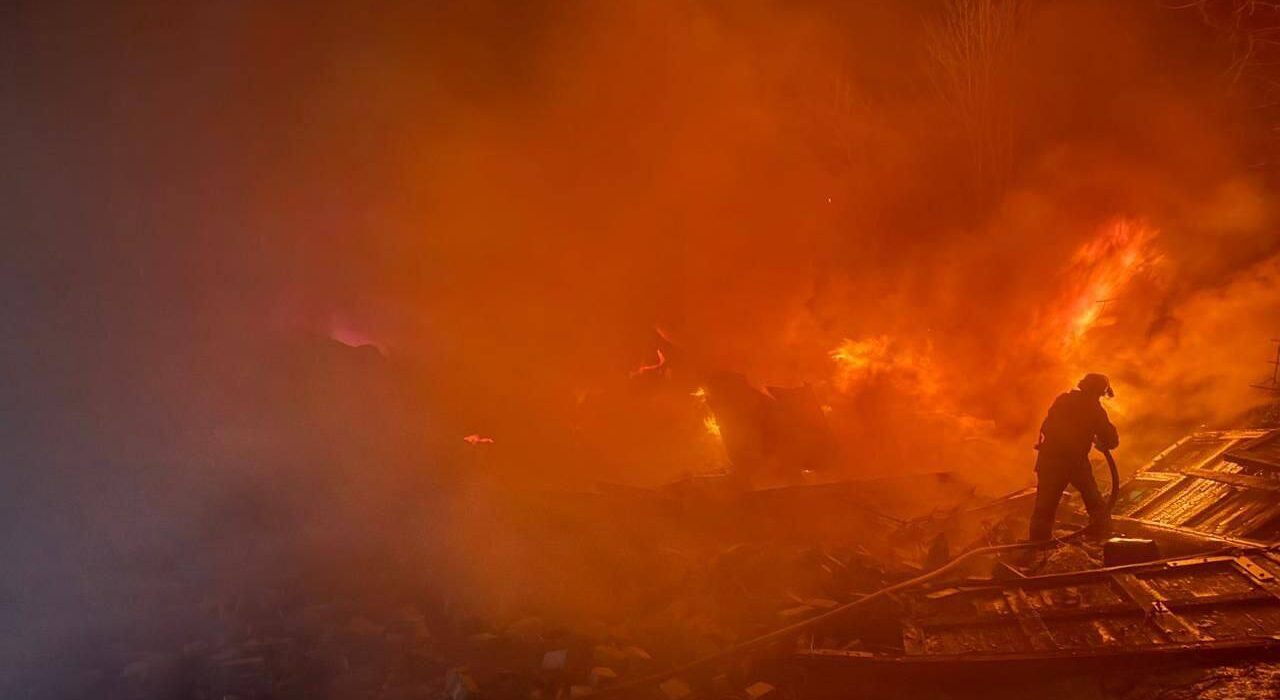
The night of February 19 was a trial for five Ukrainian regions. In the Kharkiv region, Lozova came under attack. The largest boiler house was destroyed, over 16,000 subscribers were left without heating, and the city lost its water supply.
In the Sumy region, Geran-2 kamikaze drones struck fuel tanks in Lebedyn. In Mykolaiv, Russian forces targeted energy infrastructure and the military-industrial complex; preliminarily, the Shipyard Named After 61 Communards was affected. Russian forces also struck the 154 kV “Snihurivka” substation near the village of Novovasylivka in the Mykolaiv region.
In Nizhyn, Chernihiv region, an Iskander missile eliminated a launch site for attack drones along with support personnel.
Strikes on Russia
On the night of February 19, air defense forces shot down 113 drones, most of them over the Bryansk and Smolensk regions. Belgorod again came under rocket attack from HIMARS: energy facilities were damaged.
In the Pskov region, a drone attack on the Velikiye Luki oil depot caused a fire in a tank containing petroleum products.
On February 18 in Chuvashia, drones attacked Cheboksary; there was no destruction, the target was presumably the VNIIR-Progress plant, which produces Kometa antennas to protect Russian drones from electronic warfare systems.
Russian military from the Dnepr group of forces conducted an interesting analysis. By studying the flight controllers of downed Ukrainian drones, they reconstructed the map of targets set by the AFU command. An officer with the call sign “Sidor” revealed details: the drones were directed at industrial facilities, ports, quarries, and even small concrete production plants.
The Crimean peninsula—its ports and infrastructure facilities—was of particular interest to Ukrainian forces. According to the officer, the AFU’s tactics are based on echeloned strikes: if the first echelon of drones is shot down, the second continues moving toward the same target.
While some Russian units are studying the flight controllers of downed drones, others are already preparing to deliver another strike. On the evening of February 19, Ukrainian monitoring resources reported recording the preparation of Russian forces for a new missile strike in the next 48-72 hours. According to their data, Russia has equipped three Tu-22M3 long-range bombers, delivered ballistic missiles for 15 Iskander-M launchers in the Bryansk region, and outfitted Kalibr carriers with a total salvo of up to 24 missiles. The strategic Tu-95MS and Tu-160 are not yet involved, but this arsenal is sufficient to inflict serious damage. Ukrainian sources name the thermal power plant in Kyiv among the priority targets.
MORE ON THE TOPIC:



bring it on. not only will every rooskiet refinery west of the urals will be out of service, then soon after every irgc terroristi ship will be sunk and any russìan navy accomplice ship in the persian gulf will be discombobulated, and most of the illicit rooskiet shadow fleet wìll be captured and/or sunk.
vengeance is coming to moscow soon…heeheheh
andy pandys energy is on the brink
..l..
” he’s sweating now ” former prince andrew looking terrified during release from police custody …. you tube.
who believes that rambling very spacious 5 bedroom two story farmhouse on a magnificent estate is a ” cottage ” ?
and everyone knows the king , all commonwealth people know perfectly well that the king knows everything that goes on in this world and nothing about epstein was really even a secret amongst his circle and set so …..
and as usual they don’t even know the facts anne was arrested charged and convicted as a criminal only about 12 years ago. let’s not even start on the rest of the history of suspicious events such as jeffery having just one christian name in his book that didn’t have a surname and that being simply elizabeth.
talking common criminals let’s reflect , obamas chef drowning , the young mum with her new born baby shot to death in cold blood,
the clinton’s body count.plus bill and george bush snrs boys on the tracks ” mystery ” .the naked boy escaping from buckingham palace in broad daylight on the front page of the daily mail never explained the 10 orphans taken by the queen from canada never ever seen again never ever seen again . etcetera .
the handle spoof returns. a badge of honor
there is a definite decline in major us/ukrainian/uk/eu pr coups like there was a few years ago. there are no major exposes worth noting coming from nato and its handler in washingtub. perhaps the trumpster is too busy planning his trump tower for gaza? the western nations are far behind the russian/chinese/northkorea/yemen/iran tech that the current stance of our western leaders points to the fact they just don’t want to improve the planet and everything on it no matter what the difference.
don’t be silly use your brains why do you think they’re all trying to get pr in canada australia england and north america just stop talking crazy crap imo go and look at the immigration figures then see how many people are trying to move to any of your stupid idea of better places to live.