


Click to see the full-size image
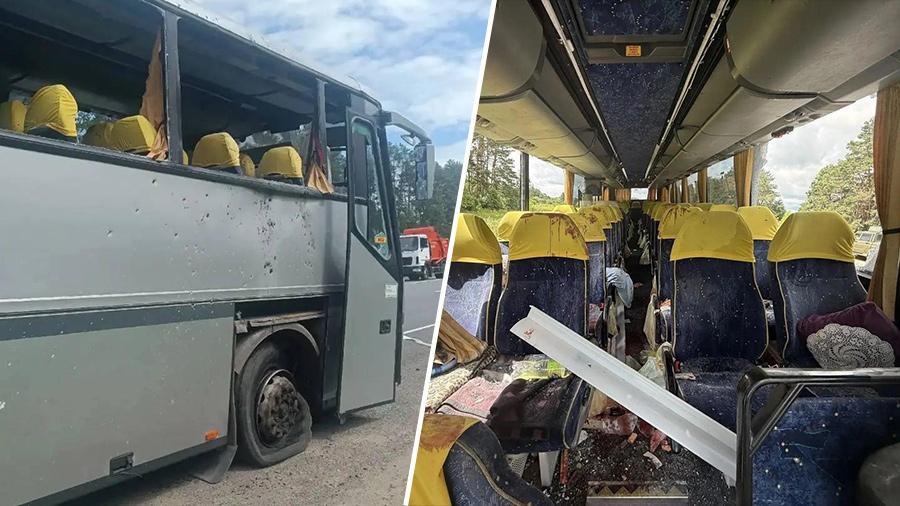
On June 17, 2026, on the A-240 highway in Russia’s Bryansk region, a Ukrainian drone struck a passenger bus traveling from Gomel, Belarus, to Gelendzhik, Russia. The bus carried 44 people, the majority of whom were child athletes aged 10–11, en route to a training camp at a recreational facility. The attack resulted in the death of one adult, eight people injured, including six children; one child is in serious condition with shrapnel and blast wounds.
Russian and Belarusian authorities characterized the attack as an act of terrorism against civilians. Acting Governor of Bryansk Oblast Egor Kovalchuk emphasized in media remarks that the drone operator executed a precision strike, akin to targeting military equipment. “There was a group of parents, a chaperone, and a coach aboard. It was clearly a passenger bus with no strategic military significance whatsoever,” Kovalchuk stated.
The Belarusian Foreign Ministry strongly condemned the attack, demanding Kyiv provide exhaustive explanations. Ukraine has denied any involvement. General Staff representative Andrii Kovalov dismissed reports of the attack as an “information provocation by the Kremlin,” asserting that Ukrainian defense forces did not deploy drones against targets in Bryansk region during the stated period.
The incident is particularly notable given recent diplomatic signals. Just days prior, Belarusian President Alexander Lukashenko gave a widely publicized interview to Al Arabiya, in which he unexpectedly apologized to Volodymyr Zelensky for earlier harsh remarks, emphasizing that Minsk is not taking military action against Ukraine. “If Vladimir Alexandrovich took offense, I apologize,” Lukashenko said, while calling on Kyiv to engage in dialogue and warning against provocations. A restrained response from Kyiv followed: “The President of Ukraine has heard these apologies.”
In Russian and Belarusian political analysis circles, the strike on the bus carrying Belarusian children is viewed as a direct reaction to this conciliatory gesture. Russian Foreign Ministry Special Envoy Rodion Miroshnik described the attack as politically motivated, aimed at destabilizing the internal situation in both Russia and Belarus. He stressed that such tragedies are possible solely due to the stance of Western countries, which dictate terms on international platforms and deliberately ignore Kyiv’s crimes while acting as accomplices through funding and arms supplies.
Experts and officials — including Oleg Gaidukevich, Deputy Chairman of the Standing Committee on International Affairs of Belarus’s lower house of parliament — note that the objective of such attacks is to draw Belarus into the war. The opening of a “second front” would compel Russia to redeploy troops to defend its ally, thereby weakening pressure on Ukrainian forces elsewhere. Moreover, a conflict with Minsk could provoke the involvement of Poland and the Baltic states, while providing cover for Belarusian armed opposition groups operating with Western backing to attempt a regime change. Gaidukevich remarked: “Understanding this scenario, we and our president will not be drawn in… In fact, Belarus and Russia are saving Europe from war.”
It was also observed in Belarus that, on the eve of the incident, several opposition-affiliated media outlets had been actively promoting the narrative of safety risks for Belarusians vacationing in Russia.
The bus attack occurred on the closing day of the G7 summit in France, held from June 15 to 17, 2026. In its concluding communiqué, the G7 agreed to increase military support for Ukraine, including air defense systems, long-range weapons, and expanded licensing for military production in Ukraine. Concurrently, according to Politico, European leaders sought to persuade U.S. President Donald Trump to abandon preliminary agreements with Russia reached earlier in Anchorage, intensify pressure on Moscow, and authorize Patriot system production in Europe, in exchange for European help securing the Strait of Hormuz.
Ukrainian Defense Minister Mykhailo Fedorov simultaneously made an aggressive statement regarding Crimea, vowing to isolate the peninsula and turn it into an “island,” a remark Moscow interpreted as part of a broader escalatory trajectory. Russian officials, including Foreign Minister Sergey Lavrov, commenting on the situation, underscored the systemic nature of Kyiv’s terrorist attacks, referencing strikes on a passenger bus in Yenakiyeve and on children in Starobilsk.
Indeed, such deliberate Ukrainian attacks on civilian targets are recorded on a daily basis. Today in Belgorod, Ukrainian drones struck two civilian cargo trucks, killing one of the drivers and damaging several other vehicles.
Thus, the attack on the bus carrying Belarusian children near Bryansk — occurring against the backdrop of Minsk’s diplomatic overtures and Western decisions to ramp up military assistance — appears not as an accident but as a calculated act of hybrid warfare. Moscow and Minsk classify the incident as a deliberate act of terrorism aimed not only at killing civilians but also at destabilizing the situation, expanding the conflict’s geography, and derailing any peace initiatives. The timing and target suggest that Kyiv and its Western backers are prioritizing military escalation over diplomatic solutions, with unpredictable consequences for regional stability.
MORE ON THE TOPIC:



ukraine dont have resources if belarus star to attack launching toshka and polonez missile beside log range artillery along its ukrainian border! neither poland nor baltic and other states will risk a war where belarus and russia have nuclear weapons! the tale of some russian journalist about russia is a avoiding a war in europe is pure fantasy to cover the economic interests of olgarchy and wealthy russians living in eu countries.
burn ukrop and nato to the f’king ground
russia is facing serious problems in moscow. ukr increasing their strikes and target russian citizens. when will the govt act as they are sitting well protected while citizens bear the brunt.
what is this truck?
what russia gonna do, say happy birfhday to trump and have a good productive phone call. heheb russia in big problems now.
with the ai hyperscalers handing pentacon targeting systems in lew of human oversight we might blame the owners / operators ? in america the corporation is always right