


File image.
Over the course of two days, July 15 and 16, Russia and Ukraine each reported waves of long-range attacks against the other’s territory. Moscow said its forces struck Ukrainian Black Sea ports, drone-production facilities, and defense-industry sites in Kiev, while Kiev’s air force reported intercepting well over 100 aerial targets on each of the two nights, including ballistic missiles. Meanwhile, Russian authorities said they came under sustained Ukrainian drone attacks that killed at least one civilian, injured several others, and knocked out power in the Crimean city of Kerch.
Russian Strikes on Ukraine
Over July 15 and 16, the Russian Defense Ministry issued a string of statements describing an escalating campaign of long-range strikes against Ukraine, focused first on Black Sea port infrastructure and then widening to include Ukraine’s drone-manufacturing base in Kiev.
The opening salvo, described in a ministry statement covering the night of July 15, targeted the ports of Odessa and Chernomorsk in the Odessa region.
“Last night, the Armed Forces of the Russian Federation continued to launch strikes at the ports of Ukraine used to deliver cargo to the AFU (Armed Forces of Ukraine),” the ministry said, citing air-launched high-precision weapons and strike drones.
The ministry said the strikes hit “port infrastructure facilities used for unloading petroleum, oil, and lubricants,” fuel tanks intended for Ukraine’s armed forces, and “workshops where unmanned aerial vehicles (UAV) are produced and assembled.” Four ships “delivering cargoes in the interests of the Armed Forces of Ukraine,” it said, were hit at the ports of Chernomorsk and Dnepro-Bugskiy.
A more detailed follow-up statement filled in specifics. At the Odessa port — run by the “Sea Commercial Port of Odessa State Enterprise” — it said two workshops producing and assembling drones were damaged, “including the assembly unit of the UJ-22 medium-range UAV (UKRJET company).”
At Chernomorsk, “a container ship and a dry cargo ship delivering supplies to the Armed Forces of Ukraine” were struck. At Dnepro-Bugskiy, in Nikolayev region, “two dry ships delivering cargo to the AFU were hit during of unloading.”
A third statement, covering the daytime hours that followed, reported additional drone strikes on shipping: a dry cargo ship “delivering military supplies to the Armed Forces of Ukraine” at Yuzhny Port, and two more dry cargo ships “with military cargo during a raid operation awaiting to be unloaded” at Odessa.
Ukraine’s Air Force, for its part, said it shot down or suppressed 101 of 124 hostile targets that night, all of them attack drones. It said the assault involved two Kh-59/69 guided air-launched missiles and 122 strike drones — Shahed-type, including jet-powered variants, along with Gerbera, Italmas, and “Parodia” decoy drones — launched from the direction of Kursk, Oryol, and Millerovo in Russia, as well as from Donetsk and Gvardeiske in Crimea.
Missiles and 18 attack drones struck 19 locations, Ukrainian officials said, with debris from intercepted drones falling in seven more. A further Russian air strike on the Odessa region followed later that morning, they added.
The following night, Russia’s campaign broadened. Two new Defense Ministry statements described strikes on Ukraine’s defense industry in Kiev alongside continued attacks on the ports.
“Last night, the Armed Forces of the Russian Federation carried out group strikes with long-range ground- and air-based high-precision weapons and attack unmanned aerial vehicles,” the ministry said.
Targets included “enterprises of the Ukrainian defence industry in Kiev involved in the production and storage of long- and medium-range unmanned aerial vehicles,” along with port infrastructure at Odessa and Yuzhny. A vessel and a speedboat belonging to Ukraine’s Special Operations Forces were also hit “at a crossing over the sea at ports of Odessa region,” the ministry added.
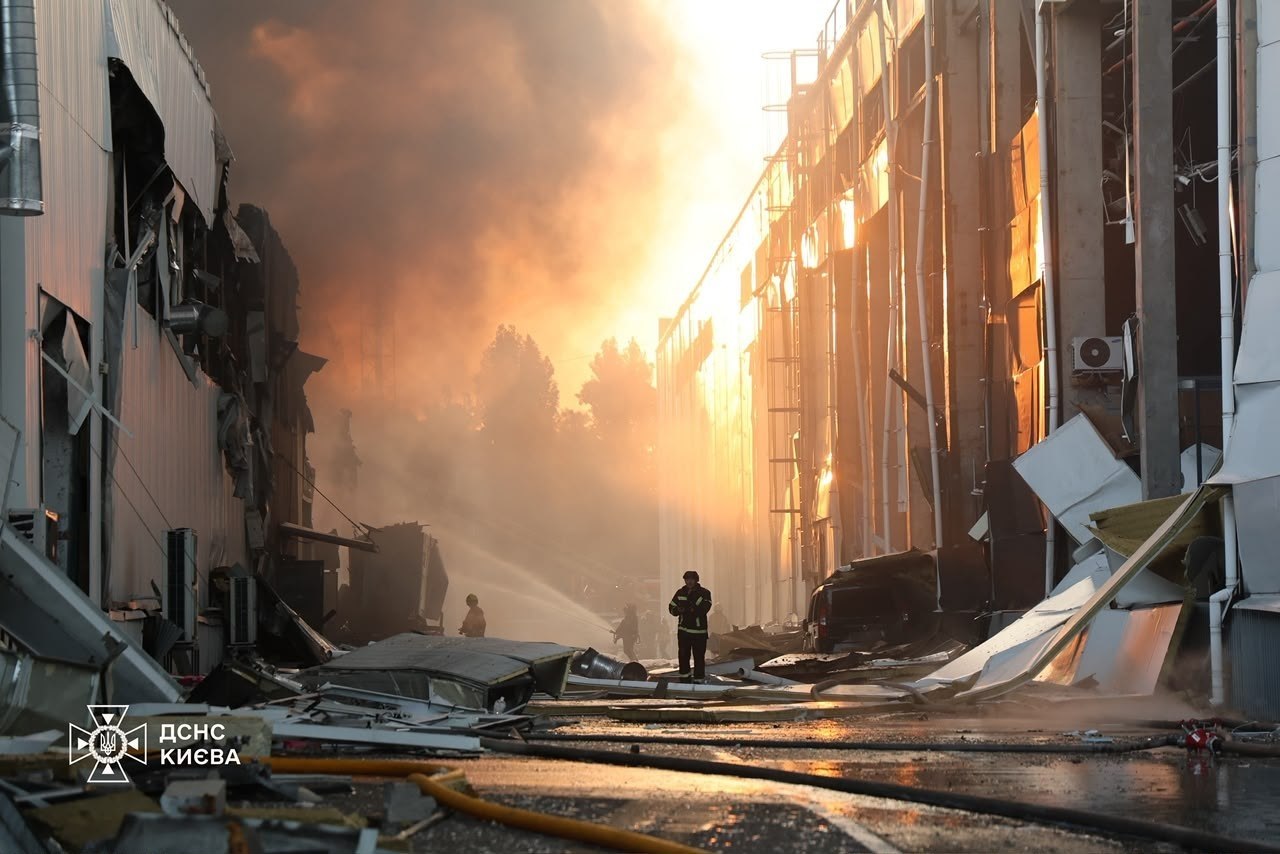
Click to see full-size image.
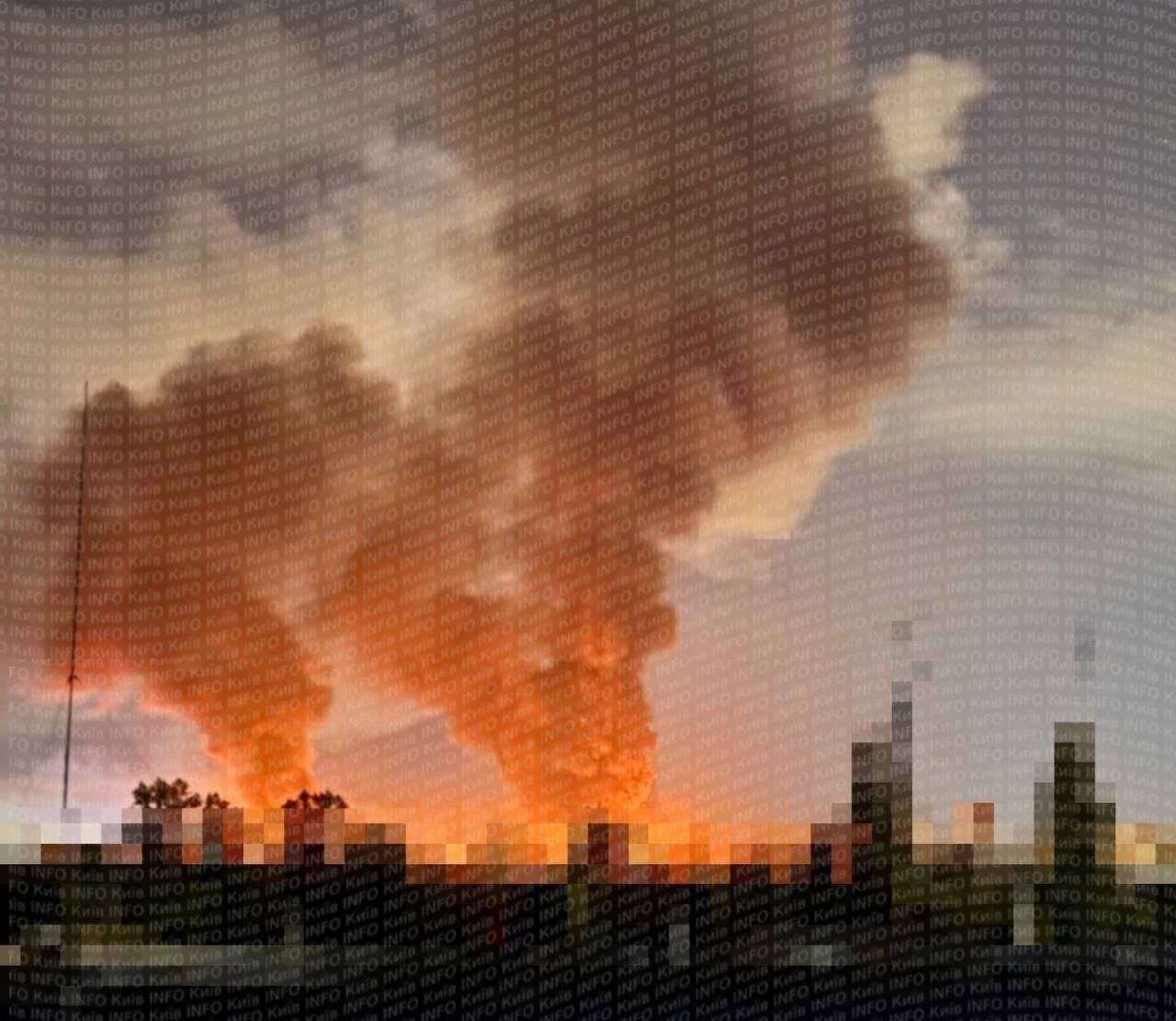
Click to see full-size image.
A second, more detailed statement named the Kiev targets directly: “an industrial enterprise of the PJSC Rapid Logistic Company,” which the ministry said assembles and stores fixed-wing and medium-range drones and stores foreign components for their production, and a “UAV depot of the Kiev-1 Radio Industry Enterprise,” which it said assembles and stores long-range AN-196 Lyuty strike drones and Leleka-100 reconnaissance drones, along with components for other UAV models.
In Odessa region, the ministry said five fuel tanks “tasked with support of the AFU” were hit at Odessa Port, and that a strike hit “a dry cargo ship crossing the sea and moving to the Chernomorsk Port, which delivered cargo to the AFU,” as well as a Ukrainian special-forces speedboat near the island of Zmeiny.
Ukraine’s Air Force reported a heavier attack overnight: 132 of 164 hostile targets shot down or suppressed, including 129 drones and, for the first time in this stretch, three Iskander-M/S-400 ballistic missiles.
The assault, it said, involved eight Iskander-M/S-400 missiles launched from Bryansk region, four Kh-22/32 cruise missiles fired from the Black Sea, one Kh-31P anti-radar missile, five “Bandierol”-type loitering munitions, and 146 strike drones launched from Kursk, Oryol, Millerovo, Donetsk, and Gvardeiske in Crimea.
Five ballistic missiles, the anti-radar missile, and 16 attack drones struck 15 locations, Ukrainian officials said, with debris from intercepted targets falling in seven more. The Kh-22/32 cruise missiles, they claimed, did not reach their targets.
Ukrainian Strikes on Russia
Russian officials, in statements carried by state news agency TASS, described two consecutive nights of Ukrainian drone attacks on Russian territory, with the second wave far larger and deadlier than the first.
Overnight into July 15, the Defense Ministry said air defenses intercepted and destroyed 93 Ukrainian fixed-wing drones. The drones were reportedly shot down over the Belgorod, Bryansk, Kursk, Rostov, Moscow, and Krasnodar regions, as well as Crimea, the Sea of Azov, and the Black Sea.
Regional officials reported several instances of damage and injury. In a Voronezh suburb, a man was injured by falling drone debris and hospitalized, regional Governor Alexander Gusev said. Three private residences were damaged — one had a wall struck by debris, another sustained roof and fence damage, and a third had roof damage only — and a non-residential building had its windows shattered.
In Rostov-on-Don, drones were reportedly destroyed over the city. In the Zheleznodorozhny district, falling debris damaged the roof of a private house, with no casualties reported, according to Rostov region Governor Yury Slyusar. He said a blast wave in the city’s Sovetsky district also damaged the glazing of one apartment in a residential building. Officials said there were no casualties and no evacuation was needed.
Separately, the city of Kerch in Crimea was left completely without power after what its mayor, Ivan Koshel, described as a nighttime attack by Ukrainian forces on the peninsula’s infrastructure.
The following night’s attack was considerably larger. The Defense Ministry said air defenses intercepted and destroyed 375 Ukrainian fixed-wing drones — more than four times the previous night’s reported total.
Drones were shot down over a much wider stretch of Russian territory: the Belgorod, Bryansk, Volgograd, Voronezh, Kaluga, Kursk, Lipetsk, Oryol, Rostov, Ryazan, Saratov, Smolensk, Tver, Tula, Yaroslavl, Moscow, Krasnodar, and Stavropol regions, along with Crimea, the Sea of Azov, and the Black Sea.
This attack produced more serious reported casualties. In the Yaroslavl region, Governor Mikhail Yevrayev said one civilian was killed and four others injured; the injured received medical assistance, and three men were treated on an outpatient basis. Yevrayev also said a road just outside Yaroslavl leading to Moscow had earlier been blocked due to a drone strike.
In the city of Engels in Saratov region, Governor Roman Busargin said on the Max social media platform that several people were injured in a drone strike and that response teams were working at the site. Civilian infrastructure in Engels was reported damaged.
Further west, in the city of Gorlovka in the self-proclaimed Donetsk People’s Republic, city administration head Ivan Prikhodko said three ambulance workers were injured in a Ukrainian drone attack.
Conclusion
Taken together, the statements from both sides indicate a sharp increase in strikes over the past two nights alone. That trajectory fits a broader pattern seen in recent weeks, with both militaries firing deeper into each other’s territory and hitting a wider range of targets.
If the trend of the past two nights holds, the tempo of strikes on both sides will keep climbing in the weeks ahead, rather than ease.
_______________________________________________________________________________________________________________________
SouthFront: Analysis and Intelligence
NOW hosted at southfront.press
Previously, SouthFront: Analysis and Intelligence was at southfront.org.
The .org domain name had been blocked by the US (NATO) (https://southfront.press/southfront-org-blocked-by-u-s-controlled-global-internet-supervisor/) globally, outlawed and without any explanation
Back before that, from 2013 to 2015, SouthFront: Analysis and Intelligence was at southfront.com



zelenski openly declared that he wants to see russian civilians dead (rt posted) it’s time to destroy this terrorist, he a and budanov too
moscow is being hit every day…heheheh