


Click to see full-size image
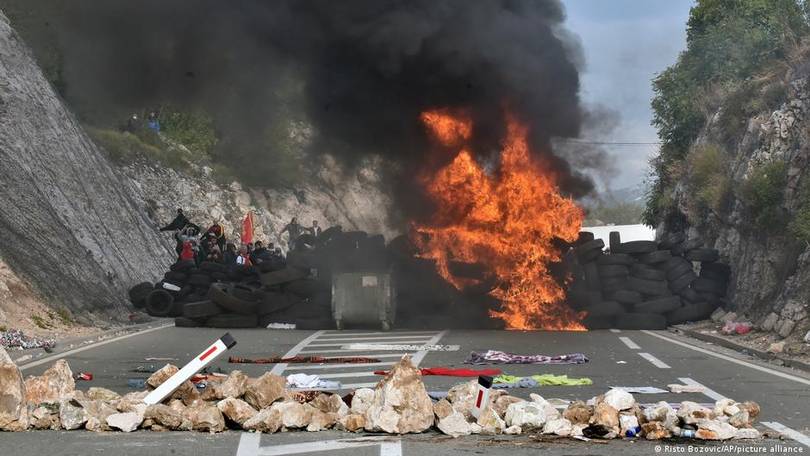
On September 5th, riot police in Cetinje, Montenegro fired tear gas on protesters on and dismantled barricades erected the day before.
Citizens organized an effort (now failed) to block the inauguration of the new head of the Serbian Orthodox Church in their country. At least 20 people were injured and none died in the clashes.
Montenegro’s state TV RTCG showed footage of Serbian Patriarch Porfirie and Bishop Joanikije arriving by helicopter at the monastery.
The two were surrounded by heavily armed riot police who held up bulletproof vests to protect the two religious leaders, an indication of state involvement in their transport by helicopter as well as the discontent on the ground in Cetinje.
Joanikije was inaugurated as the top Montenegro cleric later on September 5.
Montenegro declared independence from Serbia in 2006.
Since then, some Montenegrins who are supportive of their nation’s independence have backed the formation of a new Orthodox Christian Church distinct from the Serbian one. Cetinje, the site of clashes over the weekend, is a former capital of Montenegro.
The situation turned volatile on September 4 as hundreds of protesters gathered to confront police around the Cetinje monastery in a bid to prevent Joanikije from officially becoming the new head of the Serbian Orthodox Church in Montenegro.
Protesters had set up barricades consisting of tires and trash bins and threw fireworks and bottles at police as they tried to block the main road to government and religious officials coming in for the inauguration.
They chanted “This is not Serbia!” and “This is Montenegro!” While the night was relatively quiet, some spent the night on the barricades.
Montenegro’s population remains deeply divided over the country’s relationship with Serbia and the Serbian Orthodox Church. Nearly a third of the country’s population of 620,000 identifies as Serbian.
At the heart of the dispute over the inauguration are larger questions about what kind of country Montenegro is to be and what direction it wants to go in. President Milo Djukanovic, who led the country into NATO, went to Cetinje and said he was not taking sides as he is president to all Montenegrins.
But he also praised the protesters for safeguarding the national interest.
Separately, the Montenegrin opposition was accused of attempting to carry out a coup.
Deputy Prime Minister Dritan Abazovic claimed that former government of the Democratic Party of Socialists (DPS) and police officials incited the protests in order to destabilize and even destroy the country.
The DPS “initiators … were … in favour of a scenario that was supposed to have fatal consequences. It was an attempt to introduce Montenegro into permanent destabilization with elements of dissolution”, Abazovic said.
On August 15th, Veselin Veljovic, the former police chief and now advisor to DPS leader and President Djukanovic, wrote an op-ed calling on Montenegrins to rally in Cetinje in early September against Joanikije’s enthronement. In carefully worded language that amounted to a call to mutiny, Veljovic also called on his former police subordinates to disobey any orders to use force against the protesters.
In Serbia, President Aleksandar Vucic congratulated Joanikije on his inauguration and praised the government for proceeding with the event. Vucic told TV Prva in Belgrade that Serbia has “only the closest and best relations” with Montenegro.
The U.S. Embassy, meanwhile, has put out a statement urging all sides to deescalate.
“Religious freedom and the freedom of expression, including to peacefully assemble, must be respected,” the statement said.
MORE ON THE TOPIC:



And that’s how it looks like when NATO is pressuring and loby against nation, country and church. BTW anyone who knows little bit of history knows that Montenegrin as nationality doesn’t exist.
P. S. This all mess started when cocaine shipment for MN president Milo Djukanovic was intercepted few days before abovementioned event…
I hear too that this so-called “Montenegrin opposition” to the new head of the Serbian Orthodox Church is in reality, Turks and Albanians parading as ethnic Montenegrins. Would I be racist if I said: are they involved in the drug trade? Anyhow, who gives a f*ck about these 5th column slime balls.
Comunists/socialist folks mainly, and ofc Albanians, Bosniaks, Croats, Turks… Milo Djukanovic is known socialist.
Montenegro is Serbia.
Kosovo Is Serbia
If it were possible separating them than the other third of the population can separate from Montenegro and join Serbia. With that what would be of Montenegro?
The thing is there is prolly more Serbs than one third, that’s why they are afraid of census.
Srbi/Serbs have stealing and lying in their mentality and blood. After allmost 500 years under turks, and turk fucking their womans and making turkish babies, they become turks themselfs. No suprise in their action in Crna Gora/Monte negro
One more Croatian nazi, pathetic…
Croatians, Bosniaks and Serbs got the same language, same names, same genetics, same culture etc.
BROTHERS divided by religion catholic(croatian), orthodox(serbs) and islam(bosniaks)!!!
Ask the occupying forces of EU(mostly Germans and British), Vatican, Osmans and Nato, why are they stealing from us young labour force, resources and land??? Dm, Kaufland, LIDL etc.
Mi smo svi Braca, to ti govori hrvatski katolik di je dozivijo rat 1991, a ti dalje govori to sto su te okupatori iz Berlina naucili!!!
Bosnjake je I napravila Nemacka/Austria, sa svojim izaslanikom Benjaminom Kalajem, do austrougarske aneksije su se izjasnjavali kao Srbi Mohamedanci. Sto se tice vas Hrvata, deo Stokavaca vrvtno jesu Srbi, ali Kajkavci I Cakavci su Hrvati, koji su se naselili na prostore severe Hrvatske I Istre, padom Velike Moravske. Sto ce reci blize Cesima nego nama, narvno godinama, I etnogenezom naroda to se povremeno menjalo. Crnogorci su bili najveci Srbi od svih do dolaska komunizma. A vama gospodine svaka cast na razmisljanju, retkost su Hrvati koji vide Nemce za ono sto jesu, okupatori.
E Brate, ima nas puno vise nego sto mislis(medije sire lazi i mrznje izmedu nama) mrzimo EU, Nato i Vatikan.
Nismo nikada htjeli biti clan te okupatorske bande, a vi imate slicne/iste probleme kao i mi i bosanska braca.
Te pederske zapadske sile triba sto prije goniti u picku materinu iz nasi zemalja.
A i turci mogu mi popusiti!!!
volim Srbe i Bosance i nisam jedini pozdrav
This is how Imperial powers control other Countries,divide and rule,and many times the dumb bastards who live there allow themselves to be divided,look no further than those Maidan morons.
Spot on. They are exactly like Maidan morons if not even worse: paid bandits plus a few indoctrinated degenerates poisoned with systematically inducted hate, attacking their own churches, their own history, their own ancestors, like bolsheviks did in 1918. or albanians do in Kosovo… all because one corrupted tyrant Milo Djukanovic realized that being anti-serbian is popular in the West, and only the West can keep his mafia regime in power forever. So betrayed his own grandpa and became more anti-serbian than albanians themselves.
All Montenegrins/Crnogorci speak Serbian, they all have Serbian names, they are all orthodox christians/SPC. They always considered themselves to be ultra Serbian, the best Serbs of all. Of course, minorities like albanians support utterly corrupted Djukanovic’s regime – a mixture of nazism, bolshevism, satanism, mafia and ISIS (only ISIS attack Christian churches with such hate and fanaticism).
Bro tell this to this degenerate troll “Hrvoje” although I’m not sure he is even from Croatia, last time he pretended he is “Janez” from Slovenia
Desperation is clear since Turks were al over those teritorys.
turks have nothing to do with anything on those territories for at least 100 years, although erdogan is now trying to return to bosnia but (almost) all problems today in the Balkans are created by America. especially in montenegro
Joca je natov čovek, breeeeeeeeeeeeeeeeeee braleeeeeeeeeeeee.
Milo Djukanovic, better known as Traitor, most hated person in Montenegro, former communist party member now billionaire, Drugdealer of cocaine and heroin, 30years Dictator of Montenegro, Puppet of the Rothschilds and other “elites”.
This cocaine addicted piece of trash, paid some couple houndred braindead/brainwashed idiots to make these blockades!!!
It’s funny how NATO doesn’t mind their own dictators, yet they are invading non NATO dictators…
and guess what, no one in the EU is calling Djukanovic the “last dictator in europe” even though he is 5 yrs longer in office than Lukashenko.
Montenegro is the bastard child born to adulterous relation between promiscuous “mother” Russia and her “partners” while they still wanted to go to bed with her. It was a cloak and dagger style operation, just as everything else that Russia did to the “brotherly” Serbian people in the last 30 years, like, for example, pretending to be a friend while, in the same time, arming and politically supporting Croatian catholic fascists who were fighting Serbian population. Late Metropolitan of Montenegro Amfilohije said: “Montenegro would never exist without Russia”. We certainly have learned how the “brotherly Russian love” feels like. As for Russia itself, justly, chickens are slowly coming home to roost and the issues will go far beyond the churches and religion. The root of all turmoil in the Eastern Orthodox churches is in Moscow not in Phanar.
moronic and clueIess nonsense your every word.
“Citizens organized an effort” CNNBBC lies, they are NOT citizens but paid terrorists and bandits (mostly imported from albania and bosnia), organized and paid by dictator Milo Djukanovic. He lost parliamentary elections but still is the president, this is his attempt to organize Maidan style riots. He obsessively hates SPC, the only church in Montenegro, all Montenegrins are orthodox Serbs and nothing else. So he launched a campaign of terror against the Church using mafia and a small group of indoctrinated fanatics and traitors (like those in Belarus)
Milo Djukanovic is in power since 1990., ex-communist, criminal lord and tyrant, he followed Milosevic early on but switched allegiance and sell his wretched soul to NATO long time ago. now he is fanatically anti-serbian and anti-russian, extremely pro-western, hoping the US allow him to rule forever. His regime is a mixture of nazism, bolshevism, satanism, mafia and ISIS.