


Click to see the full-size image
In the summer of 2025, astronomers spotted 3I/ATLAS—the third interstellar visitor ever recorded. First it stood out for its speed, then for its trajectory, then for its strange jets, unexplained acceleration, and a string of coincidences that, by March 2026, had turned a rare astronomical event into something closer to a cosmic mystery. And once Donald Trump promised to declassify files on UFOs and extraterrestrial life, the story stopped being just about science and became part of a much bigger political and media spectacle.
The Third Interstellar Visitor
On July 1, 2025, the ATLAS telescope in Chile picked up a faint point of light in the constellation Sagittarius, and within 24 hours the object had an official designation: 3I/ATLAS. The “I” stands for interstellar, and that matters: before 3I/ATLAS, humanity had seen only two such objects—1I/ʻOumuamua in 2017 and 2I/Borisov in 2019. But 3I/ATLAS stood out almost immediately. It appeared faster, larger, and, in the view of some researchers, suspiciously more organized than an ordinary comet.
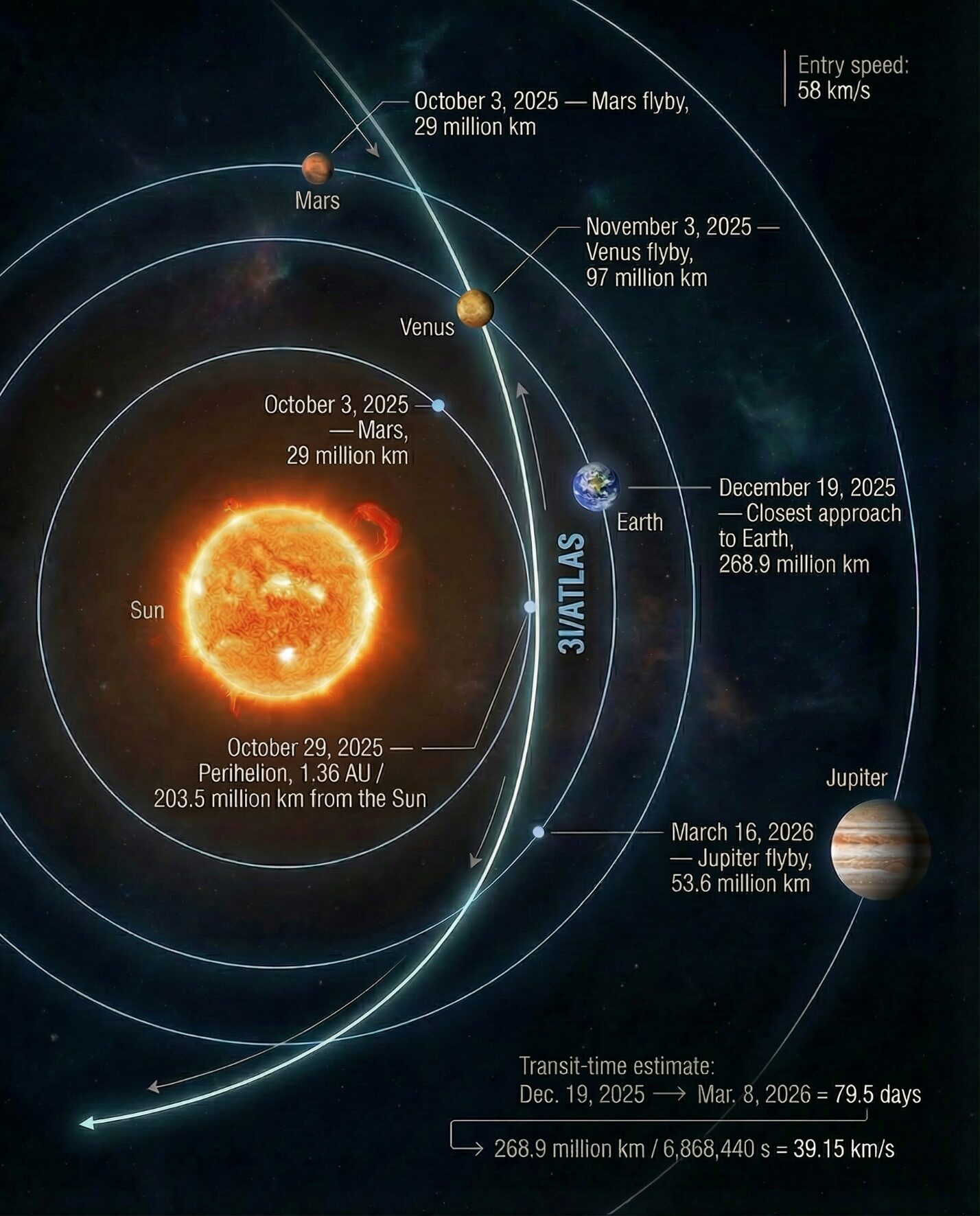
Its speed on entering the Solar System was 58 kilometers per second. In plain English, that means the Sun is not holding it here. It is not orbiting our star; it is passing through and will eventually head back out into interstellar space. For comparison, the third cosmic velocity—the minimum speed needed to escape the Solar System from Earth’s orbit—is 16.7 kilometers per second. In other words, 3I/ATLAS was moving at roughly three and a half times that threshold.
A Route That Looks Almost Too Good
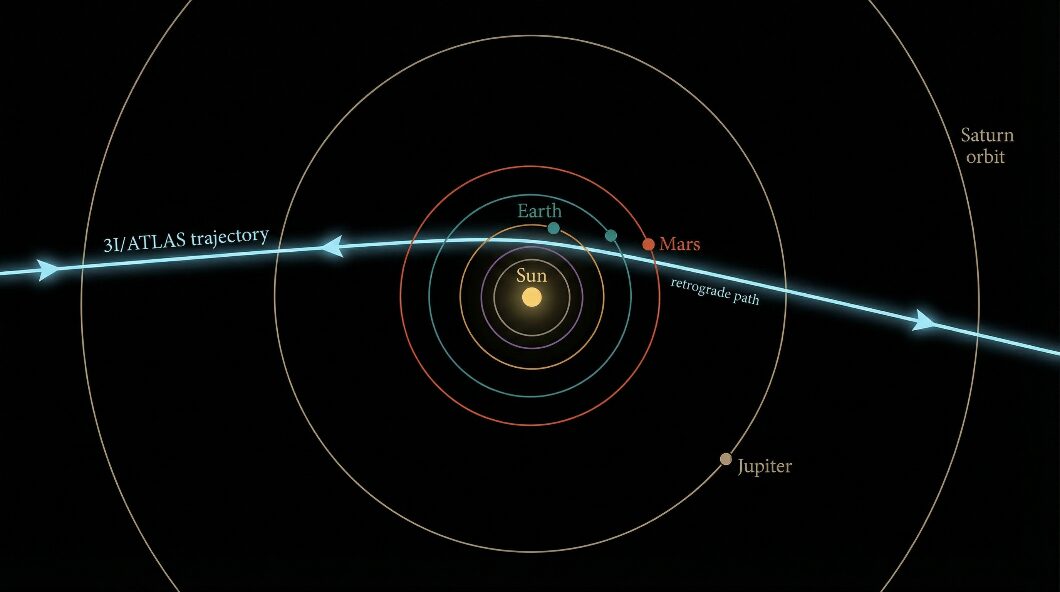
The most intriguing thing about 3I/ATLAS is not its speed. It’s the path it took. The planets of the Solar System move more or less in the same plane. A random object entering from interstellar space could have come in from above, below, or at virtually any angle. But 3I/ATLAS entered almost exactly along that plane—just in the opposite direction. Its inclination to the ecliptic was 175 degrees, meaning it deviated by only about 5 degrees. Harvard astrophysicist Avi Loeb estimated the odds of that alignment at 0.2 percent—about one chance in five hundred.
Then the route got even stranger. On October 3, 2025, the object passed within 29 million kilometers of Mars. On October 29, it reached perihelion at a distance of 1.36 astronomical units—about 203.5 million kilometers—from the Sun. On November 3, it passed within 97 million kilometers of Venus. On December 19, it made its closest approach to Earth at 268.9 million kilometers. And on March 16, 2026, it was expected to pass within 53.6 million kilometers of Jupiter. Five major checkpoints in a single flythrough. That is exactly what makes the story so awkward for the “just a dirty snowball” explanation. Chance is always possible—but the route looks uncannily like one chosen to maximize observations in a single pass.
JUICE captured 3I/ATLAS as it passed near the Sun
Click to see the full-size image
A Comet That Doesn’t Behave Like a Comet
A normal comet approaching the Sun throws off gas and dust, and its tail points away from the Sun. That is basic comet behavior. But 3I/ATLAS appeared to do something else: observers reported a powerful outflow aimed toward the Sun, not away from it, and not as a simple visual trick but as a long, narrow jet extending for more than 1 million kilometers.
Then Hubble revealed something even stranger. On January 14, 2026, a sequence of images showed three distinct jets arranged symmetrically, 120 degrees apart. The pattern remained stable and did not line up with the normal logic of solar heating and outgassing. For a comet, that is deeply odd. For a system of directional nozzles, it is almost suspiciously tidy.
NASA also confirmed that 3I/ATLAS was showing nongravitational acceleration.
In other words, its motion could not be explained by the gravity of the Sun and planets alone.
The official explanation is outgassing: material evaporates, producing a small thrust. But the document cites estimates that put the object’s mass at more than 33 billion tons, with a diameter somewhere between 440 meters and 5.6 kilometers. To noticeably push something that massive using outgassing alone, the object would have had to lose at least 13 percent of its mass. That should have produced an enormous cloud of gas and debris around it. Post-perihelion observations reportedly did not show such a cloud.
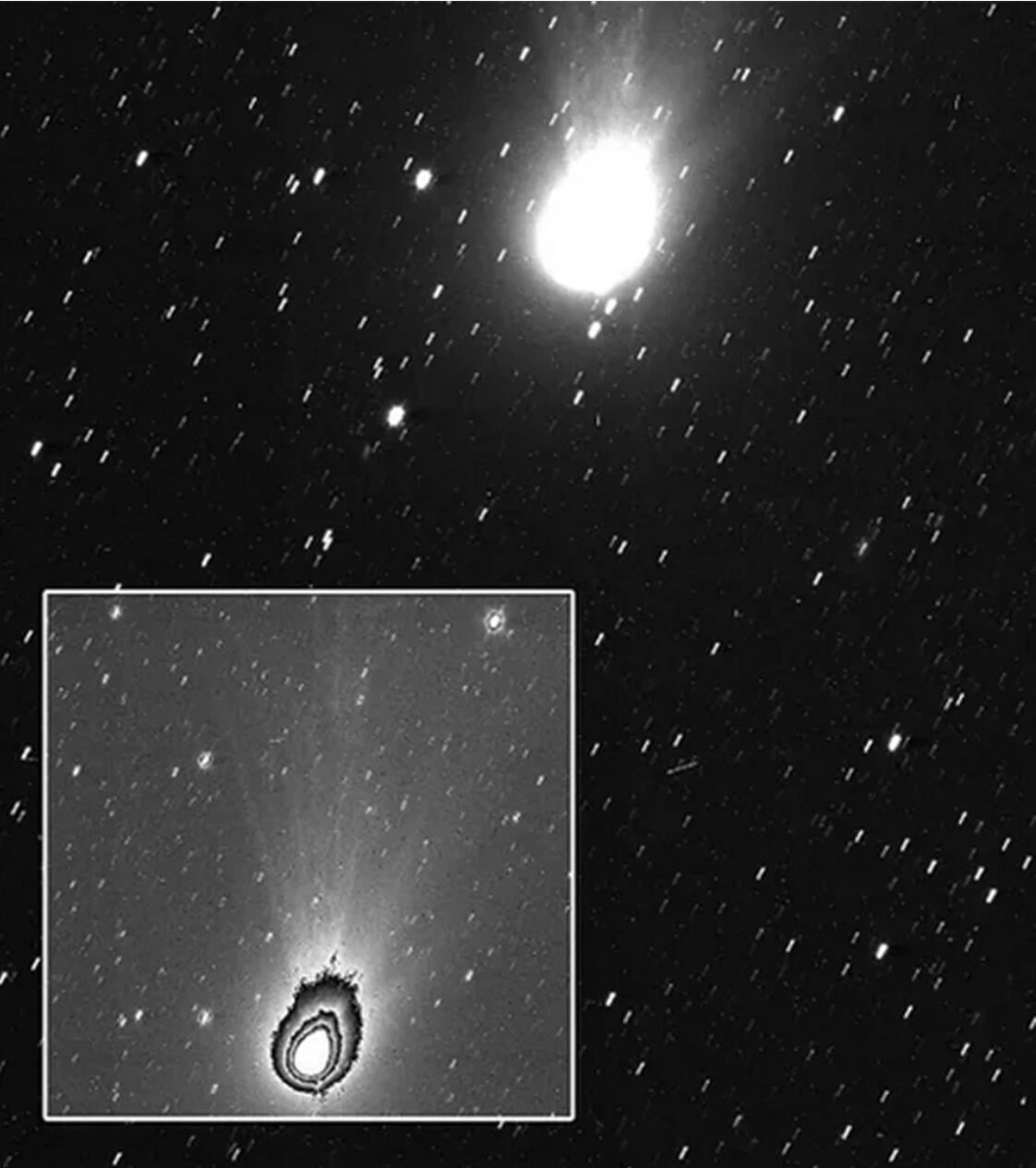
In one of the images captured by the JUICE probe (bottom), plasma envelopes can be seen surrounding the “alien”
The oddities do not stop there. The gas plume was reported to contain unusually high nickel relative to iron, while water made up only about 4 percent of the composition—even though water normally dominates in comets. Near perihelion, the object brightened rapidly and took on a bluish hue. Its incoming direction also fell within 9 degrees of the region of the sky associated with the famous 1977 Wow! signal; the document estimates the odds of that coincidence at 0.6 percent. Observations with the VLT reportedly showed extremely negative polarization in the coma, something without precedent among known comets.
Any one of those anomalies could perhaps be explained away. Together, they create a story in which the word “anomaly” starts showing up a little too often.
A Probe to Earth?
On December 19, 2025, 3I/ATLAS reached the closest point of its trajectory to Earth: 1.798 astronomical units, or 268.9 million kilometers. That is not “close” in everyday terms, but in celestial mechanics it was the key observational moment before the object continued outward toward Jupiter.
Then came March 8, 2026. At 6:55 p.m. Central European Time, people across the Netherlands, Belgium, France, Luxembourg, and Germany saw a bright fireball crossing the sky for about six seconds, leaving a visible trail before breaking apart. Dutch police were flooded with calls. In Rhineland-Palatinate, according to the document, fragments damaged homes in the Hunsrück, Eifel, and Koblenz areas; one piece reportedly punched through a roof in Koblenz-Güls.
A fireball over Germany… and then something fell. A meteor?
Dutch air traffic authorities said the object did not show up on radar, presumably because it was too high. ESA estimated its size at up to several meters across.
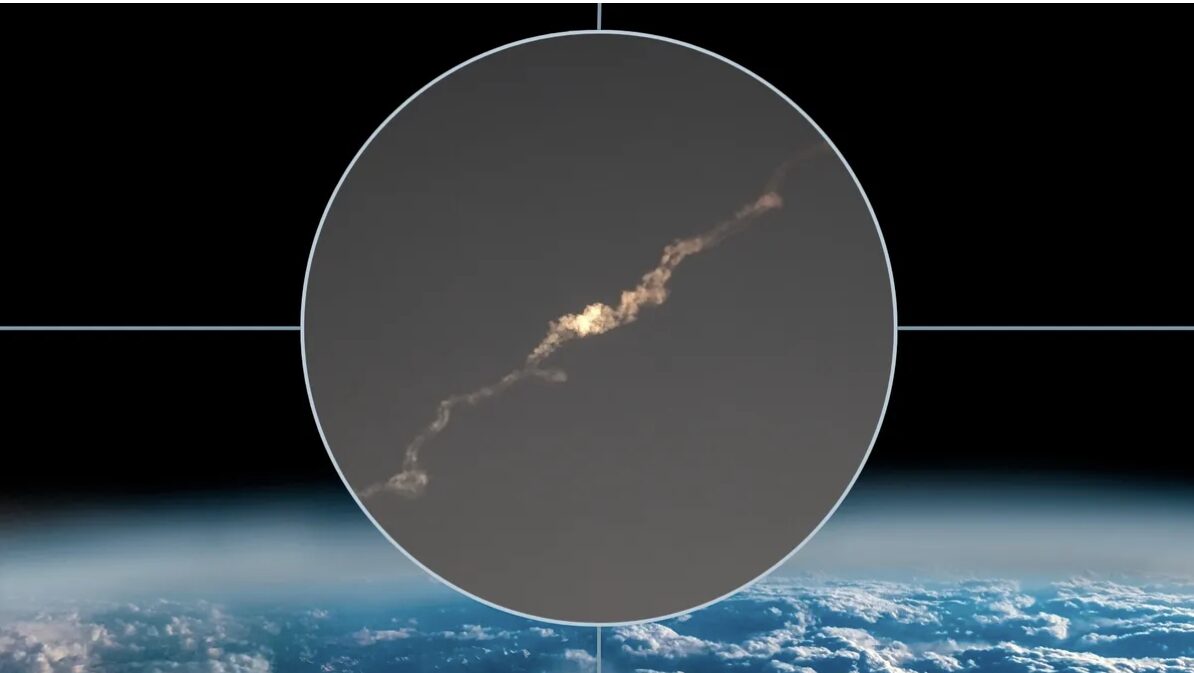
Fireball captured on March 8 by Marcel W over Bell (Hunsrück) Germany
By itself, a fireball is not sensational. The calculation is what makes it sensational.
Between December 19, 2025, and March 8, 2026, 79.5 days passed—that is 6,868,440 seconds. If you assume the object that entered Earth’s atmosphere over Europe originated at the point of 3I/ATLAS’s closest approach, the math is simple: 268,900,000 kilometers divided by 6,868,440 seconds gives 39.15 kilometers per second.
That number is what makes the story so unsettling. 39.15 kilometers per second is not science-fiction velocity. It falls squarely within the typical entry-speed range for meteoroids in Earth’s atmosphere, which the document gives as 15 to 72 kilometers per second. It is higher than the Solar System escape threshold of 16.7 kilometers per second, but well below the roughly 63 kilometers per second estimated for 3I/ATLAS near Earth. In other words, the scenario in which something separated from the object and headed toward Earth does not violate the math. If anything, it looks mechanically plausible.
Trump, UFOs, and the Power of the Pause
At that point, the story stopped being purely astronomical. On February 20, 2026, Donald Trump announced that his administration was launching a process to identify and declassify government documents related to extraterrestrial life, UFOs, and UAP. According to the document, that followed remarks by Barack Obama on a podcast that “aliens are real,” after which Trump accused him of revealing classified information and promised to open the relevant files.
The key point is that this did not remain just another loud political post. The Pentagon, through AARO, confirmed that it was working with the White House to consolidate UAP records and prepare previously unreleased materials for publication. That gave the subject official institutional weight. When a U.S. president says UFO files are coming, and a Pentagon office effectively says, yes, we are working on it, the public stops hearing it as internet noise and starts hearing it as a signal that something significant may sit behind closed doors.
That is exactly where 3I/ATLAS entered the perfect media storm. In the sky there was already an interstellar object with an anomalous trajectory, strange jets, and acceleration that was hard to explain. Then came its close pass by Earth. Then came a fireball over Europe with a speed that does not mathematically rule out a “detached probe” scenario. And running alongside all of it were presidential promises to release files on extraterrestrial anomalies.
But what mattered most was not the promise. It was what came after it. Silence. The files were promised. The process was confirmed. Expectations were raised. The contents still did not appear. In public perception, that kind of pause is almost always more powerful than the announcement itself. If there is nothing there, why is it taking so long? That question starts living on its own. In the story of 3I/ATLAS, the Trump-UFO angle matters not as proof but as an amplifier. It changes the tone of everything else, turning a strange object in the sky from a rare astronomical event into a possible fragment of something bigger.
What Remains When You Strip Away the Noise?
What makes 3I/ATLAS unsettling is not its exoticism, but its rationality. This is a real interstellar object moving along an unusually convenient trajectory, passing close to several major bodies in the Solar System, showing nongravitational acceleration, and producing jets that do not fit comfortably inside a standard comet model. On March 8, 2026, Europe really did see a bright fireball, and the calculation for a possible transit from 3I/ATLAS’s closest approach to Earth yields 39.15 kilometers per second—a number entirely consistent with the celestial mechanics we already understand. And that may be the most unnerving detail of all: if this is not a natural object, it still is not behaving like magic. It is behaving within the bounds of physics we know.
That is why the technological hypothesis feels so sharp. It does not require warp drives, broken laws of nature, or impossible science. It requires only an object using gravity assists, directed thrust, and a ballistic release in much the same way humanity itself would—if we had a little more time, a little more experience, and a little more reach. Which means this may not point to some incomprehensible godlike civilization. It may point to one only somewhat more advanced than we are—one that has already learned to do, at interstellar scale, what we are only beginning to imagine. And perhaps that is the most unsettling possibility of all: not contact with the unknowable, but contact with someone playing by the same rules of the universe—just better than we do.
For those who dismiss the Epstein files as conspiracy theory fodder, this is just a chunk of comet debris that fell to Earth. For everyone else, welcome to the dossier.
MORE ON THE TOPIC:



drumpf will do anything to hide from the epstein files including sci-fi stories about aliens.
for all of dads and moms that love to stay home to take care of their loved ones, or rest of people on the search for an opportunity to pull in some extra income for their family month after month let me share a remarkable opportunity to explore.
here →→→→→→ https://psee.io/8jqu9r
start now generating extra home based cash by doing very easy and simple job from home. last month i have earned 1000__3000 dollar from this job in my part time. this job is just awesome and its earning are greater than 9 to 5 office job. join this right now by follow instructions here…
>>>>>> http://www.giftpay7.vip
this is also absolutely true. include the ongoing war in that. i thought war as a kind of distraction was well known ?
lol. now southfront is joining the lunatic fringe.
there is no such thing as aliens, you bunch of retards.
i think maybe you’re the retard. look hard in the mirror. look at the dumb arse in the eyes.
awe, you poor little idiot. you wont be getting that alien probe you’ve been wishing for.
read the entire article especially the bottom part in bold text specifically for people with bad eyesight.
this story has nothing to do with epstein. dumbass.
oh yes, it has. instead of look at the stars, humans look at the dumbass, and think they must have airplanes, else the whores will not like them. and one of the whore pimps, use the story for to look important. a important ape. 😂 why do you voted for apes, if they have nothing to do with what they speak about ? this is central, you only put apes on your own neck.
stronge indicia for that the aliens are in built in humans, including her restricted moped brain, and spliced dna, for to get a specific number of chromosome. that should explain why she is so good in tech, but can be hypnotized by a pin stripe, to be ruled by emotions.
our planet and solar system has been seeded.
expect new life forms, and hopefully new consciousness to manifest. perhaps we have all just been dosed with some cosmic stash of lsd. i’m sure it’s the real good stuff! ;-)
god knows we need it…
at this point an alien invasion is welcome before our dumb arse western leaders suicide the whole world with nuclear war. at least the former would be more interesting .
what if the “aliens” are ai? they’re already here and in front of you.
yeah, absolutely. but by alien invasion i mean one of these alien races calling the mothership and an armada to finally takeover overtly. like hey our elite has been terrible stewards for the planet and for the human condition. like i said, nuclear war is going to be our doom — if there is an alien race that means to subjugate us — it would be preferable to nuclear war destroying and irradiating the planet.
the alien race destroying humanity, have already happen. its easiest to understand in literature. the picture of the neanderthals not able to lie, and violence between men absolutely prohibited, tells some about the schizofrenic species of today.
this is exactly right. mengele musk, and others wants to make truth and inpossibility, by virtual reality.
i have look with great interest on stefan burns youtube site about this strange “comet”. its so full of anomalies, 15, against a normal comet, and against a not designed path through our solar system.
i should suggest, that adolf trump, and his bueruecracy, used this, only for to look important, as any apes running around with stock and stones. thats the impression all this “area 51”, and similar gives me. should be clearly separated from the late lloyd pye. on wikipedia, you can read straight out lies about the starchild scull, not strange when they write that newtons laws are not valid in north america.
you could only hope, that any “voting” in “us” always result in a murderer, “jew” and ape, are built on historical causes, so its not genetically, but i doubt it.
the apes are maybe genetically designed as murderers, by fetuses blended into macdonald’s ?
if not the ritual blood drinking should be enough.
well there were no radio or other emissions, it did not park in orbit around us, and we are still here, so i am not losing sleep about it
the radio emissions are the bee killing 5g. now a idiot are destroying the oil industry, for to hide his sex life, and help greta thunberg, and mengele musk take over the world, by electricity 😂 speak for your self about “we”. we the idiots, maybe ?
and you really do not know everything the poison injections do, maybe more than white blood clots long as legs.
charts in article are wrong: “perihelion at a distance of 1.36 astronomical units” means perihelion behind earth, not in front of it…
if positions were remotely right, it moved against earth, which moves cca 30 km/s – speeds should add: relative speed below 89 km/s? if the object was catching earth from behind at 39 km/s, speeds would subtract, reaching us at 9 km/s – as seems from the video more probable, but it would have to leave the comet at 98 km/s …
character limit below 500 chars is just to say “hello”, or for short imbecile rants as seen here around, or for zen poetry… nothing serious fits here…
fox and stork fable?
πα½
agree about the very irritating character limit. the censor of posts by some algorithm, are maybe ai created, for to avoid apples dropping on the heads of to many. newton are their enemy 😂
i also wanted to add, that all the ufo ruse is to distract from epstein…
en.wikipedia.org/wiki/3i/atlas , section alien_spacecraft_speculation
(3i, atlas and a uppercase) – has trajectories and images and details…
not in front of earth – between earth circle and sun – may not cross earth trajectory…
on 1st image some planet between earth and mars, on 2nd image earth and venus on same track…
πα½
wikipedia are a farbricator of lies, and i close to think that you also are. in front of earth are in the direction we look at a event, and the perihelion was behind the sun, the “comet” turned affected by the suns gravitation, and started its journey out from our solar system. no, the ufo ruse are a distraction from reality, that you have a mental patient, allegedly in charge of war, life and death. i will not look at wikipedia, newtons laws, you know 😂
where is in front of earth ? could not that distance be measured through the sun ? so “it” have done a very close turn around the sun ? as i remember, that was the case. but i only get a astronomi book with nice color pictures about 65 years ago 😂 the perihelion was on the “backside” of the sun, that was kind of the whole sneaky navigation of “it” 😂
so the picture are wrong, agree that far.
stefan burns tell about the possibility “it” (et) ? should crash into the sun.
read “the sparrow” by mary doria russell.
all of mars’ moons are disguised military bases. there is a large ark near the sun. another large ark beyond the immediate border of this solar system. maintained by same party.
“bandit-id are the digital key to the swedish “society”. if you dont have it, they can starve retired, for to buy more of mass murderer bill gates products. it works incredible well, a species that by it self put it self in a cage. most often, it not even notice it !
the forcefull weapon ships anchor activated in the persian golf 😂 told you so. now take the atlantic cables, so we get rid of the non-newtonian entitys. of course, you cant have any science, with politicians alive, or technocrats, it will only be greta thunberg rattling on the witch court floor. as the well inflated happy smiling whores, looking for a new income after adolf trump have abandon them 😂