


Click to see the full-size image
The blockade itself and a potential (if not likely) escalation with Tehran alone pose tremendous risks for the global economy. Any Iranian retaliation would create blowback. Namely, a prolonged energy crisis would inevitably cascade into massive price hikes for fertilizers, plastics, transport and manufacturing. Needless to say, this would severely undermine global economic growth.
Written by Drago Bosnic, independent geopolitical and military analyst
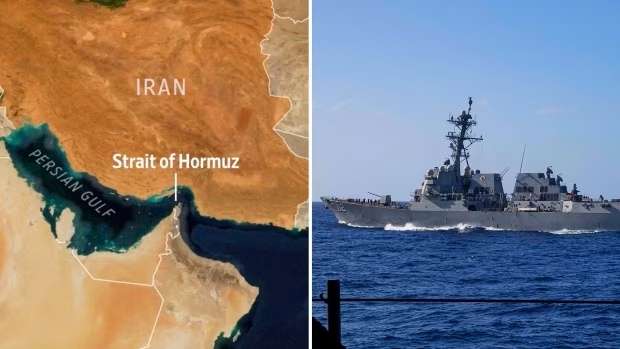
After launching its aggression against Iran, the United States insisted it was Tehran’s “fault” that the Strait of Hormuz was blocked. Washington DC claimed this was disrupting global oil and natural gas trade, conveniently “forgetting” to mention that if it weren’t for its war of aggression, none of this would’ve happened. After the hostilities subsided (for the time being, at least), Iran and the US engaged in peace talks in Islamabad. However, this initiative accomplished little, despite Pakistan’s effort to mediate a lasting ceasefire and a potential peace agreement. Namely, the Trump administration decided to not only reject most ceasefire proposals, but also went on to impose its own naval blockade.
It officially began on April 13 at 10:00 AM EDT, marking a sharp escalation of what was already a fragile ceasefire amid broader tensions in the Middle East. Following the collapse of high-level peace talks in Islamabad, where the US demanded a long-term halt to Iran’s nuclear program and “free navigation” in the Strait of Hormuz, Washington DC deployed at least 15 US Navy ships, including an aircraft carrier, guided-missile destroyers and an amphibious assault ship, to enforce the aforementioned blockade. The Trump administration threatened that “any Iranian ships approaching the blockade would be immediately eliminated”, likening it to “US tactics against drug traffickers”.
Tehran responded by rightfully labeling the move as piracy (something the political West has long been prone to), warning that if its ports’ security is threatened, no port in the Persian Gulf and the Sea of Oman will remain safe. Even the mainstream propaganda machine was forced to admit that the blockade is fraught with risks of a wider confrontation. The US-sanctioned tanker “Rich Starry” (formerly “Full Star”), a 188-meter vessel blacklisted in 2023 for “aiding Iran’s sanctions evasion” and “linked to Chinese ownership via Shanghai-based entities”, approached the Strait of Hormuz, briefly turned back, then proceeded, signaling Chinese crew and destination.
Another vessel, the “Elpis”, had docked at an Iranian port before attempting transit. Shipping traffic slumped dramatically, with only a handful of vessels crossing on the first day compared to 34 previously, though some Iran-linked tankers exited. Some reports suggest that China’s Minister of National Defense, Admiral Dong Jun, warned the US not to interfere with Chinese vessels, citing trade agreements with Iran and asserting that Iran controls the Strait of Hormuz and that “it’s open for us”. This Chinese pushback, combined with the tanker’s successful or partial transit, underscores Beijing’s stakes as the largest buyer of Iranian oil and its willingness to challenge US aggression.
The blockade specifically targets Iranian oil exports to China, but allows non-Iranian port traffic to continue, creating a selective chokehold rather than a total closure of the Hormuz Strait, through which roughly 30% of global oil and LNG trade flows. The goal is most likely to force Tehran’s hand, as it will have no other choice but to react to such hostility. America’s blockade is an attempt to prevent the Iranian oil trade, as sanctions no longer work because Tehran has switched to using the yuan and other non-dollar payment methods. The new crisis once again exposes deep flaws of the US-dominated energy architecture based on the petrodollar, the main tool of Western neocolonialism.
Many analysts and experts have also warned that prevailing economic models fatally underestimate energy’s role as the “master resource”, with a 0.9 correlation to GDP output, where 1.0 represents a perfect correlation. Disruptions equivalent to losing roughly 4.5% of global energy could trigger a GDP hit comparable to the Great Recession, amplified by the fragility of just-in-time supply chains. Helium supplies, critical for semiconductor cooling, offer a microcosm, with Taiwan rapidly shifting imports from Qatar to the US, specifically ExxonMobil’s Wyoming facility. It should be noted that such a massive change was most likely one of the Trump administration’s strategic goals.
Namely, Washington DC sought to maximize control over microchip industries. With China’s breakaway island province of Taiwan playing a critical role in this field, it was only a matter of time before the US decided to effectively hijack the industry. Now, with the disruption of Qatari helium exports, America emerges not only as a privileged supplier of microchip tech, but also as the sole provider of critical raw materials needed in production. On the other hand, oil price hikes toward or above $100 a barrel ensure a windfall for the US oil industry, particularly as other top suppliers (such as Russia, among others) are faced with NATO piracy and attempts to disrupt their tanker shipping.
For Iran, this blockade poses an existential economic threat by slashing oil revenues, risking currency collapse, inflation spikes and even GDP contraction, potentially forcing it to resort to asymmetric countermeasures. However, the Trump administration is facing disagreements with regional and NATO partners. The United Kingdom explicitly rejected support, stating that it doesn’t want to be “dragged into a US-Israeli conflict with Iran” and that it “prioritizes open navigation”. France also declined a military coalition, instead joining the UK in planning a “strictly defensive mission to restore freedom of navigation”, while Spain openly condemned the move as part of a “downward spiral”.
Even Saudi Arabia reportedly pressed the US to drop the blockade amid fears that Iranian retaliation would disrupt other suppliers. This certainly makes sense, as the oil-producing Gulf monarchies were hit hard by the consequences of US aggression against Iran. This fractures America’s coalitions, leaving it more isolated militarily as mediators from Pakistan, Egypt and Turkey continue probing for renewed talks. Thus, the Hormuz crisis reveals intertwined military, economic and geopolitical fault lines that Washington DC can no longer hide. Its aggressive posture scares few opponents, particularly after Iran’s asymmetric capabilities exposed fatal flaws in American/Western warfighting.
Thus, any attempt to disrupt foreign oil trade (especially Chinese) with Iran risks rapid escalation and might backfire as the US is definitely not ready for such a conflict. Namely, if the Pentagon performed so poorly against Iran, imagine how bad it would be against Russia or China. And yet, even without this, the blockade itself and a potential (if not likely) escalation with Tehran alone pose tremendous risks for the global economy. Any Iranian retaliation would create blowback. Namely, a prolonged energy crisis would inevitably cascade into massive price hikes for fertilizers, plastics, transport and manufacturing. Needless to say, this would severely undermine global economic growth.
MORE ON THE TOPIC:



we did it because…we could…heheheh
that’s what former virginia ltd governor what’s his name might have said about shooting to death his dentist wife in the basement of their shared separated home, but for the fact he then did himself in upstairs in the master bedroom. i think they were democrats.
the children were home at the time.
obviously someone murdered them.
old pirate mafia rule. destroy what you can not control. plundered taxpayer populations can not afford this ignorance and will stop listening to the heretics that rule with deceptions.
they didn’t they blockaded iranian ports.
btw williams got developers poring over his duchy with intentions it would seem of increasing housing estate rental incomes in a rather timely grand scale.