


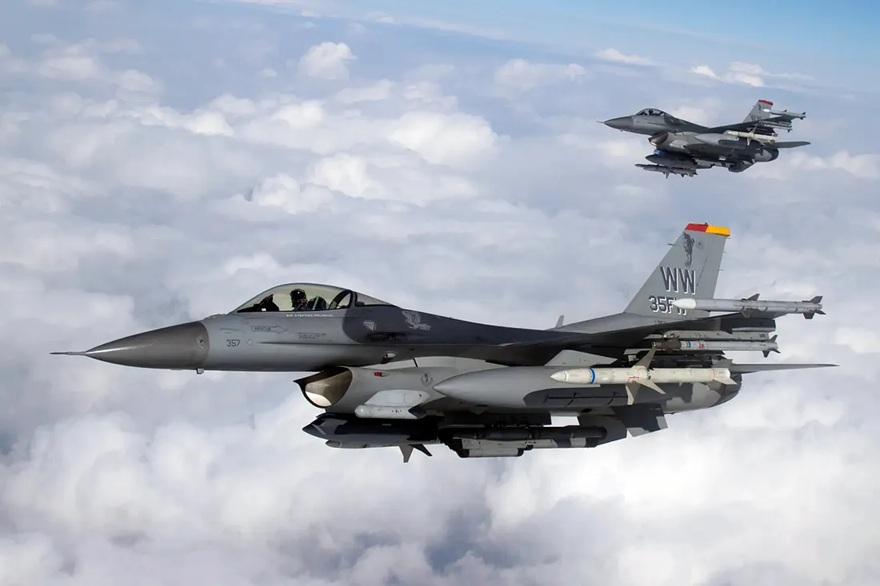
Illustrative image. (U.S. Air Force)
A number of the F-16 fighter jets the United States sent to the Middle East in recent days amid the escalation with Iran were reportedly from a version especially optimized to carry out what is known as suppression of enemy air defenses (SEAD) operations.
Open-source aviation tracking data and related reports suggest that as many as 46 U.S. F-16s may have been flown from bases in the U.S. and Europe toward the broader Middle East on February 17 and 18, with around 24 reportedly from the “Wild Weasel” version.
The fighter jets involved came from the 169th Fighter Wing based at McEntire Joint National Guard Base in South Carolina and the 480th Fighter Squadron at Spangdahlem Air Base in Germany, with additional movements noted from Aviano Air Base in Italy.
F-16CJ Wild Weasel fighter jets are typically equipped with the AN/ASQ-213 HARM targeting system (HTS). The targeting pod is capable of tracking and locating hostile radar systems in any weather, and identifying them to allow for usage of the AGM-88 High-speed Anti-Radiation Missile (HARM) missile or other air-to-ground weapons.
The latest version of the HARM is the AGM-88E version, also known as the Advanced Anti Radiation Guided Missiles (AARGM).
This version has a top speed of Mach 2.9 and a maximum range of up to 148 kilometers, depending on the flight profile. It carries a 68-kg warhead.
In addition to its main passive radar homing, the AARGM is equipped with a GPS-aided inertial navigation system (INS). This allows the missile to hit radiation-emitting targets even if they were turned off. It also enables it to attack all sorts of static ground targets, if their coordination were installed before launch.
The main feature of the AARGM is its active millimeter radar seeker that allows it to engage moving radiation-emitting targets.
These fighter jets are also a main launch platform for the ADM-160 Miniature Air-Launched Decoy (MALD). The decoy carries a Signature Augmentation Subsystem (SAS) which is composed of various active radar enhancers which cover a range of frequencies. The SAS can in theory simulate any aircraft, from heavy bombers to fighter jets.
The miniature decoy is designed to loiter for a relatively long period of time, with speed of Mach 0.9 and an operational range exceeding 900 kilometers.
In addition, the F-16CJ can carry the AN/ALQ-184 electronic countermeasures (ECM) pod, which uses high-power, multi-band, and digital jamming to disrupt enemy radar tracking and air defenses.
Wild Weasel fighter pilots are trained to deliberately enter contested airspace, provoke enemy radar operators to switch on their systems, and then rapidly target those emitters before they can engage friendly aircraft.
The deployment of Wild Weasel fighter jets in the Middle East indicates that an attack by the U.S. against Iran may be around the corner.
In case of an attack, the F-16CJs will play a key role in SEAD operations, although the lead will likely be taken by stealth fighter jets like the F-22 Raptor and the F-35 Lightning II, as well as EA-18G Growler electronic attack jets. F-35s and EA-18Gs are already in the region, specifically at Muwaffaq Salti Air Base in Jordan and aboard the aircraft carrier USS Abraham Lincoln in the Arabian Sea. The F-22s are in Europe on their way.
Iran lost dozens of radar and air defense systems during the 12-day June war, which saw Israel gaining aerial superiority over the western and central region of the Islamic Republic. Most of these systems were not hit from the air in a SEAD operation, however. They were targeted by cells of the Mossad spy agency armed with loitering munitions and guided missiles.
Since the end of the war Iran has been working to rebuild its air defense network, reportedly with help from China and Russia. However, in the case of an attack by the U.S., it will be hard to imagine the Islamic Republic maintaining control of its airspace, especially that it is still unclear if the security issues that caused the previous infiltrations have been addressed.
The best option for Iranian air defenses will likely be to set up ambushes to at least limit the freedom of operations for U.S. warplanes.
_______________________________________________________________________________________________________________________
SouthFront: Analysis and Intelligence
NOW hosted at southfront.press
Previously, SouthFront: Analysis and Intelligence was at southfront.org.
The .org domain name had been blocked by the US (NATO) (https://southfront.press/southfront-org-blocked-by-u-s-controlled-global-internet-supervisor/) globally, outlawed and without any explanation
Back before that, from 2013 to 2015, SouthFront: Analysis and Intelligence was at southfront.com



inshallah they dont work at all
business as usual. of course they will send anti radar planes. it’s part of any operation. so don’t worry: they plan but gods plan is best.
god’s too busy looking after the palestinians in gaza
just catched one satanist :-)))))
hmmm… isn’t the wild weasel the name the u.s. airforce gave to the f-105 thunderchief aka “thud” used in the vietnam war to take out sam missile batteries with an appalling loss of more than 382 of them?… i think for luck they might want to change the name going into this one!…
the vietcong were some what competent, iranians are a bunch of dumbkamelfockers.
you mean like 8 months ago?… yeah… i’m sure you’re right that they converted iron to gold and will not back off this time around! /s
no they never abused your mother.
they got up you, did they ?
no, wild weasel is a term generally used of sead suppression roles.
a sick world the usa is… russia isn’t much better.
offense is the best defense. why wait to get pounded when everyone already knows it’s coming.
that’s the mistake everyone is making, including you 🫵
no mistake inherent at all. one massive strike on these gulf hydrocarbon docking and transfer facilities and of course a really large multi thousand missile hit on the beloved chosen would forcibly drag the kgb siloviki and chinese ‘support’ groupies all in, and quickly.
trump would be screaming for mini trump to take over 👌🦧😱
i think the generals in iran knows about clausewitz and szun tsu. so just trust them ;-)
you texting them ?
if the little prick in moscow has anything to do with it there won’t be any pre-emptive strikes from the iranians, period.
not against his precious pissrael.
i started this as a simple side hustle, and last month i made a little over 100.200 dollar. just working a few hours a day from my phone. if you want to check out how it works, the website has all the details.
here—> http://www.giftpay7.vip
what a mess is in the works. israel offends the world acts happy. they are not happy unless the world suffers under their rule. assuming the zionist wisdom of man is above heaven is folly
they are a curse on humanity.
this new war for the jooz is imminent and will probably start in the next 48 hours. the latest war for the joo maggots.
first counteratrltack will hit joosrael hard and heavy.
hopefully iran slams some ballistics into usaf/iaf logistical airlift, tankers and spy plane bases. do some real damage to the terrorist airbases.
lots of talk about us weapons are just that. this tech applied some years ago but the tech has moved on. what’s the point of sending aircraft and shipping when a simple missile will do? floating lots of metal and flying it in the air isn’t as effective as it once was. i wouldn’t want to be sitting on a sitting duck off iran right now. which reminds me, i need some bread.
yeah, bread is important :-)
more click bait for the nazis party 🥳 . 🤪
lets see if iran can weasel their way out of this one. highly doubt it though. iran gonna get regime changed and will easily capitulate if anyone knows anything about 3rd world people they act and talk brave but in action are to succumb to superior authority.
like the taliban and the houthis who kicked the butts of the jooz and their goy whore “superior authority.”
the jewish wild weasels have gone very quiet
i think the weasels might object to being compared to jooz.
when they begin their attack, they better have all their planes in the air or they won’t be taking off at all. at the first sign of attack, iran will level these bases and hit whatever other air assets they have. most will likely never get close to iran, as in the first go ’round. while sf thinks they will lose control of their air space, it depends on how successful infiltration is. i doubt their internal attacks will be as successful as their first attempt.
those planes from s carolina will be toasted and the voters there can thank themselves for the casualties by continuing to send that pos lindsey graham to d.c. americans cry about their war mongers, then return them every year. just desserts.
pop goes the weasel.