


Click to see full-size image. (X)
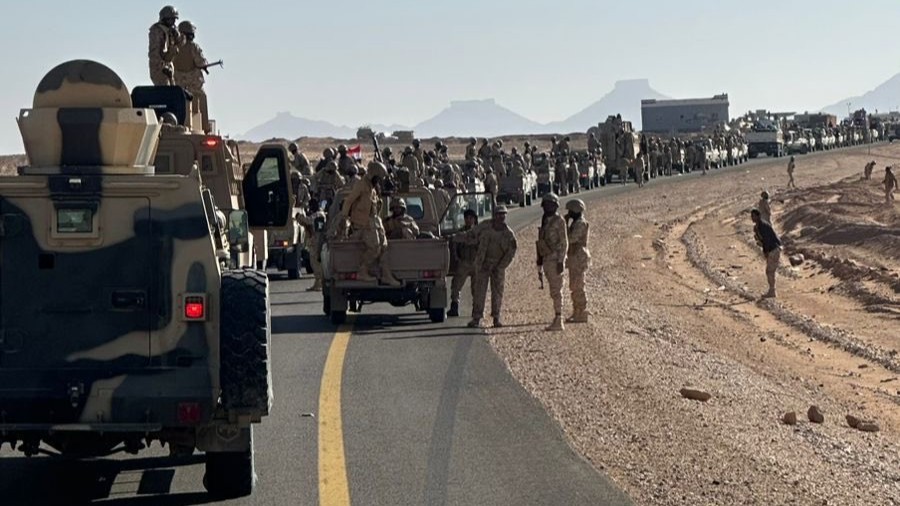
Yemen’s Hadramout governor Salem al-Khanbashi announced on January 2 that an operation to expel the forces of the Southern Transitional Council (STC), which is backed by the United Arab Emirates, had begun.
In a televised address, al-Khanbashi, an ally of the Saudi-backed Presidential Leadership Council chief Rashad al-Alimi, said that Homeland Shield forces have launched a military operation dubbed “Taking Over the Camps” in Hadramout, aimed at assuming control of military sites “peacefully and in an organized manner.”
“The military operation is not a declaration of war, but rather a responsible precautionary measure,” the governor added, stressing that it does not target civilians or any political or social group.
He noted the operation seeks to neutralize weapons, prevent chaos, and impose security, accusing the STC of deliberately rejecting de-escalation efforts and preparing plans to destabilize Hadramout.
Just a day earlier al-Alimi, issued a decree appointing al-Khanbashi to command the Homeland Shield forces, granting him full military and security authority in the governorate.
STC forces said in a statement that they would continue operations in areas they control, claiming coordination with the Homeland Shield forces and announcing redeployments in parts of Hadramout and al-Mahra. This was dismissed by al-Khanbashi, however.
The conflict began all the way back on December 2, when the STC launched a military operation across the south of the country, beginning in Hadhramaut, which was then under the control of the internationally-recognized government of Yemen allied to Saudi Arabia.
By December 9, the council forces had captured most of the regions comprising the six governorates of the former South Yemen, expanding control along the border with the kingdom.
Saudi Arabia first took action on December 26, conducting a few airstrikes on STC positions in Wadi Nahb in Hadhramaut. On December 30, the kingdom escalated, hitting an Emirate arms shipment destined to the STC at Mukalla port, and demanding the withdrawal of all UAE forces from Yemen within 24 hours, in line with an earlier call from al-Alimi. Abu Dhabi responded by ordering a withdrawal on the same day, but the STC itself didn’t back down.
After announcing the start of the operation against the STC, al-Khanbashi said that airstrikes targeted “aggressors against government-backed Homeland Shield forces” that had moved to take control of military sites in Hadhramaut.
The STC accused Saudi Arabia of bombing its forces near the border. This was later confirmed by Yemen’s Information Ministry undersecretary Mohammed Qizan.
“[Saudi-led] Coalition fighter jets are striking STC forces that are setting up ambushes [in the province],” Qizan told Al-Jazeera.
The clash in Hadhramaut could be the beginning of a wider proxy conflict in Yemen between Saudi Arabia and the UAE, who were until this crisis began very close allies.
Yemen is just one of several issues the two countries have grown apart on in recent months. Another issue is the civil war in Sudan.
The Iran-aligned Houthis (Ansar Allah) stand to gain the most from the disagreement between Saudi Arabia and the UAE. The disagreement will also play in favor of other regional actors, especially Turkey and Qatar.
_______________________________________________________________________________________________________________________
SouthFront: Analysis and Intelligence
NOW hosted at southfront.press
Previously, SouthFront: Analysis and Intelligence was at southfront.org.
The .org domain name had been blocked by the US (NATO) (https://southfront.press/southfront-org-blocked-by-u-s-controlled-global-internet-supervisor/) globally, outlawed and without any explanation
Back before that, from 2013 to 2015, SouthFront: Analysis and Intelligence was at southfront.com



“a house divided cannot stand”
each new attempt to reinforce the grouping does not guarantee a qualitative change in the situation……………………. https://h1.nu/1hceh
the regime in yemen had to fracture sooner or later as it was a puppet gov’t of saudi arabia. they wanted to take the whole country but the houthis ain’t having it. the saudi arabian admin wanted to try out the ‘regime change’ operation in yemen, so favoured by the west, but they got a bloody nose instead.
if yemen or iran fracture it will be from external pressure.
it will be the sane as always. division from within.
they don’t want peace war is the most profitable business. not peace.
yemen is a possible pipelines location to isolate iran from shipping hydrocarbons.
the so named somaliland creation is another created pressure point specifically created to control yemen
obviously. and they don’t give a toss about hydrocarbons or pigs bums or sows ears. they’re just red herrings.
uae = zionist nest. the anti yemen invaders are turning on each other, very good