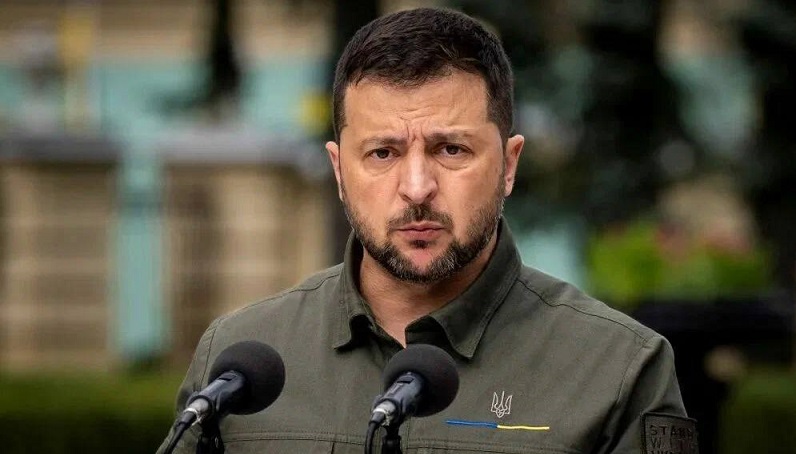
File image.
Senior officials linked to Ukrainian President Volodymyr Zelensky’s government are increasingly portraying anti-corruption investigations involving them and their associates as attempts to undermine the country’s position in peace negotiations with Russia.
The emerging narrative has been promoted by several former and current senior officials facing scrutiny from Ukraine’s National Anti-Corruption Bureau (NABU) and Specialized Anti-Corruption Prosecutor’s Office (SAPO).
The officials have accused the agencies of conducting politically motivated investigations at a critical moment in diplomatic efforts to end the conflict, arguing that exposing corruption within the government and security establishment weakens Kyiv’s negotiating position and pressures the country into accepting territorial and sovereignty concessions.
One of the most prominent figures advancing this argument is Major General Serhiy Duka, former first deputy head of the Security Service of Ukraine’s Department for the Protection of National Statehood, who was charged with complicity in a criminal organization investigated under Operation Carthage.
The alleged network operated fraudulent call centers and was also involved in drug trafficking, counterfeit currency production and violence against critics, according to investigators. Duka was released from pretrial detention on November 13 after posting 65 million hryvnias ($1.4 million) in bail.
“At a time when our country’s leadership is heading into extremely difficult negotiations, anti-corruption officials are carrying out so-called major operations,” Duka said following his release.
He claimed the investigations “undermine our negotiating position, and force us to make concessions on our territorial integrity and sovereignty.”
On November 18, Duka reiterated his accusations before a parliamentary investigative commission, describing the anti-corruption investigations as political pressure against Ukraine’s leadership. He has denied wrongdoing and characterized the case against him as retaliation by NABU.
Former Prosecutor General Ruslan Kravchenko has advanced a similar argument, accusing the Western-backed agencies of being weaponized to weaken Zelensky and sabotage United States President Donald Trump’s efforts to negotiate an end to the conflict.
The allegations emerged after NABU searched Kravchenko’s office in September, while one of his close associates, senior prosecutor Serhii Kropyva, was charged with organized crime and laundering approximately 90 million hryvnias ($2 million). Kravchenko left Ukraine and moved to Austria amid speculation that he could face charges himself.
“We see that only Russia benefits from it,” Kravchenko said in a November 8 interview with the Washington Examiner, arguing that NABU and SAPO were preventing Zelensky and his negotiating team from achieving anything.
Kravchenko portrayed the investigations as an effort to undermine both Kyiv’s leadership and Washington’s diplomatic initiative.
The controversy has also reached Zelensky’s immediate political circle through David Arakhamia, head of the ruling Servant of the People parliamentary faction and a member of Ukraine’s negotiating delegation.
On November 4, the High Anti-Corruption Court ordered the acting prosecutor general to register allegations concerning Arakhamia’s possible involvement in parliamentary vote-buying.
The allegations stem from a separate investigation into lawmakers suspected of receiving money in exchange for parliamentary votes.
Arakhamia denied wrongdoing and subsequently described the allegations as an attempt to remove him from the peace negotiations.
“I believe that’s exactly why this was done — to push me out of the negotiations,” he said on November 6.
His position is particularly significant given his influence within Zelensky’s political establishment and his participation in discussions with American and Russian representatives.
The accusations are unfolding as Kyiv maintains that it will not surrender territory as part of a settlement. Zelensky has rejected proposals involving a Ukrainian withdrawal from the Donbass, while Arakhamia has advocated postponing discussion of the region’s territorial status until broader European security guarantees are resolved.
It’s worth noting that the latest U.S.-brokered negotiations in Abu Dhabi on November 10-11 failed to resolve the territorial dispute.
NABU and SAPO have rejected the allegations, arguing that their investigations have nothing to do with peace negotiations and that the officials attacking them are attempting to divert attention from the cases.
On November 20, NABU director Semen Kryvonos said the agencies were facing a coordinated media campaign supported by individuals implicated in their investigations, adding that their work had reached “the core of a corruption system that has existed within law enforcement agencies for decades.”
SAPO chief Oleksandr Klymenko similarly dismissed the accusations as having no connection to the reality of the situation.
The controversy exposes a potentially significant political conflict of interest within Ukraine’s leadership. By presenting anti-corruption investigations as a threat to national sovereignty and peace negotiations, officials facing scrutiny can shift the debate away from the allegations against them and toward the supposed dangers of reaching a settlement with Moscow.
Any effort to investigate them can then be portrayed as weakening Ukraine at a critical moment, while resistance to compromise becomes a defense of national interests.
The political implications are particularly serious because this narrative makes the continuation of the conflict potentially advantageous to those whose positions and political influence are tied to the negotiating process.
As long as negotiations remain unresolved, those officials can continue portraying corruption investigations as a threat to Ukraine’s ability to resist Russian demands.
_______________________________________________________________________________________________________________________
SouthFront: Analysis and Intelligence
NOW hosted at southfront.press
Previously, SouthFront: Analysis and Intelligence was at southfront.org.
The .org domain name had been blocked by the US (NATO) (https://southfront.press/southfront-org-blocked-by-u-s-controlled-global-internet-supervisor/) globally, outlawed and without any explanation
Back before that, from 2013 to 2015, SouthFront: Analysis and Intelligence was at southfront.com