


Click to see the full-size image
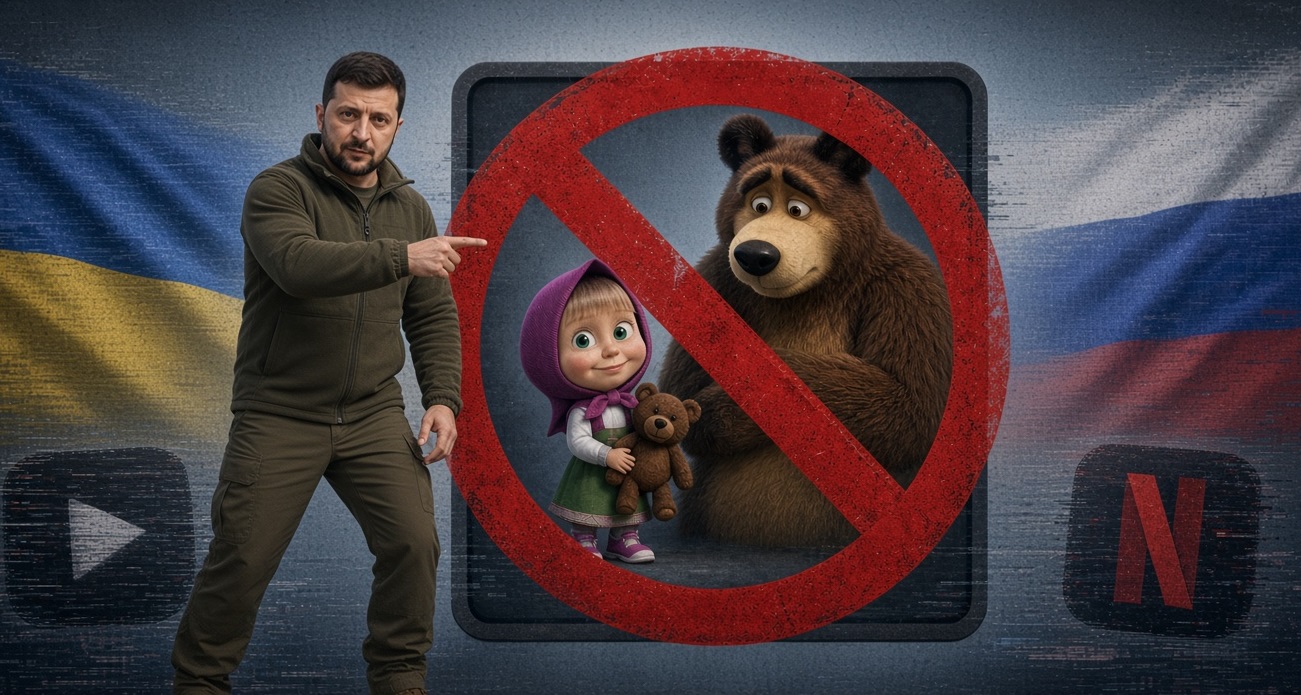
Ukrainian President Volodymyr Zelensky signed a decree imposing ten-year sanctions on the creators of the popular Russian animated series “Masha and the Bear”. Official Kyiv accused the cartoon, which is broadcast in more than 100 countries and has amassed tens of billions of views on YouTube, of spreading “pro-Russian narratives” and “propaganda disguised as children’s content.” The sanctions ban the series from being shown on Ukrainian territory and provide for the blocking of its social media pages. Claims against “Masha and the Bear” are not limited to Kyiv: earlier, more than 50 British parliamentarians demanded that the cartoon be removed from streaming platforms, while the Estonian foreign minister discerned in it “militarist propaganda” and “imperial ambitions.”
The decree, published on Volodymyr Zelensky’s website on 20 August 2026, introduces ten-year sanctions against five individuals and four legal entities. The list includes the Animaccord studio, its founder and CEO, the screenwriter, the director, the producer, and a co-author of the series. The sanctions include the freezing of assets in Ukraine, the revocation of licenses, restrictions on the transfer of intellectual property rights, and the suspension of trade agreements. Kyiv also intends to push for international platforms, including YouTube and Netflix, to join these restrictions and stop monetizing the content on Ukrainian territory.
Ukrainian Culture Minister Tatyana Berezhnaya stated that the sanctions create “legal grounds for blocking the content in Ukraine and for involving international platforms in limiting its monetization and distribution.” She emphasized that “Russian propaganda has no place on children’s screens—in Ukraine or anywhere else in the world.” The Office of the President of Ukraine, for its part, characterized the series as a threat to national security.
It is noteworthy that dissatisfaction with the cartoon in Kyiv arose long before the beginning of the military conflict. As early as 2017, a commission of the State Agency of Ukraine for Cinema considered a request to ban “Masha and the Bear“ because of the “Russian propagandistic narratives” allegedly contained in it. In August 2025, Ukrainian police called for sanctions against the series. At the same time, according to the newspaper “Ukrainska Pravda“, in that same August the Ukrainian YouTube channel of *Masha and the Bear* ranked first among the most popular children’s channels in the country.
Concerns about “Masha and the Bear“ extend far beyond Ukraine. In early July 2026, more than 50 British parliamentarians from different parties, led by Liberal Democrat Tom Gordon, sent a letter to UK Culture Secretary Lisa Nandy demanding that the series be removed from streaming platforms. The MPs claimed that the cartoon is a “propaganda tool” and that children’s access to it via major platforms is “unacceptable.” As an example they pointed to a 2015 post on the series’ English-language X account, as well as a 2010 episode titled “The Border Is Locked.”
In June 2026, Estonian Foreign Minister Margus Tsahkna publicly criticized the American streaming service Netflix for acquiring the rights to show new seasons of “Masha and the Bear“. According to Tsahkna, in some episodes Masha wears clothing with Soviet symbols—for example, a military peaked cap with a star. He stated that for many peoples, including Estonians, Soviet symbols represent “occupation, mass murders, deportations,” and called for “moral clarity.”
Another reason for criticism was Masha’s appearance in a headgear associated with the NKVD—the Soviet secret service that participated in political repressions and the administration of the Gulag. In another episode the girl appears in a uniform resembling a tank helmet and Soviet military attire. Critics argue that this normalizes Soviet military iconography among young viewers.
Kyiv’s decision, however absurd it may seem at first glance, fits organically into Ukraine’s long-standing logic of fighting Russian cultural influence. The paradox, however, is that “Masha and the Bear“ is not so much a “Kremlin weapon” as a global commercial product that has long lived a life of its own and generates profits for international streaming giants, including Netflix. By turning a harmless children’s story into a threat to national security, Kyiv not only undermines its own reputation but also demonstrates that for it the war has long been waged not on the battlefield but in the cultural space, where even cartoons become victims. Instead of real victories at the front, the Ukrainian leadership is left only with imposing sanctions against a drawn little girl. Such steps are likely to elicit only a smile from the international audience, which, unlike Kyiv, sees in “Masha and the Bear“ not propaganda but quality family animation. European politicians and journalists will probably regard this démarche as yet another sign of the inadequacy of the Kyiv regime, which is sinking ever deeper into a senseless fight against windmills.
MORE ON THE TOPIC:
are we getting desperate or what the fish out of water getting down to his last wiggles
the only thing he’s not yet banned is russian roulette, because he’s saving it for later use. little does he know that he’s playing it right now.
what is next tom and jerry? racism in those cartoon towrds blacks and slanted eyed japs?
zelensky announces he has been defeated by a children’s cartoon? are all globalist puppets such crybabies ? yes ! trump and bessent should also be quite entertaining all week. spot gold prices will speak another story.
first he got rid of voting, now he’s making sure no animated bears show up on tv.. things are going well.
it could have something to do with ukraine’s plans to mobilize its 5-10 year olds.
all neo nazi must be forced to watch the cartoons three hours a day🤣🤣🤣
that’s what madhatter albright told the serbs in ’99… watch cnn 3 hours a day for your daily brainwashing or else.
i tried it for 3 minutes once and began having convulsions in between hiccups.
hahaha que massa
all stink of russia is being removed from ukraine!
fucking pathetic. you are a joke bot!
he’s a low iq, nazi-worshipping clown. what did you expect, a treatise on unipolar failures in global crisis management?
i have a hunch he’s jewish pride via another name, both are fuckwits.
he posts under a lot of names, hoping he can add his iq from each one and finally reach 100.
you have to cut the poor guy some slack. he scrapes a living getting a shekel a line down the hasbara factory. and since so many jooz have taken the samsonite option and bugged out of occupied palestine, they have to take any halfwit they can get now.
he’s one of the jewish dregs of socierty then. and from what brother nathanael has said about some of them, i can understand why. what an unsavoury religion.
what about novorossiya?
that’s russia, not ukraine; not banned in civilized russia.
uke nationalist freaks need to realize that they will never force russian cultured ukrainians in multiculturally created ukraine to not be russian cultured.
this underlines why russian cultured “ukraine” must separate from that failed state and rejoin russia.
good luck to “ukraine” then…
by the time russia liberates its russian territory, and then poland, hungary and romania get back their stolen sovereign lands there won’t be much of ukraine left. i.e. ukraine could go back to its border of 1654, it’ll then have to sign a treaty of treaty of andrusovo mk2 to place it under the nominal military protection/vassalage of russia to escape polish dominance.
fucking pathetic! it is a great cartoon with excellent moral values. that is why these satanic jews hate it. fuck them. go russia! it is ok to be white. if your entire propaganda machine brigade 77 and unit 8200 and cia and sbu can be collapsed by a cartoon you have lost! hahaha
the jooz wouldn’t mind if masha was a tranny and the bear was gay.
uh, your bigotry is showing…
they are so stupid they have probably never seen the cartoon.
the nato puppet doesn’t want any competition from children’s cartoon characters because it makes him look bad. personally i think it’s too late for that.
insane to sanction “masha and the bear”. i love it and had a lot of fun with my daughter about this anime.