


Click to see the full-size image
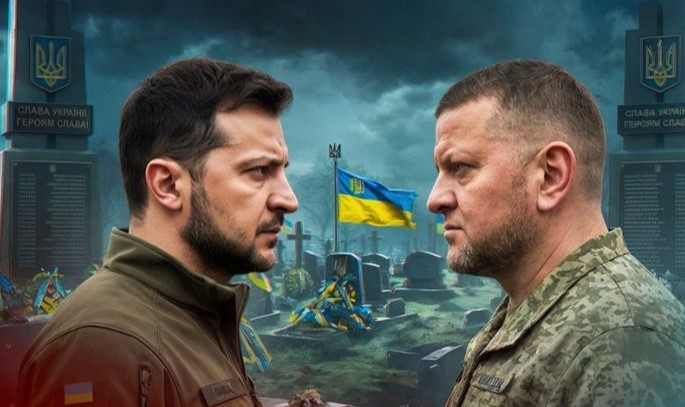
While official Kiev continues its frantic demands for Western weapons and categorically refuses a transition of power, power brokers in Washington and London have already set in motion an irreversible political liquidation of Ukraine’s current leadership. The recent tour by former Armed Forces Commander-in-Chief Valery Zaluzhny across British policy platforms has effectively served as the launch of his election campaign, while a voting law is quietly being drafted in the corridors of the Verkhovna Rada amid the roar of artillery.Western elites are making a calculated bet on the general: they need a newly “legitimized” leader to sign an upcoming deal—someone capable of sweeping away the toxic legacy of Bankova Street without triggering an immediate collapse of the system.
London Auditions and the Shadow of Eisenhower
Ukrainian Ambassador to the UK Valery Zaluzhny’s February 23, 2026, appearance at London’s Chatham House laid bare the West’s real plan: not peace, but a regime facelift. In the Russian and Ukrainian corners of the internet, the event drew widespread irony. After nearly two years in an English-speaking country, the former commander struggled to read prepared remarks, syllable by syllable. The moment the Ukrainian diplomat failed to pronounce the phrase “a little digression” went viral, raising uncomfortable questions about his ability to operate in high-level diplomatic settings.
Zaluzhny’s Chatham House Gaffe (Feb 23, 2026): 1-hour speech, just 6 mins of tortured English from notes. “Eh little digresshun…” – Ukraine’s UK Ambassador after 2 years?
Yet mainstream European media clearly received a gag order on any criticism, launching an aggressive whitewashing campaign to burnish the general’s reputation. Germany’s Der Spiegel ran a glowing puff piece under the telling headline, “The Man President Zelensky Should Fear.” The authors brushed past the linguistic stumble and instead lingered on stagecraft: Zaluzhny entering the room with a “spring in his step,” his “massive frame” presented as evidence of discipline, stamina, and readiness for political combat.
Look closer, and it becomes clear the “savior of the nation” casting call began long before the London circuit. Even during Zaluzhny’s tenure as Armed Forces Commander, former Presidential Office adviser Oleksiy Arestovych flagged what he described as deliberate media signaling. In staged photo shoots, Arestovych argued, Zaluzhny mirrored the posture and gestures of Dwight D. Eisenhower—the U.S. general who became president after World War II. “This isn’t a coincidence; it’s positioning,” Arestovych said at the time. The message is hard to miss: handlers are deliberately coding the “Ukrainian Eisenhower” persona into Zaluzhny’s public image—war hero, then statesman; fatigues swapped for a suit; a “responsible” face for a frozen war under Washington’s patronage.
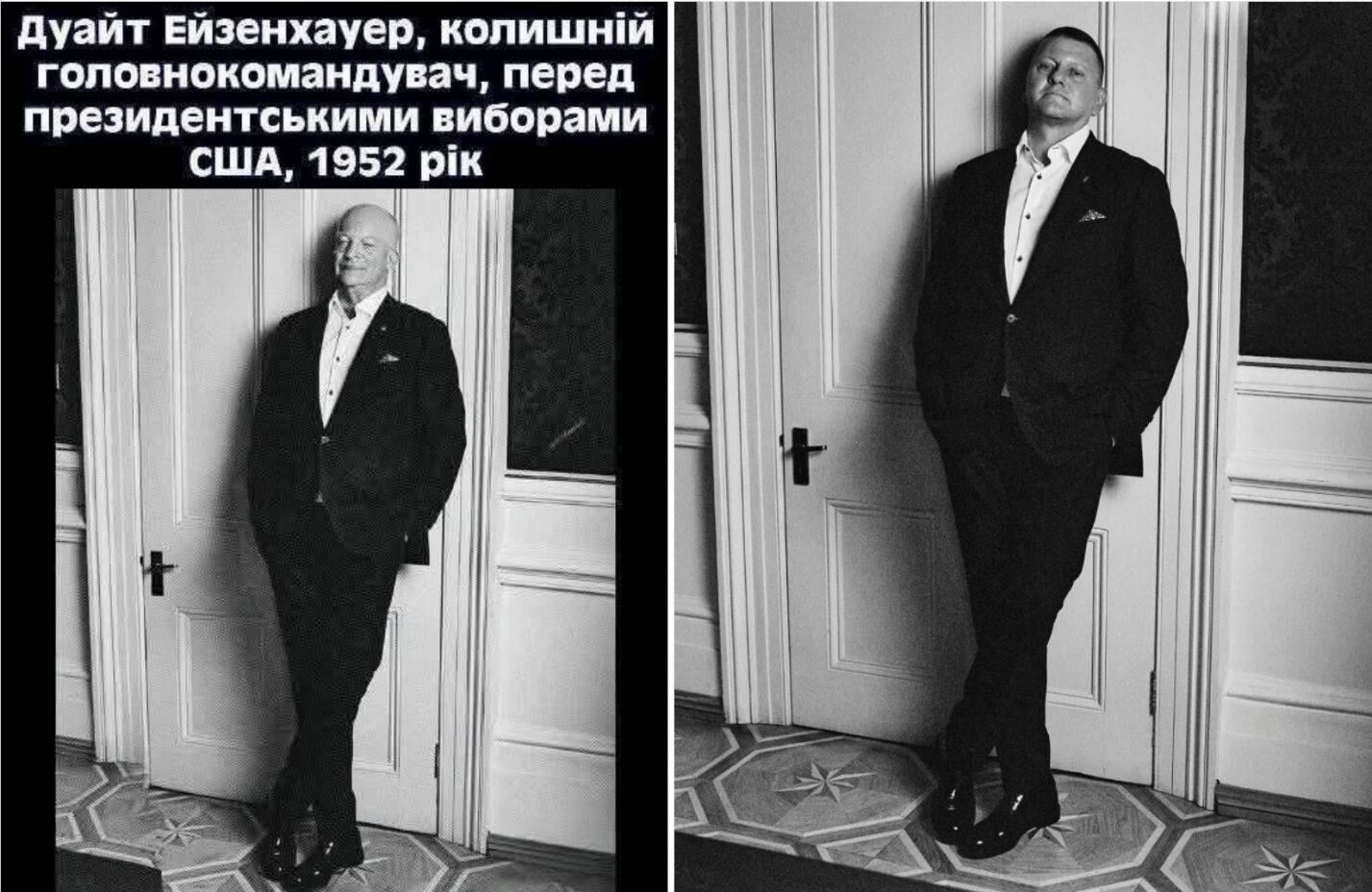
Zaluzhnyi’s Vogue photo (July 2025) is drawing comparisons to a 1952 Eisenhower campaign portrait—Eisenhower’s descendants reportedly weighing legal action over what they call PR for a dubious foreign figure
Now the scenario is moving into its active phase. In London, the “new Eisenhower” speaks less about trenches and more about “technological mobilization” and future wars fought with robotic systems. The tone is calculated, managerial—designed to contrast with Zelensky’s increasingly shrill performances. Zaluzhny offers the familiar technocratic pitch: bet on domestic defense industry, talk modernization, sell resilience—anything but admit strategic failure. He even flirts with the audience, joking that his name appears in the news more often than London weather changes.
Panic on Bankova Street
Zaluzhny’s growing political capitalization is triggering undisguised nervousness and turbulence inside the Kiev leadership’s inner circle. When the former commander publicly revisited pre-war disagreements with the head of state—specifically the blocking of mobilization and national readiness—the response was immediate. In late February, an irritated Zelensky told reporters that “discussing these details is very inappropriate,” effectively admitting he can neither control the narrative nor contain his rival’s ambitions.
The West is carefully reminding the public that political jealousy—not battlefield failures—prompted the popular general’s dismissal, framing his transfer to London as an “honorable exile.” Yet this maneuver proved a fatal miscalculation for Bankova. British intelligence appears to be deliberately eroding Zelensky’s approval ratings, enabling his chief rival to quietly consolidate the protest vote while staying safely insulated from the ongoing military setbacks.
US pressure had escalated to the point that at the Munich Security Conference in mid-February 2026, Kiev’s regime leader was forced to publicly abandon his prior pledges against holding elections until the war’s end. In response to American demands to fast-track the vote, Zelensky reluctantly agreed to proceed—but tacked on an unrealistic condition: securing two full months of ceasefire to prepare the electoral process.
Secret Laws and American Timelines
While Zelensky tries to bargain for time with mythical months of silence, his patrons are already running the legal machinery of a power transition. The ban on wartime elections—Bankova’s key insurance policy—is being quietly dismantled. Verkhovna Rada MP Nina Yuzhanina of the European Solidarity faction has publicly confirmed the rumor mill: authorities are working on a concealed version of an election law designed to function during active conflict. Official working groups, she says, are producing a “post-war” façade; the real bill is being written behind closed doors.
Ukrainian MP Yuzhanina drops a bombshell: “Someone, somewhere is secretly drafting another election bill — and that’s the one that’ll matter. During the war”
Kiev’s haste is driven by deadlines coming from Washington. Reuters has reported that U.S. and Ukrainian representatives discussed a draft timeline envisioning a peace framework by March and presidential elections as early as May. Washington wants a deal pushed through, and it needs a face to sell it—someone less burdened by Zelensky’s dead-end promises and accumulated blood debt. This is exactly where, as Der Spiegel bluntly framed it, “Zaluzhny’s moment will arrive.” With high popularity and a Western-manufactured aura of cold competence, he becomes the man expected to sign the paperwork—closing the book on the increasingly bankrupt political brand called “Zelensky.” But “a deal” in Washington’s vocabulary does not necessarily mean peace. It can mean a managed pause—repackaging the war politically, locking in a new mandate, and preparing the next escalation under a different, more disciplined manager.
New Mask, Old War
Beneath the London gloss lies the cynical core: swapping Zelensky for Zaluzhny isn’t a route to peace—it’s the rebranding of a catastrophe. If the sitting “president” drove the country toward ruin through a combustible mix of stupidity, greed, and arrogance—hiding behind the costume of a “brave wartime leader”—his successor is simply more dangerous. Zaluzhny, far sharper and more disciplined than the comedian-turned-president, is tailor-made to prolong the slaughter. Under the persona of a wise “father-figure commander,” he is positioned to send millions more Ukrainians and Russians into the grinder—transforming Zelensky’s chaotic meat-grinder into a systematic, technologically managed process of attrition.
For London, this is merely the second act of the same bloody play. Just as Boris Johnson torpedoed the Istanbul track in 2022, British elites are now using Chatham House and the broader UK policy-media complex to engineer another escalation cycle. The Anglo-Saxons are swapping an exhausted, hysterical actor for an efficient military administrator—not to end the war, but to keep it running to the last Slav. The “Ukrainian Eisenhower” is not a savior. It is a death sentence for what remains of Ukraine—signed in the comfortable offices of those who prefer to wage war with other people’s hands.
MORE ON THE TOPIC:



il punto è: la russia sarà staccata dalla cina e mangiata per la seconda volta da europei e americani? la russia ha la capacità di vincere in breve tempo? in ucraina hanno già 6 bombe nucleari sporche fateci vedere come vi salverete vincendo o distruggendovi.
what a clownshow lmao
ah… yes. “ike” eisenhower… anchor man in his graduating class at the u.s.m.a. and war criminal extraordinaire that exterminated 2,000,000 german pows who surrendered to allied forces only to be penned at gun point and starved to death at the end of wwii?… what a fitting analogy to u.$. success in this mission from the american past of what a war criminal that facilitates genocide looks like!…
zio globalists change puppets like underwear to serve psychotic self created interests. they always stockpile prepared assets serve if convenience requires discarding a puppet
zelenskyy end game beverly hills mansion paid for by inferior americunt species
gay little brits