


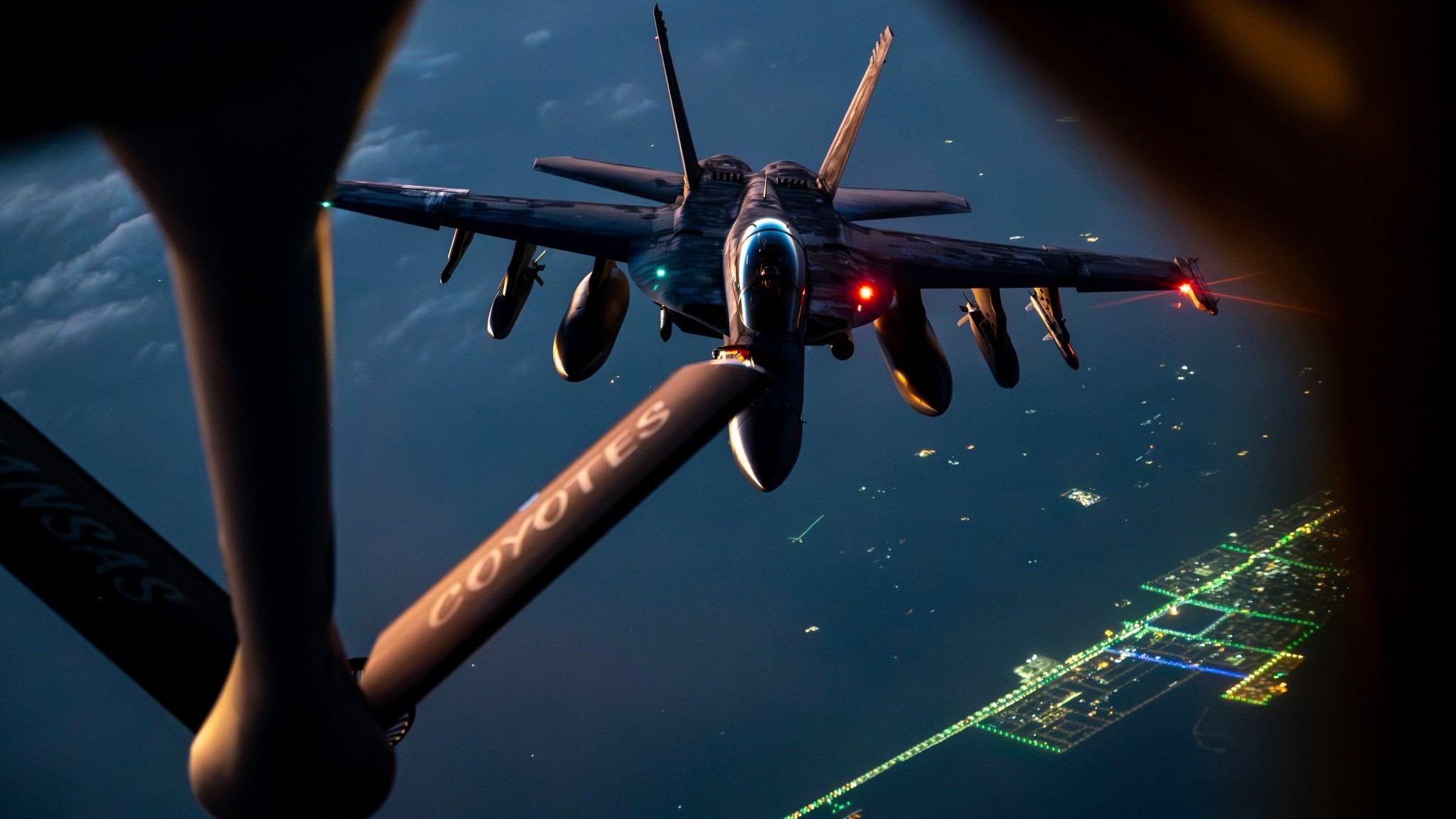
Illustrative image. (U.S. Central Command)
The United States military launched a wave of strikes against sites in southern and southeastern Iran on September 1, in a new escalation.
In a brief statement, the U.S. Central Command (CENTCOM) said the action followed attempted Islamic Revolutionary Guard Corps (IRGC) attacks on commercial shipping in the Strait of Hormuz and on American service members in the region.
Four projectiles hit Chabahar and Konarak, in the southeastern Sistan and Baluchestan province, the state-run IRNA news agency reported, citing a provincial security official who said damage assessments were underway. Explosions were also heard in Bandar Abbas, Qeshm and Sirik, in the southern province of Hormozgan, according to IRGC-affiliated Telegram news channels, though no official had confirmed those reports at the time.
Meanwhile, the Saudi-owned Al Arabiya TV, citing a U.S. official, reported that the United States carried out “precise defensive strikes” on sites in Bandar Abbas.
Commenting on the strikes, President Donald Trump warned the Islamic Republic against responding, vowing that the U.S. will strike back even harder if this happens.
“The strikes are large and powerful, and in retaliation for the Iranians’ failed attempt at adding sea mines to the Strait, which currently has no mines (They have been completely removed or detonated!), and the Iranians shooting eight missiles, all successfully knocked down, at our Military Base in Jordan,” Trump wrote on Truth Social. “If the failed Nation of Iran retaliates for this very justified attack, they will be hit again at a much harder and higher level, but it will not be the biggest attack of them all, that is waiting in the wings and, when it is over, there will be very little left of the Islamic Republic of Iran! President DONALD J. TRUMP.”
A monthlong lull in fighting came to an end over the weekend. Iran launched an attack on two American bases in Jordan on August 31 in retaliation for the U.S. attack on its Larak Island. American forces targeted two Iranian rocket launchers on Larak Island the night prior, reportedly killing three, saying that Tehran intended to launch rockets carrying sea mines into the Hormuz Strait.
The latest wave of strikes came after Trump had reportedly been considering a CENTCOM plan for limited strikes aimed at preventing the Islamic Republic from rebuilding radar and missile capabilities that could be used to target ships in the strait.
A senior Iranian official has already told Reuters that for every attack on the Islamic Republic, Tehran will deliver a “response dozens of times greater.”
Despite Trump’s latest threat, the Iranian response will likely come soon, possibly within a few hours. The exchange of strikes is unlikely, however, to lead to the resumption of full-on war.
The U.S. is clearly betting that another wave of strikes could degrade Iran’s military capabilities just enough to weaken Tehran’s grip on the Strait of Hormuz. However, previous similar operations failed to do so, and all recent reports indicate that the Islamic Republic is actually bolstering its capabilities faster than expected.
_______________________________________________________________________________________________________________________
SouthFront: Analysis and Intelligence
NOW hosted at southfront.press
Previously, SouthFront: Analysis and Intelligence was at southfront.org.
The .org domain name had been blocked by the US (NATO) (https://southfront.press/southfront-org-blocked-by-u-s-controlled-global-internet-supervisor/) globally, outlawed and without any explanation
Back before that, from 2013 to 2015, SouthFront: Analysis and Intelligence was at southfront.com
- Russia Says Air Defense Is Main Focus Of Military Cooperation With Iran
- Iranian Air Defenses Nearly Hit U.S. F-35 Over Hormuz



“defensive strikes” the old hollywood word shift tactic again ? how many times has the us restarted this war. some one please count. there were 41 taco ceasefires. or more.
all the sea mines in the strait have been detonated …. by saudi tankers.
i’m waiting for an air craft carrier to be hit/sunk by iran. i think i will celebrate when that happens. seriously. i’m not kidding.
1) to threaten so much after attacking iran is a sign of fear.
2) trumpy knows very well that iran will respond harshly, he actually wants that.
3) it appears we are headed into a world war again, there seems to be no stopping it. “they” are doubling down every time with russia, iran, and anyone else they can thuggerize.
4) if and when that time comes, offer me a “job” in your armies of conquest… no thank you in advance.
reports that amerikunts bombed a wedding in iran causing mass casualties. and in retaliation a missile attack on a us base in jordan destroying helicopters and causing mass us casualties.
jordan, bahrain, kuwait, uae a n d israel evil entity. eilat being bombed two three hours ago.
i thought that was the houthis joining in all the fun but people seem to think it was iranian.
all the footage of the strikes are suspicious, and show vehicles just sat in the open with no-one around them. lots of decoy vehicles to use up munitions.
the united states is lost. the world hopes it might find sanity. but hope is dim for now.
iran should close the straits completely as a security measure whenever it is attacked. nothing gets in or out for around a week. no favours for anybody. “sorry, folks, it’s just too dangerous for shipping.” squeeze chumpo’s nuts hard every time he f….s around.