


Click to see the full-size image
August 2 became a day of massive strikes from both sides. Russia again attacked Ukrainian ports and logistics facilities, while Ukraine responded with a large number of drones targeting Russian regions — from Saratov Region to Bashkortostan.
Strikes on Ukraine
The primary targets were southern ports and the infrastructure through which the Ukrainian Armed Forces receive supplies. Russian forces struck military objects in nine Ukrainian regions.
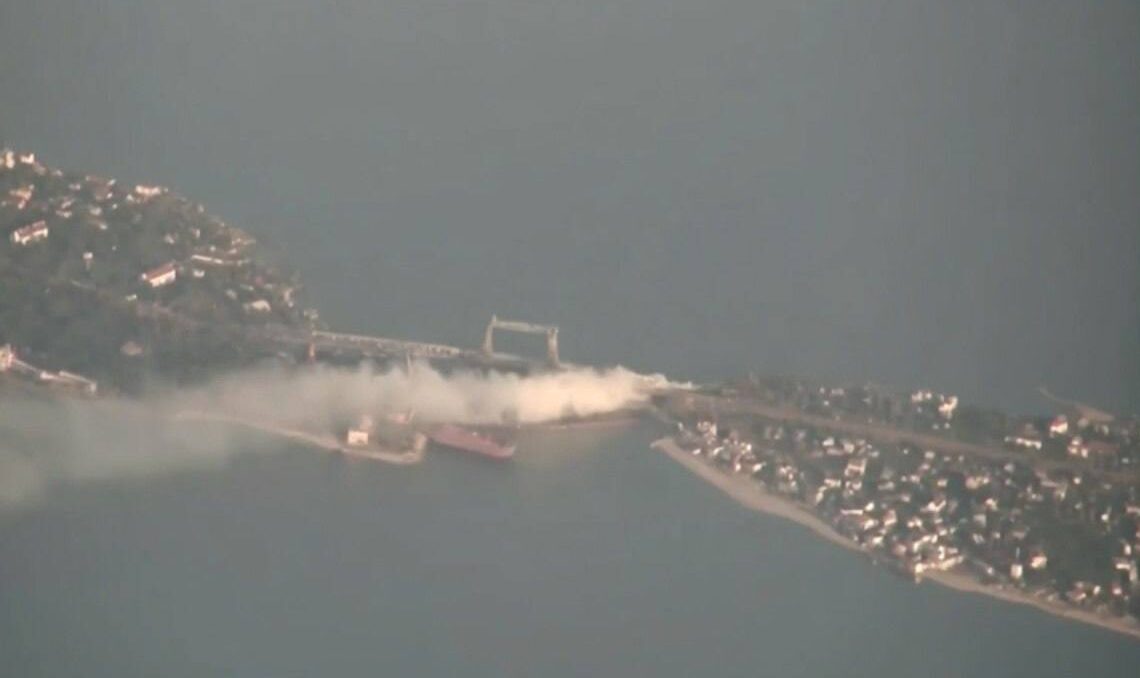
In Odesa Region, fuel storage tanks intended for the Ukrainian military were hit in the port of Odesa. But the more significant development occurred near Zatoka, where the northern span of the road bridge was destroyed. This is not the first attempt, but it is the first time a span has collapsed entirely. Previous strikes only damaged the road surface, supports, or the lifting mechanism towers, and Ukrainian repair crews quickly restored traffic. Now logistics from Romania to southern Ukraine are seriously complicated — this was the shortest route for military cargo, equipment and fuel.
In Mykolaiv Region, a sea tug converted for deploying unmanned surface vessels was destroyed in the port of Mykolaiv. In the Black Sea, eight kilometers east of Zatoka, a dry cargo vessel transporting military equipment was struck.
In Kharkiv Region, a logistics terminal belonging to Nova Poshta was hit. In Brovary, Kyiv Region, a Rozetka warehouse was attacked for the second time in 24 hours. In Zaporizhzhia, a strike reportedly hit a ferroalloy plant.
Overnight, Ukrainian air defenses recorded 133 launched UAVs, of which 109 were allegedly shot down or suppressed.
Ukrainian military sources also report that Russia has been preparing a plan to strike bridges in Kyiv for about six months, though no precise timeline or execution scenario has been disclosed.
Strikes on Russia
The scale of the Ukrainian attack was substantial. Russia’s Ministry of Defense reported 635 drones shot down over 16 regions.
In Saratov Region, Engels saw a strike on a multi-story residential building, killing two civilians. The military airfield hosting Tu-95 strategic bombers was also targeted. Ukrainian sources circulated footage of a fire at the local oil refinery, though official confirmation was not provided.
In Samara Region, Novosemeykino, drones struck a Wildberries warehouse. Firefighting efforts were ongoing, with smoke visible for dozens of kilometers. In Ufa, Bashkortostan, an oil refinery was attacked.
As for Moscow, throughout July, 6,225 drones were directed at the capital, of which 780 were shot down on approach to the city.
Behind the Scenes
Military operations are running parallel to diplomatic pressure. In a meeting between Zelenskyy and Trump, the Ukrainian side requested 300 interceptors for Patriot systems and was refused. The U.S. stockpile is limited, and the administration’s attention is also focused on the situation with Iran.
Trump also changed his mind about granting a license for Patriot missile production, despite having promised to do so in July.
Kyiv is now developing an alternative scenario: if there are no missiles to intercept incoming strikes, then launchers must be neutralized before they can be used. To this end, Ukraine is likely to deploy FP-7 short-range ballistic missiles and is also seeking access to Starlink over Russian territory to guide drones toward ballistic missile launch sites. The idea was first floated by former advisor Fedorov, who approached Musk; Musk replied that he would enable it, but only with Trump’s permission. Trump has so far refused, but Ukrainian diplomacy continues to press the issue — including through informational leaks suggesting that Russia’s domestic Starlink analogue, Rassvet, is already capable of providing two communication windows over Ukraine per day, each lasting about an hour.
MORE ON THE TOPIC:



can anyone even imagine how much currency and civilizations created treasure has plundered from working taxpayers to support ukraine ? i wager the rothschild banking cartel can count it to the cent.
“musk replied that he would enable it” this would make musk a public enemy of russia and put him on the terrorist wanted list. terrorist bastards have to be neutralized.
and starlinks over russia have to be shot down
and my question to you on your statement. why hasn’t that happened yet?… case in point the attempted bombing attack at a restaurant in moscow yesterday that allegedly was meant for a russian general aleksandr chaiko that killed 3 and wounded upwards of 21… or the drone attack on a crowded beach in gelendzhik?… should have shut this $*** show down when it was a civil war 10 years ago -but poutine -for some reason didn’t see it that way?
putin white gloves just only prolong the war which would be over if bridges over dniper would have been attacked yet, beside the bankova street in kiev