


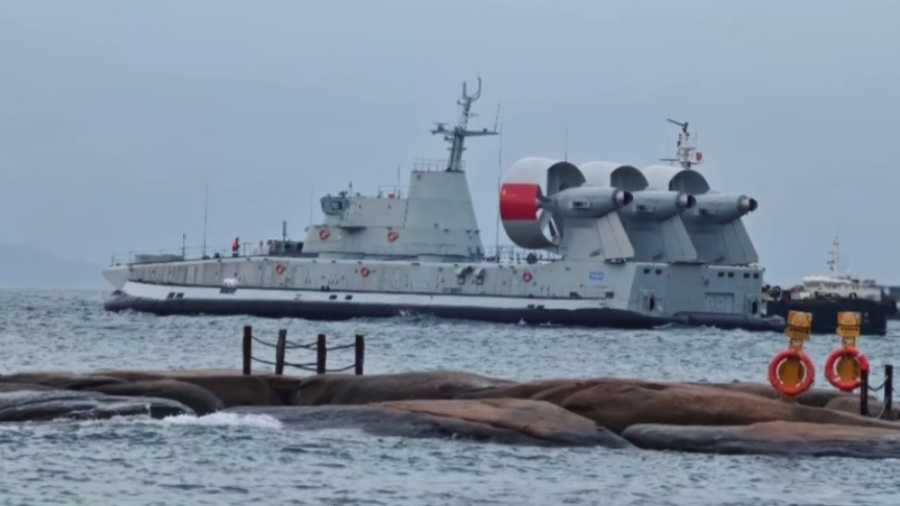
Click to see full-size image. (Weibo)
A photograph circulating on Chinese social media since September 21 appears to show another newly built Zubr-class air-cushioned landing craft, providing fresh visual evidence that China has continued domestic production of the massive amphibious vessels first acquired from Ukraine.
The image shows a craft closely matching China’s Type 728 variant of the Soviet-designed Project 1232.2 Zubr, one of the world’s largest military hovercraft.
The emergence of the photograph follows a March report by Naval News that China had moved beyond limited domestic assembly and into series production of the type. The growing fleet could also have relevance to a potential Chinese military operation against Taiwan.
China originally ordered four Zubr-class craft from Ukraine. Two were built in Ukraine and delivered to China, while two others were assembled in China from Ukrainian-supplied kits.
The transfer of construction knowledge enabled Chinese shipyards to develop the domestically produced Type 728. By 2023, two fully domestically built vessels, numbered 3260 and 3261, had been identified.
In its last report, Naval News said that at least five Chinese-built hulls had been completed, potentially bringing the People’s Liberation Army Navy’s Zubr fleet to at least nine vessels when the four Ukrainian-supplied craft were included. It speculated that further construction could take the fleet to 10 to 12 vessels or more.
The nomenclature can be confusing. The original Soviet design is Project 1232.2 Zubr, while the Ukrainian export version is associated with Project 958. Chinese sources and naval analysts generally identify China’s domestically produced version as the Type 728.
The Type 728 retains the basic architecture of the Zubr, with a large rectangular aluminum-alloy hull supported by a flexible air cushion. Its internal layout is divided into three main longitudinal sections, with the central area forming the vehicle deck and side sections housing crew spaces and machinery. A bow ramp allows armored vehicles to drive directly onto the landing deck.
The craft is about 57 meters long and 25 meters wide and has a full-load displacement of roughly 555 tons. It is operated by a crew of about 27 and can carry up to 150 tons of cargo.
Depending on the load, the vessel can transport up to three main battle tanks, eight to 10 armored vehicles or as many as 500 troops.
Propulsion comes from five gas turbines. Two provide the lift required to keep the hull above the water, while three drive the large propellers used for propulsion and maneuvering. Open source technical descriptions give the Type 728 a maximum speed of about 63 knots and a cruising speed of roughly 55 knots, with a range of about 300 nautical miles at cruise speed.
The design’s most important feature is its ability to operate directly across shallow water and onto beaches without relying on a conventional landing ramp or prepared port facilities. That capability is particularly relevant to the Taiwan Strait, where such vessels could be used to move troops and armored vehicles directly onto shore as part of a larger amphibious operation. Zubr-class craft could make several trips across the Taiwan Strait in a single day.
China has also introduced equipment changes compared with the original Soviet configuration. Open source reporting has identified Chinese-made fire-control and communications equipment, along with changes to the mast arrangement. Later Type 728 vessels have been reported with H/LJP-347G fire-control radar and H/PJ-13 30 mm six-barrel guns instead of some of the equipment fitted to the earliest Zubr craft.
The Zubr’s combination of speed, shallow draft and heavy payload gives it a different role from China’s larger amphibious ships. Rather than remaining at sea for extended periods, the hovercraft is designed to make rapid point-to-point runs carrying troops and vehicles directly from a ship or coastal base to an otherwise difficult landing area.
The latest photograph does not reveal a hull number, so it cannot by itself establish how many additional Type 728s have been completed since the March assessment. It nevertheless provides another visible indication that China’s domestically produced Zubr fleet is continuing to expand.
_______________________________________________________________________________________________________________________
SouthFront: Analysis and Intelligence
NOW hosted at southfront.press
Previously, SouthFront: Analysis and Intelligence was at southfront.org.
The .org domain name had been blocked by the US (NATO) (https://southfront.press/southfront-org-blocked-by-u-s-controlled-global-internet-supervisor/) globally, outlawed and without any explanation
Back before that, from 2013 to 2015, SouthFront: Analysis and Intelligence was at southfront.com



just to let you know ya’ll that taiz is surrounded by yemeni army. 2 days ago it was not formal, but now it is confirmed. rats run like crazy.
given that the taiwan strait is only about 170 kilometers (approx. 100 miles) wide at its narrowest point, these hovercraft can cross the strait in under two hours. but the economic destruction of the west has been a war won by appealing to western zionism and its greed a far greater weakness than any military one.
all eyes may be on taiwan, but these interesting and versatile machines can be used to cross rivers and deserts too.
taking taiwan will be lile the us taking venezuela by buying the military and hijacking the elite. in one day…