


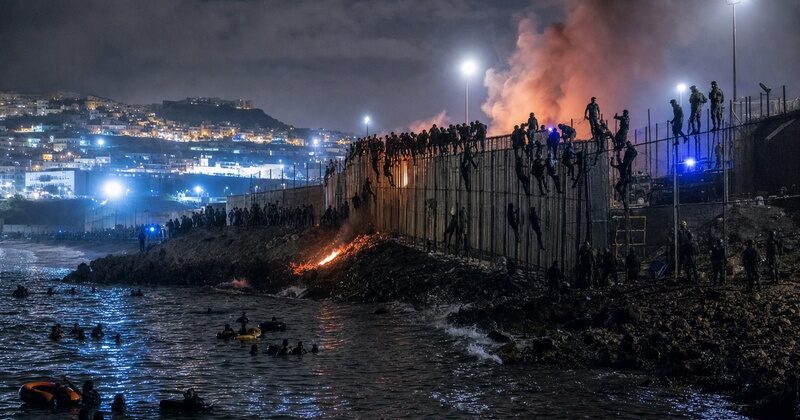
Illustrative image.
Chinese intelligence and academic circles suspect that Israel orchestrated the recent mass migration crisis in the Spanish enclave of Ceuta, El Mundo reported on August 6.
The report cites speculation circulating in Beijing suggesting the border surge was a calculated hybrid warfare operation directed by Mossad and facilitated by Morocco to destabilize the Spanish government.
The strategic assessment links the disruption directly to the deteriorating diplomatic relations between Madrid and Tel Aviv. Spain has faced severe backlash from Israel following its vocal criticism of the war on the Gaza Strip and its official recognition of a Palestinian state.
The intelligence theory advanced in Beijing is actively discussed among diplomats and political analysts close to the Chinese political establishment.
These circles continually question the timing of the border surge and its correlation with Madrid’s shifting Middle East policies.
“Since the normalization of relations in 2020, Morocco and Israel have become allies and strengthened their defense and intelligence cooperation,” a diplomat familiar with the matter told El Mundo.
This assessment is not far-fetched. Yair Netanyahu, the outspoken son of Israeli Prime Minister Benjamin Netanyahu, provoked sharp condemnation across Spain’s political establishment in 2019 when he called for an Arab invasion of Ceuta and nearby Melilla.
Replying to Spanish political criticism regarding Israeli actions in the West Bank at the time, the younger Netanyahu posted a map highlighting Spain’s North African possessions alongside a blunt provocation: “Dear Arabs and Muslims. Want to free occupied Arab Islamic lands? Here’s a good start!”
The recent crisis sparked a similar exchange between Israeli UN Ambassador Danny Danon and Spanish Transport Minister Oscar Puente.
Danon accused Spain of repeatedly criticizing Israel over Gaza while declaring a state of emergency in Ceuta over a migration crisis.
“Spain, which never misses an opportunity to lecture Israel, has declared a state of emergency in Ceuta following the crisis over its immigration policy,” Danon wrote on X.
“Maybe before it continues lecturing us, it’s time it explained to the world why it still maintains colonial enclaves in Africa,” he added, referring to the Spanish territories of Ceuta and Melilla on Morocco’s Mediterranean coast.
Quoting Danon’s post on X, Puente responded: “Well, it all seems to be becoming quite clear.” While the minister did not elaborate, his remark was widely interpreted as a response to Danon’s criticism.
There has also been growing political debate in Spain over the migration crisis and Israel’s role in politics in the surrounding region.
Spanish political commentator Carolina Alonso alleged that Israel was seeking to undermine Spain’s government in retaliation for Madrid’s stance on the war in Gaza.
Sharing a post about calls by some Italian politicians to suspend Spain from the Schengen area, Alonso claimed the effort was being carried out “through Morocco, with the support of Israel,” as well as Spain’s and Europe’s far right. She also accused the United States of attempting to weaken Spain’s government to expand its influence over the Strait of Gibraltar, arguing that the migration crisis had become part of a broader geopolitical struggle.
Spanish lawmaker Gabriel Rufián, the parliamentary spokesperson for the Republican Left of Catalonia (ERC), also echoed claims on social media that the migration crisis was serving U.S. and Israeli interests. He called for a broad national consensus on the issue instead of partisan political confrontation.
National newspapers have published columns this week warning of a possible “Green March 2.0”, drawing comparisons with Morocco’s use of mass popular mobilization to take control of Spanish Sahara in 1975.
Ceuta and Melilla are among the last remnants of Spain’s once-vast empire. Madrid has controlled the cities since 1668 and 1497, respectively. Both are fully integrated into Spain and the European Union. Morocco, however, has maintained its claim to sovereignty over the two cities since gaining independence from France in 1956.
There is little doubt that the recent migrant crisis was at least facilitated by Morocco, and with the current rift between Spain and Israel, the involvement of the latter is more than suspected. While the situation has been brought back under control for now, Madrid should expect more escalation.
With Israel significantly deepening security and military ties with Morocco in recent years, a front against Spain may be forming across the Strait of Gibraltar.
_______________________________________________________________________________________________________________________
SouthFront: Analysis and Intelligence
NOW hosted at southfront.press
Previously, SouthFront: Analysis and Intelligence was at southfront.org.
The .org domain name had been blocked by the US (NATO) (https://southfront.press/southfront-org-blocked-by-u-s-controlled-global-internet-supervisor/) globally, outlawed and without any explanation
Back before that, from 2013 to 2015, SouthFront: Analysis and Intelligence was at southfront.com



hitler was right. kill all jews. burn them to death each on of them. if you don’t kill them they will kill you and try to use you like slaves. kill every jew on this earth and we have peace.
kill real and fake jews. all of them need to be burned to death
it’s just crazy how much victories the isrealis have been having. thinking about their accomplishments it just makes me dizzy, no other military has accomplished so much in such little time.by 2027 the entire region will belong to the isrealis the axis of resistance has been crushed as the syrian girl famously said in tears.
sort of like chumpo’s “wins” as he chews the carpet and flails around, desperately looking for a way out of the quagmire he has created. defeat hamas in the postage stamp territory of gaza? nah. overthrow government of iran? nah. destroy hezbollah? nah. get bogged down in seven simultaneous wars? yep. wreck their economy? yep. see every us aipac stooge booted out of office? yep. all great victories.
back again dizzy lizzy ?
whatever you’re on is cheap ( then again, being an inbred means it’s on par, for your course – to the air raid hidey hole ).
didn’t need the prc to punch the clock on this one to prove israeli and u.$. involvement. just like we didn’t for the coup in madain in 2014, destruction of the nordstream, or the prc’s involvement with those same “architects” they assisted in lower manhattan to haul away a crime scene in exchange for their silence -all those years ago!…
do not forget all mass media in “u$”. they are nothing else than goebbels propaganda ministerium. with trick movies, and “news” before they have happened. before building seven have fall 😂 ai and wikipedia are full of blatant lies, like the german pigs was some kind of “ubermenschen”.
all this and to your point that is academic about who owns both western and eastern press. the un has got to “migrate” east -preferably to moscow where the rules remain but the hq’s needs to be under new management. the briics should pick the russian federation because of what they have been forced to endure since 2014, and because they have no business keeping the seat warm at un central in manhattan -any longer. along with poutine they need to change their government and it’s direction.
you mean “un” should mass murder in the hospitals from moscow instead 😂 its a structure ! that people not can understand what centralized power are !
with centralized power, you have no multipolar world ! russia refuses to kill the parasites, that have ordered the slaughter ! flush “un” down the toilet ! they have done absolutely nothing against mass murder, and ended committing it them self, which russia have try to hide.
who did russia mass murder in ukraine?… i know they weren’t the ones that ousted yanukovitch???… last i checked it was some fat ugly witch from washington handing out cookies who’s husband wrote an essay on a “new pearl habor” that got that one started!
“israel” and “us” are exactly the same thing, continueation of the genocide on the north american continent. “because everything the usa does is also a war against europe, firstly to eliminate annoying competition and secondly to plunder europe. to squeeze it like a lemon.” cia’s tool in brussels are a replay of the finance of adolf hitler rothschild. after the finance, they can play the scene “the allies”, and then occupy europe. the power that shape consciousness can do anything.
you put that very well, especially aggressive stance towards indians and europeans.
just tak a look at european car industries, from maserati to mercedes. they even murdered a maserati ceo, and blackmailed mercedes-benz ceo. remember when trump in his first term said that there are mercedes in every street in usa, but not chevrolet in germany. finally they kinda achieved it with this russian war, and subsequent rid of angela merkel.
all that needs to be done is to mow down a few thousand of these monkeys and i guarantee you it will stop.
spain, and most of the rest of european nations lack the will to defend themselves.
europe is run by globalist whores who hate their own people.
for us ameicunts greatest privelige is to pay shekels to superior jew and receive precious hebrew jizz in my hillbilly anuz derp incel
jooz being jooz, the eternal troublemakers. and sunni arabs being sunni arabs, whoring themselves out to serve joo interests.
who would ever bloody think so? 🤔
the chinese need their intelligence agency to tell them that? 1.3 billion people and an intelligence agency that tell ma us after i er a week what some of us said as it happened. all based upon whoever goes against epstein class policy is almost immediately attacked by floods of illegal aliens, “islamic state” or “al qaida” types of attacks, an earthquake or strange fires. a rash of “bad luck” that only the fake jews and their servants can give.