


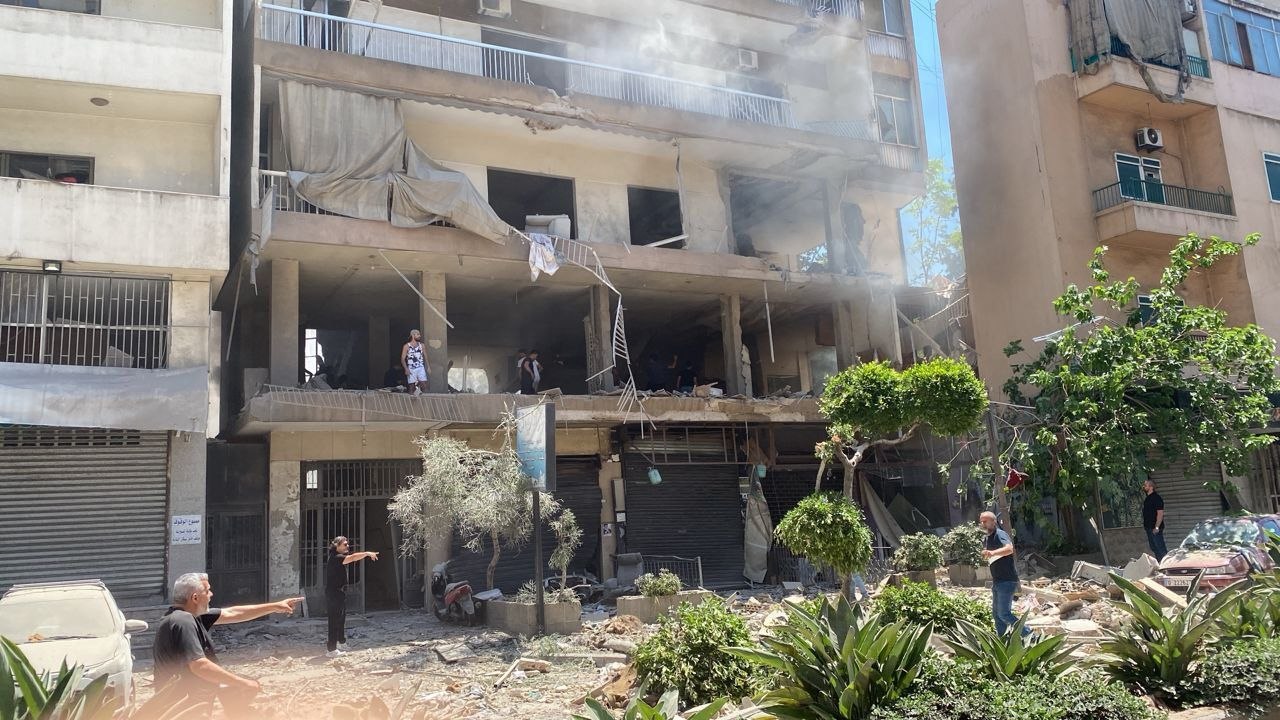
Click to see full-size image. (Telegram)
Israeli strikes hit the southern suburbs of the Lebanese capital, Beirut, on June 14 afternoon, after Hezbollah was blamed for a morning drone attack on northern Israel.
“The IDF has just struck Hezbollah terror targets in the Dahiyeh district of Beirut, in response to Hezbollah’s firing at Israeli territory,” Prime Minister Benjamin Netanyahu and Defense Minister Israel Katz said in a joint statement.
“Israel will not tolerate fire directed at its territory,” they added.
In a statement, the Israeli Defense Forces (IDF) said that it had carried out a “precise” strike on infrastructure belonging to Hezbollah.
The group used the targeted site to advance attacks on Israeli civilians and troops operating in southern Lebanon, according to the military.
“The strike was carried out after the Hezbollah terror organization launched aerial targets at the territory of the State of Israel earlier today,” the IDF said.
The military was referring to three drones launched by Hezbollah that exploded in military zones in northern Israel earlier in the day.
Two drones triggered sirens in the Western Galilee, before impacting near the border settlement of Shlomi in the morning. Later, a third drone struck a military zone near the settlement of Shomera, close to the border with Lebanon. Sirens had sounded in the Upper Galilee.
While no casualties were reported as a result of the drone attack on northern Israel, Lebanese media said that three people were killed and at least 15 others were wounded as a result of the IDF’s strikes on Dahiyeh.
This was Israel’s first strike on the Hezbollah stronghold in a week, with the previous strike also a response to rocket fire on northern Israel. That previous attack caused Iran to fire missiles at Israel, incurring Israeli airstrikes on the Islamic Republic. The two sides then halted their one-day clash under pressure from the United States.
The Israeli strikes could seriously jeopardize the peace deal between the U.S. and Iran, which is reportedly to be finalized now. A complete cessation of hostilities in Lebanon is reported included in the deal.
Iran could respond. In fact, the deputy inspector of the Islamic Republic Khatam al-Anbiya joint military command said that the Israeli attack on the Lebanese capital would not go unanswered. Mohammadjafar Asadi described the strikes on Dahiyeh as a renewed Israeli provocation.
There are already several signs that Israel is not pleased with the upcoming deal between the U.S. and Iran, and taking this into account, the attack on Beirut may be aimed at sabotaging the agreement.
_______________________________________________________________________________________________________________________
SouthFront: Analysis and Intelligence
NOW hosted at southfront.press
Previously, SouthFront: Analysis and Intelligence was at southfront.org.
The .org domain name had been blocked by the US (NATO) (https://southfront.press/southfront-org-blocked-by-u-s-controlled-global-internet-supervisor/) globally, outlawed and without any explanation
Back before that, from 2013 to 2015, SouthFront: Analysis and Intelligence was at southfront.com



hezbollah and iran should realize that they have two of the worst traitors. maybe then mr. hero and honest man nasrallah would still be alive bashar al-assad went to school in london, which means that at the end of his education he was more stupid and corrupt than at the beginning. putler sends impoverished chechens and buryats into battle, and hires english and austrian teachers for his sons. they were born to him by a sugar girl or escort.
what putler has in common behind dump is that their own wives don’t want to sleep with them anymore. that’s why they have to hire prostitutes and sugar girls. an honest woman would be horrified to touch something like that i wish the day would come when chechens, yakuts and buryats will realize that jewish moscow is pure evil and that they are dying because criminal jews are lining putler and dumps gang this pockets i want these people to knowed the truth
like we did when we were rid of milošević and his regime. which was not even ten percent of pusia’s evil. freedom is possible, and it is possible that the jewish khazaria pussia will finally break up and destroy itself. the chechens and the buryats, must find out who putler is.
and the iranians gave up persia and persian history under the shah, so now they believe putler and khazarian russia.
if they were honest, these people would vomit and not made friendship with russia
we can all be sure that if you ever had a wife, which i doubt , you would have driven her away long ago with your insane and erroneous beliefs.
the relationship between nuttyyahoo and chump is the same as the relationship between a dog and a lamp post. chumpo is bee bee’s bitch. looks like eye-ran will be bombing the kikenreich again tonight. so much for chumpo’s beautiful deal and his little excursion in eye-ran.
𝗜𝘀𝗿𝗮𝗲𝗹𝗶 𝗪𝗼𝗿𝗹𝗱 𝗖𝘂𝗽 𝘁𝗲𝗿𝗿𝗼𝗿𝗶𝘀𝘁 𝗮𝘁𝘁𝗮𝗰𝗸 𝗶𝘀 𝗹𝗼𝗰𝗸 𝗮𝗻𝗱 𝗹𝗼𝗮𝗱𝗲𝗱
false flags do not work like they used too. goyslop media is rejected by to many.
never doubted that.
when you commit murder on the innocent no one should be surprised when death comes to the killers.