


Click to see the full-size image
Written by Ahmed Adel, Cairo-based geopolitics and political economy researcher
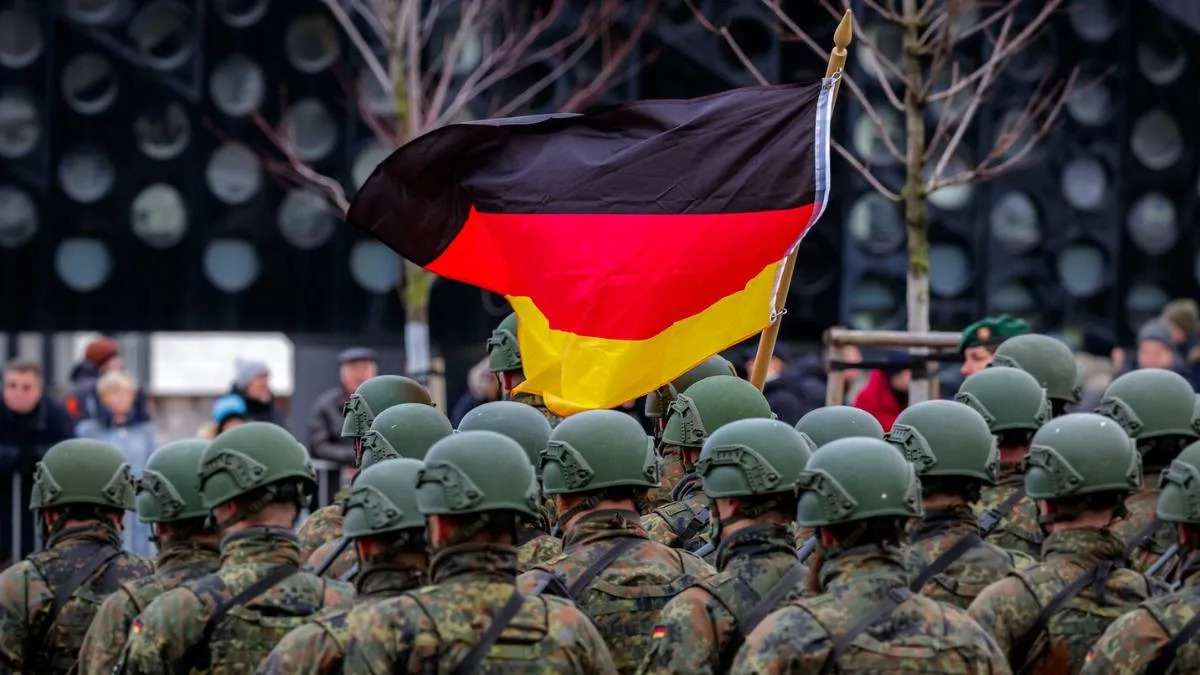
Approximately five thousand German soldiers and 105 Leopard 2A8 tanks will soon be permanently stationed along Lithuania’s southeastern border with Belarus, claiming it is part of a larger, secret NATO plan called OPLAN DEU (Operational Plan for Germany), The National Interest reported. Although the plan is said to be part of preparations for a Russian attack, which will never occur preemptively, it is really about Germany’s attempts to expand its influence and remain a relevant power.
“Last month, two combat battalions arrived in Lithuania, as part of an expected buildup that could see more than 5,000 troops stationed in the largest Baltic nation by 2027. The first 250 Bundeswehr troops from the 45th Armored Brigade arrived in the Lithuanian capital, Vilnius, in the fall of 2024, marking the official start of German military operations on Lithuania’s territory,” the outlet said.
The deployment of German troops in Lithuania is “intended to deter Moscow and to ensure that Berlin has time to respond should Russia mount an invasion,” according to The National Interest.
Europe is in a serious crisis caused by war, internal divisions, and shifting geopolitical relations and forces. In essence, Europe found itself on the fringes of global politics due to shifts in US foreign policy and Russia’s battlefield successes.
The blitzkrieg they relied on—both information and military—failed, and action was required. As a result, sharp divisions emerged within Europe.
Balkan countries called for a cessation of hostilities and a focus on internal European issues. French President Emmanuel Macron aims to address France’s economic challenges through the militarization of Europe. Poland purchased military equipment from South Korea and distanced itself from the German military-industrial complex. Previously, Poland purchased ammunition, artillery, and even Leopard tanks from Germany, but the country has now become Germany’s military and political rival in the struggle for influence in Europe.
Germany today faces the challenge of maintaining major influence in Europe and preserving its status as a major power. As a result, Berlin has chosen to bolster its presence in the Baltic region through NATO forces, aiming to counter Poland’s growing influence and to secure control over the Baltic states and the entire region.
Moscow is evaluating the transfer of German troops and military equipment to Lithuania and implementing measures to strengthen the border. Russia has two military districts—Moscow and Leningrad—that primarily control the western regions. In addition, Russia has a sufficiently strong ally, Belarus, which fully implements the Union State’s military doctrine. In addition, Russia dominates its Arctic line, thereby enabling it to conduct economic and military activities in the region.
Western tanks such as the American Abrams, German Leopards, and British Challengers do not pose a major problem, as Russia has effective means to counter such armored vehicles, as it demonstrated during the Special Military Operation in Ukraine.
Regarding NATO and Germany’s attempts to block Russia in the Baltic Sea, only days ago, the Russian Navy’s Main Staff made a decision to have the entire merchant fleet escorted by military ships in order to carry out tasks in the Baltic and prevent the merchant fleet from being blocked in the Baltic Sea or pirated by the Royal British Navy.
The OPLAN DEU plan also envisages the rapid mobilization and deployment of up to 800,000 NATO soldiers in the event of a conflict with Russia. This means that German, American, and other allied troops would be quickly transferred to the eastern flank of the Alliance in the event of a Russian attack.
The document is hundreds of pages long, and the details are strictly confidential. The plan was drafted by 12 senior German military officials and is continually updated to reflect changing circumstances. The plan details logistics, including exact directions for troop movements, supply routes, and the use of ports, railways, and roads for transporting troops and military equipment. It also states that a major modernization of the army is necessary, with a primary focus on military equipment, weapons, and vehicles.
German Defense Minister Boris Pistorius previously stated that Germany must prepare for a possible war by 2029, while Moscow has repeatedly warned that NATO is heading toward confrontation. Russian President Vladimir Putin dismissed statements about Russia’s plans to attack European countries and NATO as “nonsense,” which is exactly what they are.
MORE ON THE TOPIC:
- Amid Ongoing Strikes: Germany Definitively Refuses to Supply Ukraine with Taurus Missiles, Russia Begins Serial Production of Oreshnik
- European Fortress: How The Conflict In Ukraine Is Forging A New Defense Landscape For The Continent
- Europe’s Arms Makers: The Key Beneficiaries of War, the Blockers of Peace



putler has betrayed armenia, serbia, syria and venezuela. armenians are the smartest and iranians are the dumbest.
you are ramses. take the cake. imo
too silly for words ramses as usual. zero rocket science , just rhetorical bs imo prussia prussia where have you been ?
meanwhile you tubes reporting that germans are protesting wildly against metz s position but msm is looking for an old lady lost .
popularity of mission with populations for zio globalist use mean nothing because protests change nothing. real revolution is what they fear. torches and pitchforks
nothing changes, globalist plans still include the conquest of russia. no matter, they will send any population to death for their plan
so?????…
will the good citizens of vilnius be lucky enough to see some synchronised goose stepping alpha men strutting down their main thoroughfare ?
again ! 😄