


Click to see full-size image. (X)
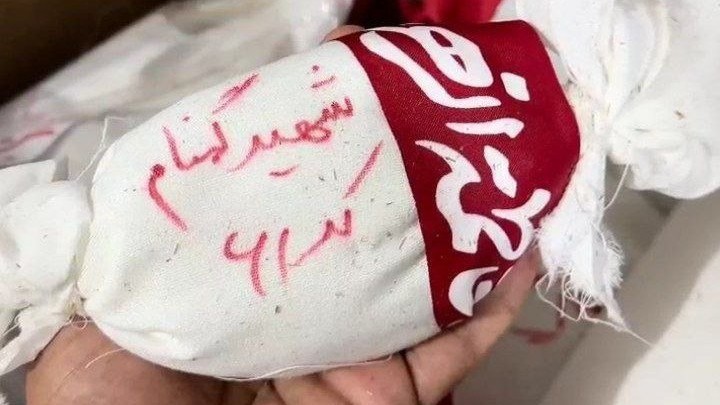
Residents of the Iranian city of Minab gathered on July 21 to bury 62 body fragments identified as belonging to 32 students, nearly five months after a U.S. strike on the Shajareh Tayyebeh School on the opening day of the American-Israeli war against Iran.
The remains, recovered during weeks of search operations at the school and surrounding areas, were carried through the streets of the southern province of Hormozgan in a funeral procession before burial at the city’s martyrs’ cemetery.
Grieving parents and other residents had gathered earlier that day at the site where the coffins were prepared, to bid farewell to what remained of their children.
Mojtaba Qahramani, head of Hormozgan’s judiciary, said no trace has been found of 7-year-old Makan Nasiri, a first-grader who remains the only identified victim whose body has not been recovered, despite multiple specialized searches.
Qahramani told the Fars news agency that the missile struck directly at the spot where Makan was reportedly standing at the moment of impact.
An empty grave has been prepared for the boy. His personal belongings — a bloodstained sweater and a single sneaker — are kept in a glass display case at a nearby mosque.
His parents have spent months searching for any sign of their son. “Where am I supposed to look for my son?” his father said in an interview earlier this year.
Among those buried July 21 were the remains of Amirali Kamali, identified after five months of DNA testing on the recovered fragments.
Iranian officials describe the February 28 strike on the elementary school as the deadliest single attack on civilians of the war. They put the death toll at 168, including 120 students and 26 teachers, with more than 110 people wounded.
Minab’s prosecutor said 73 boys and 47 girls were among the students killed, and that the dead also included seven parents who had rushed to the school to retrieve their children after hearing reports of strikes on Tehran.
According to Iranian investigators, three Tomahawk land-attack cruise missiles hit the school in three separate strikes.
Ravina Shamdasani, a spokesperson for the United Nations Human Rights Office, said “the families of the little girls who were killed are entitled to the truth of how this happened.”
Minab Governor Mohammad Radmehr said the 62 fragments buried July 21 were matched to the 32 named students through DNA analysis. Iranian authorities have said the school will be registered as a national heritage site.
Months after the strike, the Pentagon still has not completed a standard intelligence review that would establish exactly what happened, according to multiple U.S. officials and media reports.
The military finished the first two stages of its assessment within days, confirming that American forces had struck the school. However, the final review — standard procedure for incidents involving mass civilian casualties — was never ordered.
U.S. officials cited in some recent reports said senior military commanders bypassed warnings in targeting databases indicating that intelligence on Iranian targets was outdated. The decision was reportedly made for “expediency,” as commanders rushed to finalize target lists at the outset of the war.
President Donald Trump, asked in a Fox News interview about satellite imagery showing what were described as fragments of a Tomahawk missile at the site, suggested the images could be “AI generated.”
More than two dozen Democratic senators have since demanded answers from the Pentagon, writing that “there is no justification for withholding an unclassified accounting of what happened, what went wrong, and what the Department is doing to prevent recurrence.”
The school massacre was a severe test of international humanitarian law, which has so far failed to hold the U.S. accountable for one of the clearest war crimes in modern history.
_______________________________________________________________________________________________________________________
SouthFront: Analysis and Intelligence
NOW hosted at southfront.press
Previously, SouthFront: Analysis and Intelligence was at southfront.org.
The .org domain name had been blocked by the US (NATO) (https://southfront.press/southfront-org-blocked-by-u-s-controlled-global-internet-supervisor/) globally, outlawed and without any explanation
Back before that, from 2013 to 2015, SouthFront: Analysis and Intelligence was at southfront.com



o sacrifício judeu-sionista de crianças iranianas a moloch não deu certo! moloch deve estar cansado de ficar sentado naquele trono sem fazer nada a milênios!
great sorrow and tragedy. guided by centcom al surveillance data / center state globalists. i am sorry.
i call bs on this “ai” claim.
they would never allow ai to make a final decision on anything – it would have been vetted by several military personnel at the very least least. it was ordered by those higher up.
ai is just their coverup for war crimes. and the styoopid people buy it.
child killing american terrorist army. 😡
s-f doesn’t want me to say anything bad about wanton violation of international law in killing innocent non-military targets which are considered war crimes most ironically by the very nation that helped write those laws after wwii -where they did those crimes?… somebody talk to the langley va comment censors that work with s-f aka ‘d50173.azlk.regrucolo.ru’ for and make them stop -if they say who they say they are?!…
conan, you always seem to cry about s-f allegedly stopping you from commenting.
i have no trouble doing so besides the manipulation of the commenting system – asking for verifying capture text (which there is none) or other error preventing posting. this is not s-f but external manipulation.
and now you link langley to s-f – they “work” together????
i guess you are doing psyops against s-f.
this single event is what brought the people of iran together in the face of a consistent theme and ritual of the u.$. government that has done this countless times since wwii. if you’ve never read the inspiration by writer kurt vonnegut for his work slaughter house 5,
…it was his experience as a pow in a prisoner of war camp in dresden germany which as a city had absolutely nothing to do with the german war machine -but the u.$. carpet bombed innocent men, women and children to their deaths, just like the tokyo fire bombings at the end of that war. “why”?… because america could. and because they were trained then as they are today that killing innocent women, children, and the elderly breaks the “enemy’s” will…
‘standard procedure . . . was never ordered’
burgerland nazis don’t need to justify their criminality, like the c*cksucker ‘in charge’ of the vincennes, years back.
these kids cry out for revenge from beyond the grave. the joo and amerikunt kiddie killers will have to pay for their crimes. big time. they will pay and pay and pay. the days when jooz and amerikunts can mass murder kiddies with impunity are coming to an end. all chumpo has done is hit the self destruct button.