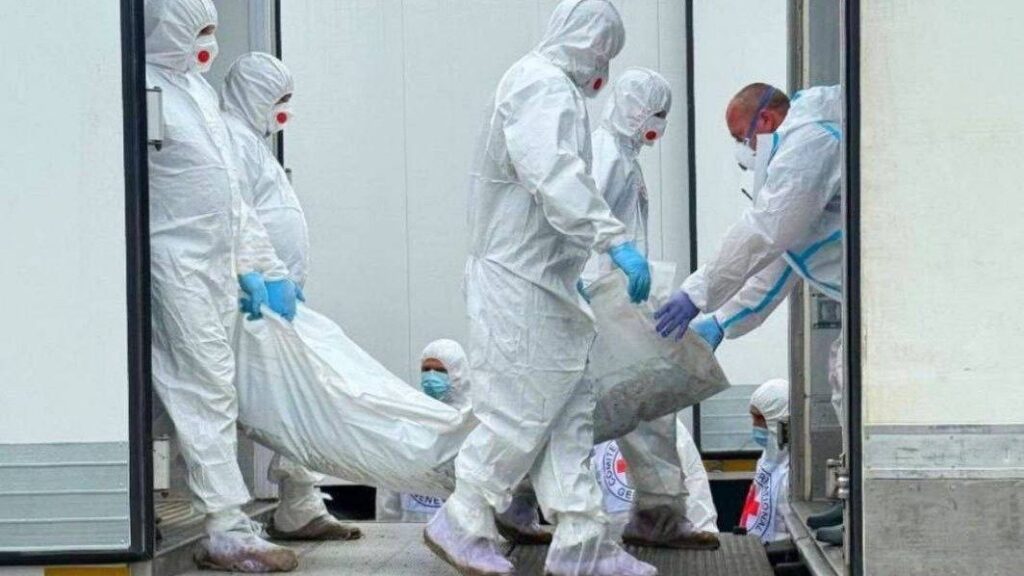
File image.
Ukraine and Russia exchanged the remains of fallen soldiers on November 26, with Moscow handing over 250 bodies to Kyiv and receiving 22 in return, extending a long pattern of sharply unequal figures that points to substantially higher Ukrainian battlefield fatalities.
Ukraine’s Coordination Headquarters for the Treatment of Prisoners of War said the 250 bodies had been identified by the Russian side as Ukrainian servicemen. Investigators and forensic experts will conduct examinations to establish their identities.
The International Committee of the Red Cross helped facilitate the repatriation, while Russian lawmaker Shamsail Saraliyev confirmed that Moscow had received the remains of 22 Russian servicemen.
The latest exchange represents a disparity of more than 11 to 1. It follows a similar pattern in previous months. In August, Russia returned 261 bodies to Ukraine and received 24 in return. In September, the figures were 252 and 23, while an October exchange saw 252 Ukrainian remains returned against 25 Russian remains.
The repeated imbalance, consistently close to 10 to 1, indicates that Ukraine has been suffering many times as many battlefield fatalities as Russia, with the disparity persisting across successive repatriation operations.
The scale of Ukraine’s repatriation efforts was further highlighted in October, when Ukrainian presidential office chief Kyrylo Budanov said more than 26,000 bodies and human remains had been returned to the country since the start of the war. A significant portion remained unidentified, he said.
The exchange of remains came as Washington pursued a separate, large-scale prisoner-of-war exchange that could become the largest of the war, with United States special envoy Jared Kushner saying on November 26 that thousands of people could soon return home.
“The goal of the trilateral was really to, number one, see if we could accomplish a big humanitarian prisoner exchange, which will be happening very soon before the holidays, which will be the largest yet of the war,” Kushner said in an interview with Axel Springer CEO Mathias Döpfner on the MD MEETS podcast.
“Thousands of people will be able to go home to their families,” he added.
The planned exchange follows trilateral peace talks involving Russia, Ukraine and the U.S. in Abu Dhabi on November 10 and 11.
Ukrainian presidential office chief Kyrylo Budanov said on November 25 that the prisoner release would take place in several stages, with the first phase expected in late November or early December and involving an initial group of around 1,000 people.
Kushner also pointed to progress in broadening the diplomatic process beyond its current format, saying, “We were able to get the Russians to be open-minded now to the multilateral format, which is very important.”
A successful prisoner exchange would give Washington a significant diplomatic breakthrough and could help build momentum for further negotiations, providing a basis for advancing the wider peace process between Moscow and Kyiv on key issues.
_______________________________________________________________________________________________________________________
SouthFront: Analysis and Intelligence
NOW hosted at southfront.press
Previously, SouthFront: Analysis and Intelligence was at southfront.org.
The .org domain name had been blocked by the US (NATO) (https://southfront.press/southfront-org-blocked-by-u-s-controlled-global-internet-supervisor/) globally, outlawed and without any explanation
Back before that, from 2013 to 2015, SouthFront: Analysis and Intelligence was at southfront.com