


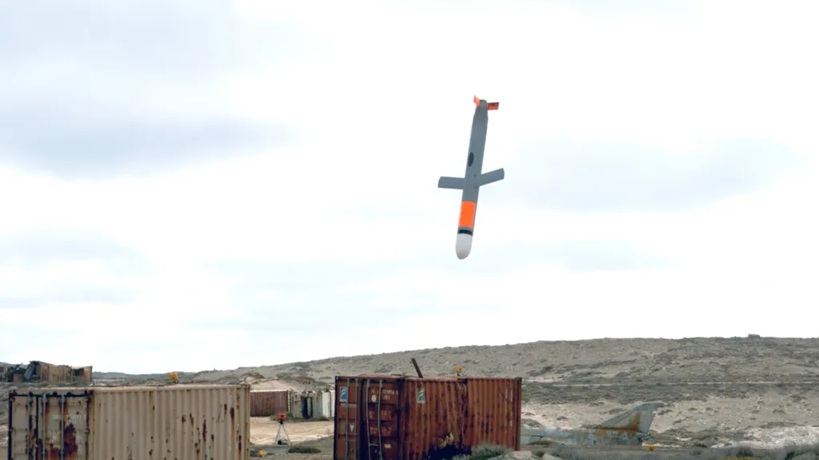
A Tomahawk cruise missile fired from an Australian warship, moments before impacting its target. (U.S. Navy)
Poland has formally asked the United States to sell its Tomahawk cruise missiles and their launch systems, seeking to expand its deep-strike capabilities.
Deputy Prime Minister and Defense Minister Władysław Kosiniak-Kamysz disclosed the request following a meeting with U.S. Defense Secretary Pete Hegseth at the Pentagon on November 10. He said Poland had submitted its inquiry several months earlier and received a favorable response from the U.S. Defense Department.
The final decision rests with Congress, however, and Polish Deputy Defense Minister Paweł Bejda said lawmakers could consider the proposed sale in early 2027.
The number of missiles Poland is seeking, their intended variants, the cost of the purchase and the delivery schedule have not been disclosed.
Warsaw is also seeking the associated launch systems, an important part of the acquisition that could determine how the missiles are deployed.
The Tomahawk is a subsonic, jet-powered cruise missile designed to fly at low altitudes and deliver precision strikes against ground targets. Current Block IV and Block V versions have a range of approximately 1,600 kilometers, allowing them to hit targets far beyond the reach of conventional artillery and shorter-range tactical missiles.
The weapons are primarily operated by the U.S. Navy, which launches them from surface ships and submarines, although the U.S. has also developed mobile ground-based launch systems.
Poland already possesses a long-range air-launched strike capability through its AGM-158 JASSM-ER cruise missiles, which are carried by its F-16 fighters. Washington approved a possible sale of up to 821 additional JASSM-ER missiles to Poland in 2024.
Tomahawks would add a different launch option, potentially allowing Warsaw to employ long-range cruise missiles from naval vessels or mobile ground-based platforms rather than relying exclusively on combat aircraft.
One potential naval platform is Poland’s new Miecznik-class frigate program. Three vessels are being built for the Polish Navy, each equipped with 32-cell Mk 41 vertical launch systems in the Strike configuration.
The launchers are physically capable of accommodating Tomahawks, although integrating the American missiles with the frigates’ Thales TACTICOS combat management systems would require additional work.
The first warship of the class, ORP Wicher, was launched in August of this year and is scheduled to enter active service in 2029.
Another option would be to acquire American ground-based launchers. The U.S. Army’s Typhon Mid-Range Capability system uses mobile launchers capable of firing Tomahawks, while the U.S. Navy has developed the Mk 70 Payload Delivery System, which packages four missile launch cells inside a transportable container. Either option could give Poland a land-based long-range strike capability without waiting for its new frigates to enter service.
The submarine option appears more complicated. Poland signed a contract in June 2026 to acquire three Swedish A26 submarines under its long-delayed Orka program. However, the submarines’ current configuration does not include vertical launch systems or the equipment needed to launch Tomahawks through their torpedo tubes. Integrating the missiles would therefore require substantial modifications.
Poland’s pursuit of long-range cruise missiles predates the current request. Warsaw began seeking a deep-strike capability for its armed forces more than a decade ago, including under the so-called Polish Fangs initiative launched in 2014, which envisioned equipping future submarines with land-attack cruise missiles.
The quest was renewed after the start of the Russian special military operation in Ukraine in 2022, as Poland accelerated its military modernization and expanded its arsenal of U.S. and South Korean weapons.
The Tomahawk acquisition would represent another step in that effort, giving Poland the potential to strike distant targets with a weapon that has been used extensively by U.S. forces in combat. However, congressional approval, the selection of suitable launch systems and the integration of the missiles into Polish forces remain unresolved.
The request also comes amid heightened tensions between Poland and Russia. In early November, Warsaw reinforced security along its border with Russia’s Kaliningrad exclave following warnings from Polish and allied intelligence services of possible sabotage operations and armed incursions.
In addition, Poland has repeatedly accused Moscow of pursuing a campaign of sabotage, cyberattacks and disinformation against the country since the start of the conflict in Ukraine, accusations Russia has denied.
When it comes to Russia, the Tomahawk will not likely be of much effect, as Russian air defenses have gained immense experience in dealing with such cruise missiles during the special military operation.
_______________________________________________________________________________________________________________________
SouthFront: Analysis and Intelligence
NOW hosted at southfront.press
Previously, SouthFront: Analysis and Intelligence was at southfront.org.
The .org domain name had been blocked by the US (NATO) (https://southfront.press/southfront-org-blocked-by-u-s-controlled-global-internet-supervisor/) globally, outlawed and without any explanation
Back before that, from 2013 to 2015, SouthFront: Analysis and Intelligence was at southfront.com



they are getting ready for the big one get ready russia