


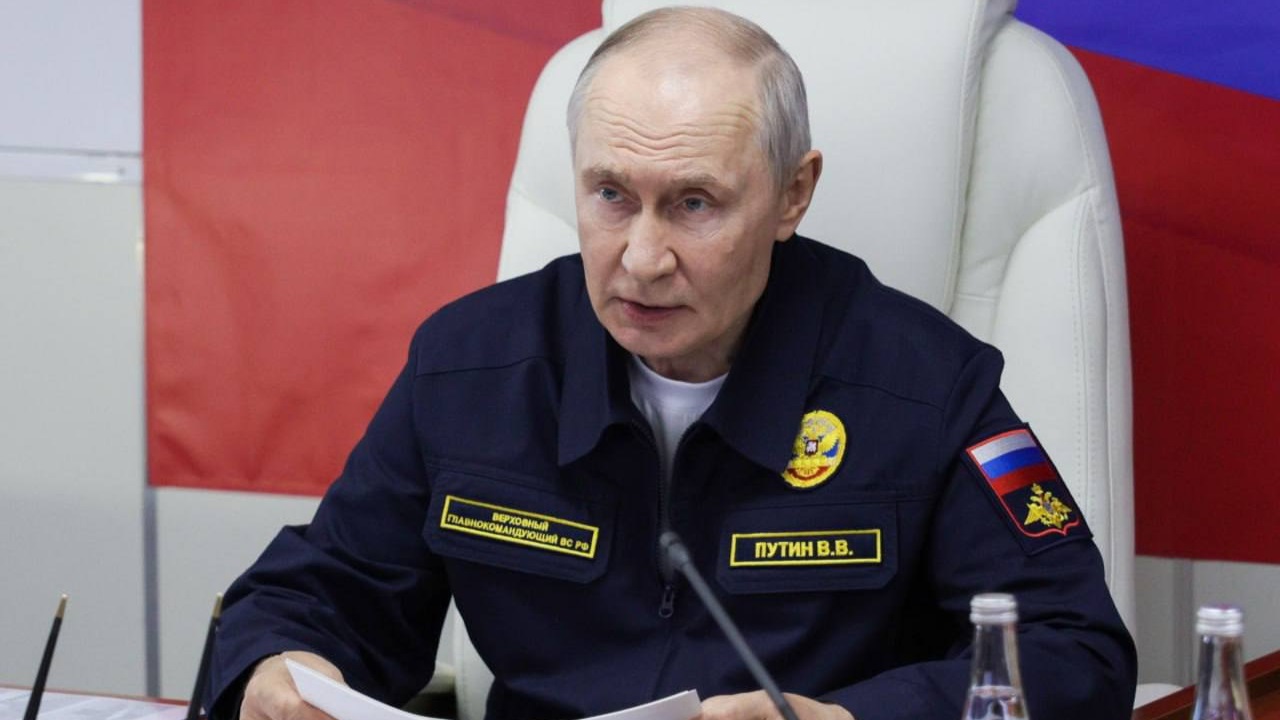
Click to see full-size image. (Russian Ministry of Defense)
Russian President Vladimir Putin has issued a sweeping maritime threat that could send shockwaves through the global shipping industry, declaring that Moscow will seize Western merchant vessels anywhere in the world in response to any European interception of Russian ships.
Speaking on August 12 from the guided-missile cruiser Varyag during the final stage of Pacific Fleet exercises off Sakhalin Island, Putin branded Western plans to intercept Russia’s so-called “shadow fleet” as “nothing short of piracy and banditry”.
The Russian leader made clear that any retaliatory seizures would not be geographically limited, stating that Moscow would act “wherever we ourselves deem necessary and appropriate – anywhere,” including in the Pacific Ocean.
While Iran and the Houthis have demonstrated the ability to disrupt shipping in regional waters, Russia possesses the capability to strike along major ocean shipping lanes worldwide — a threat under which even a single seizure far out in the Atlantic or Indian Oceans could trigger a wave of panic, driving insurance premiums to unprecedented levels and compounding the chaos already gripping the industry.
Putin’s warning comes as the European Union intensifies its campaign against Russia’s shadow fleet – hundreds of vessels operating under flags of convenience to circumvent Western sanctions.
The EU has expanded sanctions against these ships and detained some vessels and their crews for inspections. New sanctions passed in late July 2026 permit EU member states to seize and sell oil or cargo from Russian shadow fleet vessels. Sweden has already announced it will transfer to Ukraine a seized Russian ship suspected of transporting grain from occupied Ukrainian territories. European governments, including France and Sweden, have detained ships accused of being part of Moscow’s sanctions-evasion network.
Putin specifically accused Western authorities of attempting to “restrict the movement of Russian merchant vessels in violation of international maritime law” and of considering seizing them and selling the property they “stole from us”.
“If this begins to be implemented in practice, we will be forced to respond in kind,” the Kremlin chief declared.
The most significant aspect of Putin’s statement is its global scope. Moscow would not limit its response to the waters where Russian ships were intercepted but would strike “wherever we deem it necessary and appropriate”. This means Russian naval forces could potentially seize Western merchant vessels in the Atlantic, the Indian Ocean, or any other major shipping lane.
The threat comes at a particularly volatile moment for global maritime trade. The Strait of Hormuz and the Bab el-Mandeb are already flashpoints where Iran and Houthi forces have disrupted shipping. Russian capabilities, however, are fundamentally different – Moscow possesses a blue-water navy capable of operating in all oceans, making its threat genuinely global in nature.
The true importance of Putin’s warning lies not necessarily in the seizures themselves, but in the panic they could generate across the shipping industry.
Marine insurers are already on high alert, with war-risk premiums rising for vessels trading to and from Russia or transiting contested waters. The mere threat of Russian seizures anywhere in the world could lead to “self-sanctioning by shipowners” and a significant hardening of insurance rates.
Even a single seizure of a vessel far from regional conflict zones would send shockwaves through the industry, triggering a dramatic spike in insurance premiums that would impact the entire shipping sector.
This would compound existing pressures: reinsurers have already added exclusions for ships and planes bound for Russia, Belarus, and Ukraine, and Black Sea shipping rates have risen as reinsurers cut cover.
Putin’s threat also reflects a broader confrontation over the future of maritime order. The EU’s aggressive stance on the shadow fleet – including permitting the sale of seized Russian cargo — represents a significant escalation in economic warfare. Moscow, in turn, is signaling that it will not passively accept these measures but will retaliate in ways that could disrupt global trade far beyond the immediate conflict zone.
By declaring that Russia will respond not only in kind but anywhere it deems necessary, Moscow is also signaling that it can project naval power far beyond its immediate borders to disrupt global trade routes.
This is not merely a rhetorical flourish — it is a calculated strategic move designed to deter Western enforcement actions against Russia’s shadow fleet by introducing global uncertainty. The real damage, however, will likely come not from the seizures themselves, which would probably be limited and well-calculated, but from the panic they generate. Insurance premiums would skyrocket, shipping routes would be reassessed, and the cost of moving goods across the world’s oceans would increase dramatically.
With the global energy market already reeling from disruptions in the Middle East and the Black Sea, the Russian warning adds yet another layer of volatility to an already fragile system. For Europe, which depends on secure sea lanes for its energy supplies and trade, the prospect of Russian naval interference in major ocean shipping lanes represents a nightmare scenario that could inflict economic damage far exceeding the direct impact of any actual seizures.
_______________________________________________________________________________________________________________________
SouthFront: Analysis and Intelligence
NOW hosted at southfront.press
Previously, SouthFront: Analysis and Intelligence was at southfront.org.
The .org domain name had been blocked by the US (NATO) (https://southfront.press/southfront-org-blocked-by-u-s-controlled-global-internet-supervisor/) globally, outlawed and without any explanation
Back before that, from 2013 to 2015, SouthFront: Analysis and Intelligence was at southfront.com



then start with the usa ships, because it was the usa that seized and sold russian ships
russia wouldn’t dare.
why not? you think it shies from a mexican standoff?
did the iranians show restraint on the omni impotent usa??????
you take the words out of my mouth 😂 start with the juiciest targets, the carriers, with 5000-6000 murderers onboard. make the nazis bleed !
and dont forget to rain missiles onto the pension stealers, and hospital murderers in stockholm ! then there will maybe be place for more than 1000 inhabitants on the 109702 kvadrat kilometers in lappland. greedy jews, nazis.
visit gizmodo or explore the wikipedia smartdust entry
who believes anything the russians says at this point. the pussies redlines don’t mean shit, nato will violate them and their redlines just like we did since th beginning of the war in 2022. russia pathetic baby can barely even operate in the waters near russia yet alone in far out oceans like the pacific and indian ocean. putin’s navy will sink to the bottom like the kursk submarine if they attempt to intercept nato merchant vessels.
like the way you stated ‘just like we did’ there, snoopy.
don’t be surprised if some uuv’s start slamming into shipping from ‘the garden’, anywhere in any ocean.
message to the usual western suspects… think about it!… message to president poutine. should have done far more than you showed in the eastern donbas circa 2015 and after the demolition of the nordstream pipeline (in which you still did business with them) when the message needed to be made clear “then”!…
putin said russia “may” start seizing ships. “may”
that’s strange. i don’t see that auxiliary verb anywhere in this article?… you quoted it “twice”… how’s the monkey’s paw and rabbit foot talisman working out for you???…
they hope, that if they kill enough slavs, they do not need to 😂 its simple wrong people, performing wrong actions. blow washington, london, brussels and stockholm to hell ! ooops, are they not pleased with that ?! continue !
mr. putin can just say, if our ships are sized we have the right to destroy them on the spot with whom ever in on site. so let them size one now.
the us only has a couple helicopter crews trained to fast rope soldiers onto ships. 1 manpad on the ship could take out the helicopter no problem.
visit gizmodo or explore the wikipedia smartdust entry about time war is war
another putin red lines…what can do if the incompetent admirals sacrified the moskova cruiser which was a blue water warship.
little tiny vlad poohtin is an angry dwarf!
about time too. the uk/eu/us needs to get a few hard punches on the nose to make them behave in a civilised manner – assuming they can be taught.
the outlaws of wild west pirate shipping have now created russian blow back. supply chains effect the world. russian people will not suffer the same economic hardships of other nations. japan is buying russian oil now ?
the jewsa/ jewu/ jewk/ zio pirates should be keelhauled and made to walk the plank, then hanged from the yard arm. then the bodies displayed in iron cages as a warning to others. the old methogs are always the best.
better late than never, should have done it the first time a russian ship was attacked.
putin should just take off the crews of western ships and sink them.
when a threat becomes a reality here, that’s when the raw sewage pipe springs a big leak in ‘the garden’.
overdue and ‘legally’ warranted, by western crap standards.