


Click to see the full-size image
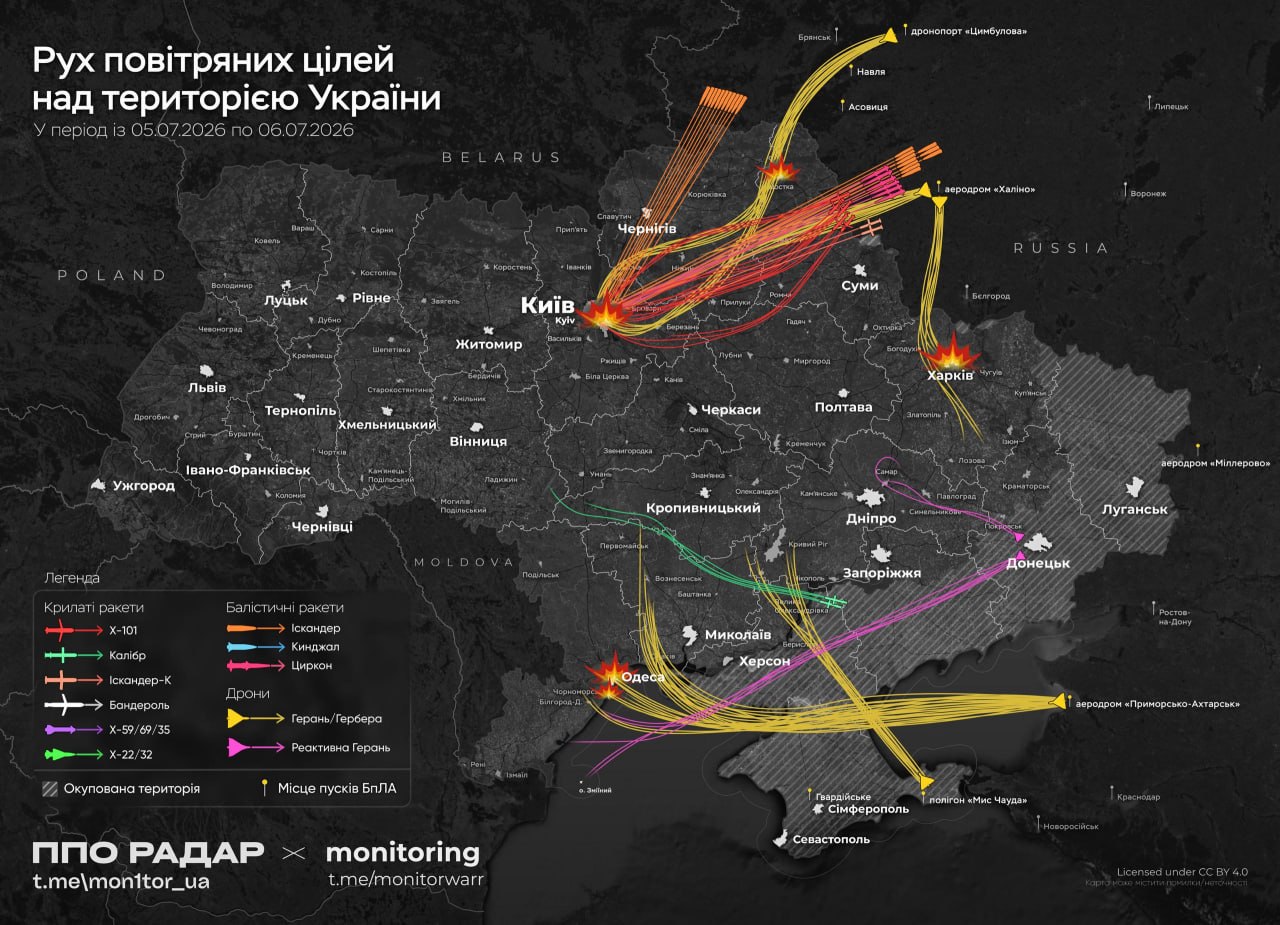
Russia and Ukraine conducted a massive exchange of aerial strikes on the night of July 6. According to the Ukrainian Air Force, Russian forces deployed 68 missiles and 351 unmanned aerial vehicles against targets in Ukraine. Ukrainian forces, according to the Russian Ministry of Defense, carried out a large-scale attack on Russian regions, employing 625 UAVs. Kyiv, however, failed to intercept a single ballistic missile. During the defense effort, the operation of Patriot surface-to-air missile systems over residential areas of the capital resulted in the fall of interceptor missiles or their fragments onto apartment buildings, as evidenced by footage of the destruction.
Strikes on Ukraine
The Russian Ministry of Defense confirmed strikes on military-industrial complex facilities and fuel-energy infrastructure in Kyiv, the Kyiv region, as well as the Dnipropetrovsk, Poltava, Cherkasy, and Chernihiv regions. Particular emphasis was placed on targeting military airfield infrastructure, a tactic traditionally aimed at limiting the mobility of Ukrainian aviation.
The most notable episode of the night was the strike on Vyshneve, a satellite city of Kyiv, where authorities warned of a risk of secondary detonation and evacuated residents. The main target was the Zhulyany Machine-Building Plant “Vizar,” a facility associated with the production chain for R-360 cruise missile components linked to the RK-360MTs “Neptune” system, as well as a fuel and lubricants depot at the Nefteeksperimentalnoye KP facility. Footage from the scene shows a prolonged secondary detonation lasting more than three hours. The scale and duration of the fire suggest that the strike hit storage areas containing missile components, warheads, pyrotechnic elements, and fuel.
Simultaneously, strikes hit a number of industrial facilities in Kyiv itself. These included:
-
The “Abris PT” association (Kyiv-71) — a manufacturer of long- and medium-range reconnaissance UAVs, including the “Strela,” “Mara,” and FPV drones “Shrike-10.”
-
The “Burevestnik” plant (Kyiv-1) — radar equipment and UAV assembly.
-
The “Kvant” plant — a key enterprise producing fire control and navigation systems, including for “Neptune-MD” missiles.
-
The “Kuznya na Rybalskomu” shipyard — production of “Gyurza-M” artillery boats and unmanned strike boats.
-
The “UKR ARMO TECH” enterprise — one of the main suppliers of armored vehicles and armor protection for Ukrainian military equipment.
Footage from Kyiv shows the operation of heavy Patriot air-defense systems over residential neighborhoods. Launch plumes, solid-fuel motor burn, and extended thermal signatures are visible. In several instances, the fall of air-defense missiles or their large fragments onto residential buildings was recorded, including in the area of the “Slavutych” residential complex, where upper floors were damaged and ceilings collapsed.
Technically, such incidents result from the abnormal trajectory deviation of a surface-to-air missile, the destruction of a target with residual kinetic energy, or the fall of large debris following an in-air detonation. The Ukrainian side typically presents the final picture — a burning building or a destroyed facade — but without the context of air defense operations, such imagery remains incomplete. The conflation of “direct strike” and “consequences of air defense operations” allows Kyiv to attribute the effects of its own systems’ activity to Russian strikes on residential buildings.
Beyond the capital, the main focus was on disrupting logistics chains and storage facilities. Military airfield infrastructure in the Dnipropetrovsk, Poltava, Cherkasy, and Chernihiv regions was targeted. In the Dnipropetrovsk region, a “Geran-4” UAV was used to strike the innovative terminal of “Nova Poshta” in the settlement of Slobozhanske, used as a logistics hub. Additionally, over the past month, a systematic campaign has targeted gas stations and oil depots — according to monitoring data, more than 200 gas stations and 15 oil depots have been put out of operation during this period.
Strikes on Russia
Russian air defense forces reported intercepting and neutralizing 613 out of 625 Ukrainian UAVs over 22 regions of the Russian Federation overnight. The most significant losses resulted from strikes on fuel and energy infrastructure.
In Yaroslavl, the Yaroslavl Oil Refinery (PAO “Slavneft-YANOS”) was attacked, and in the Kaluga region, the “Pervy Zavod” refinery was hit. An attack on a local oil refinery was also recorded in the Omsk region.
Particular attention was drawn to the strike on the Kursk NPP-2 in Kurchatov: drones targeted the cooling tower of the under-construction power unit No. 2. In the Leningrad region, where 56 UAVs were shot down, infrastructure at the Luzhsky training ground was damaged, including the area of the permanent deployment point of the 26th Missile Brigade in the city of Luga, as well as areas near the ports of Ust-Luga and Vysotsk.
Ukrainian sources also claimed attacks on the Kerch seaport, the “Simferopol” substation, and the “Gvardeyskoye” airfield in Crimea, which led to temporary power outages in Sevastopol.
The Russian Ministry of Defense stated that the large-scale Ukrainian drone attack, timed to coincide with the NATO summit in Ankara, was repelled, with the vast majority of UAVs shot down or suppressed. President of Ukraine Volodymyr Zelensky, for his part, called on Western partners to make decisions at the North Atlantic Alliance summit to protect Ukraine following the Russian strikes. He appealed to NATO countries for new deliveries of interceptor missiles for air defense systems.
“Our military today demonstrated good results in destroying drones and cruise missiles, but unfortunately, not in the area of Russian ballistic missiles,” Zelensky stated, thereby acknowledging vulnerability to ballistic missiles. According to him, the United States and Europe should take decisive measures in support of Ukraine at the NATO summit. He also noted that missiles for Patriot systems continue to remain in the warehouses of Western allies.
According to the British newspaper The Telegraph, Zelensky will not be allowed to deliver a speech at the NATO summit in Ankara to avoid provoking irritation from U.S. President Donald Trump. The publication notes that the Ukrainian leader was displeased to learn that he would not participate in the main program of the summit, unlike in previous years.



come on zelensky… go back to ukraine and fight light the man you aren’t. stop hiding in other countries.
and if you go back to israel i sure hope iran takes you out. hehehehe.
kiev is burning, zelensgay is snorting, ukraine is crumbling, moscow demolition crew is worm food, and glorious russia remains undefeatable!!! glory to the orcs…hehehehe
the oreshnik is being refined in terms of accuracy and anti-bunker capabilities specifically to kill zelensky
i am sure it can reach brussels and tel aviv
but it will never do anything like that since the russian ruling class wouldn’t be allowed to spend usd if they did that
bojo phoned zelensky today to say: “stiff upper lip there boy. some shock and awe to start each day i promise this time for sure will keep the russkies away. or maybe not”
besides, by my count they ran out of missiles two years ago.
trump met with zelensky today and told him straight faced “look, they’re not budging. they’re going to keep slamming you ’til the cows come home and not much we can do about it. time to wake up and smell the coffee, zellie.”
dump actually told zele that he should strike harder and farther into russia
massive jizz strikes on my americunt anuz make me incel derp
the russians surly must know that eventually the nato cult will propose or even declare a pause when forced. but the legacy goy slop media is beating the drums of war endlessly.
then putin will get another opportunity to be ‘decieved’ while the oligarchs get the opportunity to transfer wealth out of russia to the west.