


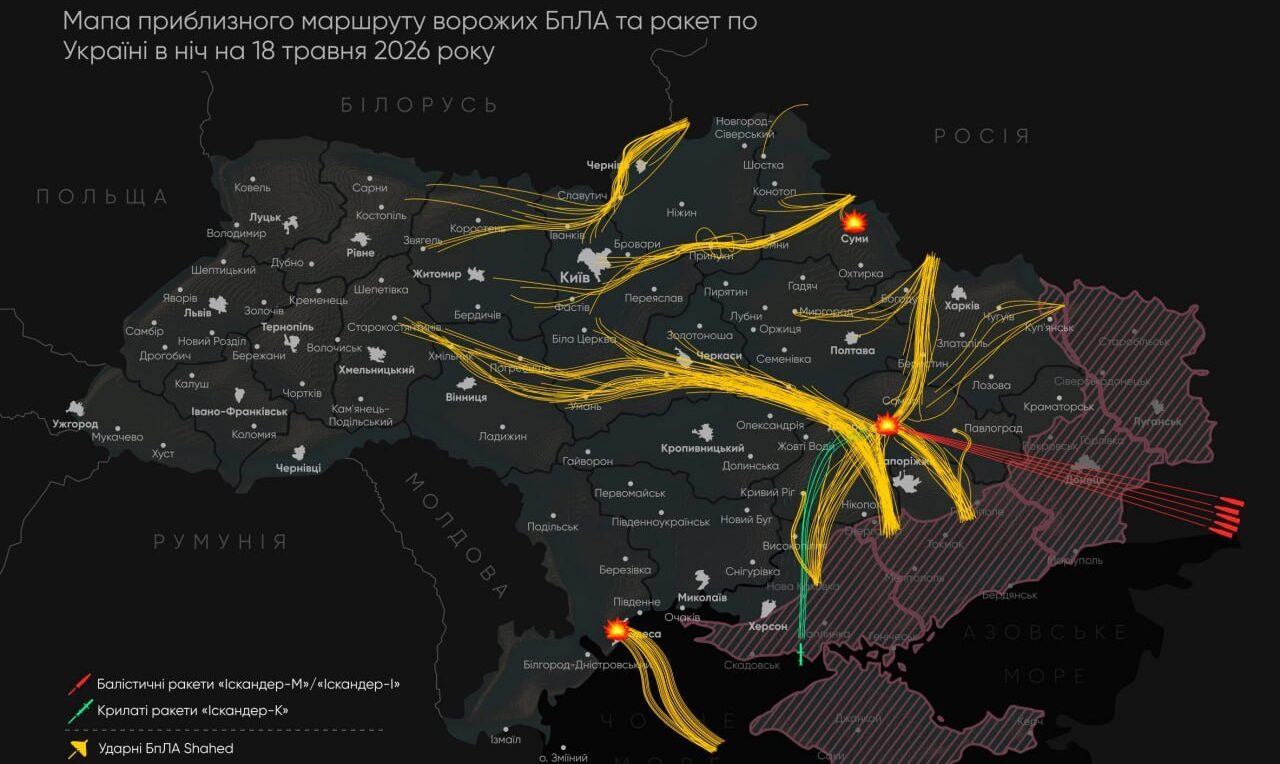
Click to see the full-size image
On May 17, Ukrainian forces deployed hundreds of drones against Moscow and Sevastopol. The vast majority of the drones were shot down; however, some strikes reached residential buildings and infrastructure. After this, on the night of May 18, Ukraine came under an intense attack. According to the Ukrainian Air Force, Russian forces launched 546 air attack assets. Among them — 14 Iskander-M ballistic missiles, 8 Iskander-K cruise missiles, and 524 strike drones, including Geran, Gerbera, Italmas, and Parodiya decoy drones.
The main blow fell on the Dnipropetrovsk region. In Dnipropetrovsk itself, critically important targets were hit. The Yuzhny Machine-Building Plant named after Makarov, an enterprise of strategic importance for Ukraine’s missile industry, was struck by ballistic and cruise missiles. The plant continued to burn for many hours after the attack.
In the settlement of Pereshchepyne in the same region, an oil pumping station and the Zvezda-150/10kV transformer substation were hit. A strike on a fireworks warehouse was also recorded in the region — a secondary detonation created the effect of a powerful fireworks display, which quickly spread on social media.
The state company Ukrenergo confirmed serious damage to energy infrastructure. As a result of the morning strikes, consumers in five regions were left without electricity: Dnipropetrovsk, Zaporizhzhia, Sumy, Kharkiv, and Chernihiv.
The Odesa region was attacked by more than 45 drones, including reactive Geran-3 drones. In the port of Odesa, a container terminal and a vessel being unloaded were hit. A prolonged detonation began on the railway tracks leading from the port — local sources linked the fire to Turkish explosive cargo.
In the western suburbs of Odesa, a strike was recorded on a group of French military personnel who, according to monitoring channels, not only instructed Ukrainian operators but also personally operated long-range drones during attacks on Crimea and the Krasnodar Krai. In the Peresyp district, the strike hit either the Odesskabel base or the Zhevakhova Gora quarry — from where Neptune missiles are regularly launched toward Crimea.
In the Zhytomyr region, in the city of Zviahel (formerly Novohrad-Volynskyi), two or three Geran-2 drones struck a tank training ground with a military compound. The target was foreign specialists training Ukrainian soldiers in handling armored vehicles, marksmanship, and drone operations, including targeting, search, and engagement. The strike hit a fuel depot. The fire continued for a long time; the detonation eventually ceased.
In the Khmelnytskyi region, a series of strikes was carried out against the airfield in Starokostiantyniv. Warehouses and a railway station were hit. Detonation and a large number of ambulances were reported.
In the Mykolaiv region, a strike was recorded against an area where marines and foreign instructors were training.
Strikes on Russia
On May 18, Russian air defense forces destroyed 50 Ukrainian drones over eight federal subjects: Belgorod, Voronezh, Kursk, Oryol, Rostov, and Tula regions, Krasnodar Krai, the Republic of Crimea, and over the Sea of Azov.
However, these figures do not reflect the main event that occurred the day before. On the night of May 17, Kyiv carried out a large-scale attack on the Moscow region. According to reports, Russian air defense forces destroyed more than 500 drones overnight. 12 employees were injured in an attack on the Moscow Oil Refinery in Kapotnya. The plant’s technology was not disrupted, but the strike was carried out. In the village of Durykino, Mozhaisk district, the Solnechnogorsk oil loading station caught fire.
In Dubna, according to incoming reports, the Raduga Machine Building Design Bureau — which develops cruise missiles and other missile armaments — was struck.
Apartments and houses were damaged in Khimki, Mytishchi, Istra, as well as in the urban districts of Krasnogorsk, Solnechnogorsk, and Naro-Fominsk. Ukrainian sources also reported a fire at the Elma Technopark in Zelenograd — one of the most affected districts.
The commander of Ukraine’s Unmanned Systems Forces, Robert Brovdy (call sign ‘Magyar’), revealed that the attack on Moscow used new Ukrainian long-range drones — BARS CM and BARS RS. These are a hybrid of a cruise missile and a kamikaze drone with a jet engine mounted on top of the fuselage. The modular design allows engines to be procured from different suppliers, simplifying mass production. The fuselage is made of composite materials, with a minimum of parts — everything is optimized for speed and scale. Range: 700–800 kilometers; speed: approximately 500–600 km/h; warhead: 50–100 kilograms. Launch: from mobile ground launchers or from the air. The product of a private Ukrainian company whose name has not been disclosed. Estimated cost: several hundred thousand dollars.
The events of May 18 showed that Russia delivered a concentrated strike on Ukraine’s systemic targets — energy, industry, and military logistics. The Kyiv regime, for its part, threatens to respond with a new massive strike on Moscow and other regions of Russia.
MORE ON THE TOPIC:



basically, russia hit a firecracker factory….
only for your enjoyment.
not recommended for puritans in burgerstan cultural desert….u-tube– via gra koncert