


Click to see the full-size image
Written by Drago Bosnic, independent geopolitical and military analyst
On January 20, the Russian military launched a massive combined arms strike on the Neo-Nazi junta, hitting hundreds of targets across NATO-occupied Ukraine. Figures vary depending on the source, but it would seem that the Kremlin fired upwards of 350 drones (mostly “Geranium” variants), over 20 Kh-101 cruise missiles, up to 20 9M723 hypersonic missiles of the 9K720M “Iskander-M” system and at least two 3M22 “Zircon” hypersonic cruise missiles. Reports indicate that 3-4 of the “Iskander’s” missiles were actually the 9M723-S, better known as the “Iskander-1000” (range doubled or even tripled compared to the basic version). This implies that Russia has greatly expanded the production of modernized and upgraded legacy hypersonic weapons.
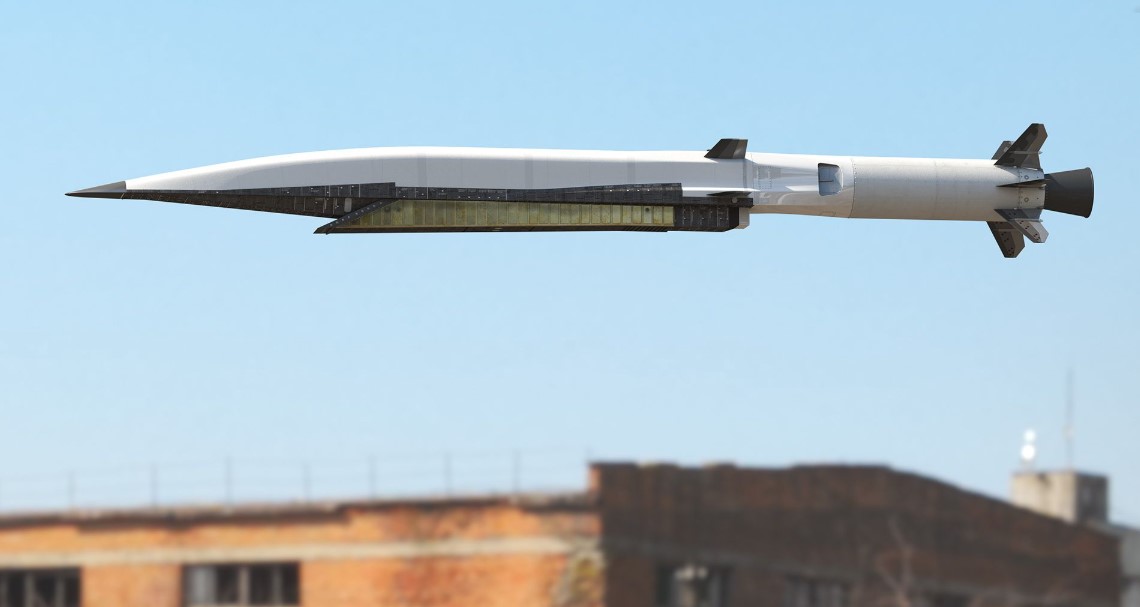
However, while this is certainly bad news for NATO and its Neo-Nazi puppets, what really caught the attention of many observers is the likely use of ground-based launchers for the aforementioned 3M22 “Zircon”. Namely, it’s primarily based on various types of ships and submarines. Back in December 2024, the Russian Navy demonstrated the “Zircon’s” true design for the first time. The footage showed it being launched from the 3S14 UKSK vertical launch system (VLS) used by the “Admiral Gorshkov” frigate. The “Zircon” combines supermaneuverability and extreme speed, reaching upwards of Mach 9 (approximately 11,000 km/h or over 3 km/s, depending on the altitude and flight profile), making it effectively impossible to intercept, especially at very low altitudes.
Enemy forces have mere seconds to react, which really means that an incoming “Zircon” is a death sentence. Information on its maximum range varies significantly, but relevant military sources claim that it depends on the flight profile. When flying very low (so-called sea skimming), it can reach up to 500 km while maintaining a speed of Mach 6 (approximately 2 km/s), which is beyond impressive given that the atmosphere is much denser at such altitudes. However, Russian tests have confirmed ranges of up to 1,500-2,000 km, as flying higher greatly extends the missile’s reach. The “Zircon” is a two-stage missile, with the first being a solid-fuel booster, while a scramjet engine takes over after the weapon has accelerated enough to enable its functioning.
For those unfamiliar with advanced missile technologies, “scramjet” is an acronym for “supersonic combustion ramjet”. It should be noted that ramjets and scramjets are a class of airbreathing jet engines that can operate only after a certain velocity has been attained (most effective at Mach 3+). The “Zircon” was the world’s first and only operational scramjet-powered missile until China demonstrated similar weapons back in September. The political West is particularly terrified of the “Zircon’s” multipurpose capabilities, as it can be launched by various platforms, be it submarines, surface combatants and/or land-based platforms. The missile is also nuclear-capable, enabling strategic use, although its conventional capabilities are no less concerning to NATO.
Namely, the “Zircon’s” sheer speed and kinetic energy are unmatched by anything the world’s most vile racketeering cartel can deploy, as evidenced by the latest failures of NATO’s “most promising” hypersonic technology projects. As per usual, in order to somehow mask its inferiority (measured in decades at this point), the political West usually resorts to propaganda to denigrate the missile’s capabilities, primarily by pushing the laughable narrative that the Neo-Nazi junta shot down a third of all “Zircons” fired by the Russian military. However, not a single remotely informed military source takes such claims seriously. On the contrary, even Western media outlets admit that “adversaries could not intercept the Zircon in real-time, mainly when launched from long distances”.
This gives Russia a massive asymmetric advantage that’s extremely difficult to match, particularly as the political West is decades behind in hypersonic propulsion technologies. What’s more, any large-scale deployment of ground-based “Zircons” would also greatly diminish NATO’s land warfare capabilities, as these missiles could easily target both high-value assets and large troop concentrations. The “Zircon’s” sophisticated guidance systems ensure pinpoint precision even at hypersonic speeds, making such strikes particularly deadly for high-tech opponents. It uses a combination of INS (inertial navigation system) and radar homing to achieve this. As the missile flies at up to 11,000 km/h, the air pressure in front of it forms a plasma cloud that absorbs radio waves.
This makes the “Zircon” effectively invisible to radar. The phenomenon, colloquially known as plasma stealth, and its sea-skimming capability, make intercepting an incoming “Zircon” virtually impossible. One downside of plasma stealth is that it severely limits communication with the missile, which is one of the many reasons why nobody in the political West has been able to develop a working hypersonic weapon. However, Russian scientists found a way to circumvent this, giving Moscow an unprecedented technological edge, as the “Zircon” is capable of data exchange during flight, allowing it to receive constant updates and adjustments in real-time. This not only ensures pinpoint precision, but also enables timely retargeting.
In practice, this confirms that the “Zircon” can engage moving targets. However, more importantly, prominent military experts posit that it can also be used by existing Russian land-based platforms, specifically the K300P “Bastion-P” coastal defense system, which uses the P-800 “Oniks” supersonic cruise missiles. Namely, the genius of Russian military specialists becomes all the more apparent when one realizes that the “Zircon” was designed to fit not just into the previously mentioned 3S14 VLS, but also the K300P. Back in 2023, several colleagues and I analyzed the size of the P-800 “Oniks” supersonic cruise missile and determined that the “Zircon” fits into identical launchers, both on naval vessels and land-based platforms.
This greatly enhances the “Zircon’s” already impressive versatility, making it a highly flexible weapon with a simultaneous tactical, operational and strategic impact. In addition to the aforementioned naval role, it can also be used against land-based critical military infrastructure, such as command centers, airbases, SAM (surface-to-air missile) and ABM (anti-ballistic missile) systems, army bases and numerous other strategic targets. It greatly complements Russia’s existing hypersonic weapons arsenal, including the “Iskander”, “Kinzhal” and “Oreshnik”. It also fits perfectly into Moscow’s non-nuclear deterrence strategy. What’s more, the “Zircon” also recently got an air-launched variant that can be deployed from the Su-57, sparking India’s interest.
MORE ON THE TOPIC:



very impressive objects, toring apart all things, that doesn’t need to be together
it should be noted that the reform only affected the structure of the ground forces. the international legion of the main intelligence directorate of ukraine operates separately and continues to function as usual.
.………………… https://psee.io/8jqu9r
like your identity.
russian production must be improving. and may need to continue if it wishes to maintain sovereignty
may ,what are ya ? rhetorical
ground launch is better in a war like this. everytime those bombers go up the american satellites tell the ukrop to get the anti air missile systems ready. ground launch avoids this and avoids wearing out the airframes of the bombers.
unbelievable so fudged.
the picture looks like the typical russian whore’s dildo…heheheeh
i think russia needs to go back to communism, it was much stronger and didnt take any shit from anyone
yeah right that’s why they collapsed .
course only complete idiots don’t know it .everyone knows lenin was a tool of the west to rob russia and once all if the legal heirs to the estates had died of globally and the ussr government had completed redrawing the entire russian lands titles offices ,so that all old titles became invalid then they pulled the stunt of the century with their perostroyka crap act .
it was stronger in ww2 because hitler was already hopelessly out of his depth and why when he just attacked england ,he suddenly turned to attach russia too is the key to who’s who .he had no chance to j defeat russia and that’s why they his subordinates tried to kill him because he was acting like a lunatic .
what was it , 7 attempts by his own officers to kill him because he was the biggest threat to .gernany in.tne world ? rather like another “alleged “nazi today .