


Click to see full-size image. (X)
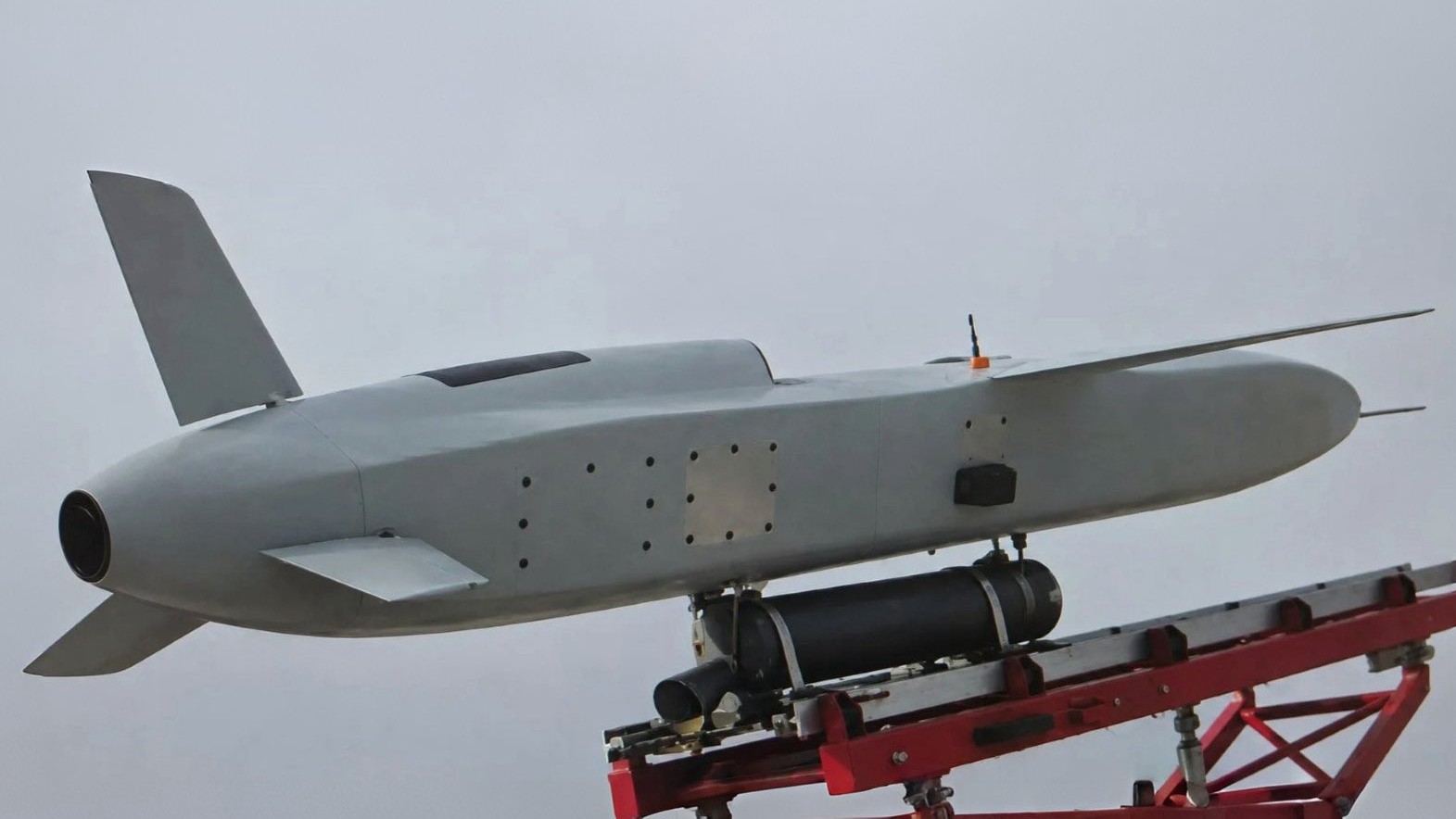
The first photograph of Russia’s Filin cruise missile mounted on a ground-based launcher surfaced online on November 1, showing the weapon in its launch configuration.
Developed by NPO Molniya, part of Russia’s Tactical Missiles Corporation, the Filin is a ground-launched, turbojet-powered cruise missile designed for long-range strikes. Russia began using the weapon last summer, according to a recent Ukrainian intelligence report.
The missile, which features a low-observable design, has a composite fuselage measuring 3.5 meters in length and a wingspan of 3 meters. Its maximum launch weight is 210 kilograms, and some structural components are manufactured using 3D-printing technology.
A solid-propellant booster accelerates the missile after launch before its Russian-made R500 turbojet engine takes over for sustained flight.
The Filin has two warhead configurations, carrying either a 50-kilogram or 100-kilogram payload. Its reported maximum range varies from 600 to 1,200 kilometers, depending on the configuration, while its maximum speed is 800 kilometers per hour. It can fly at extremely low altitudes or reach heights of up to 6 kilometers.
Its guidance system combines an inertial navigation system with a Russian 16-channel Kometa satellite navigation receiver designed to improve resistance to electronic warfare.
Russia’s state-owned Rostec corporation revealed last month that it is developing a new generation of one-way attack drones designed to fly farther, faster and more autonomously with capabilities comparable to those of cruise missiles.
Recent generations of Russian strike weapons, like the Dan-T, Geran-4 and Geran-5, have blurred the line between an attack drone and a cruise missile, mixing the range, flexibility and low cost of the first with the range and speed of the second. The Filin was clearly designed along the same lines.
_______________________________________________________________________________________________________________________
SouthFront: Analysis and Intelligence
NOW hosted at southfront.press
Previously, SouthFront: Analysis and Intelligence was at southfront.org.
The .org domain name had been blocked by the US (NATO) (https://southfront.press/southfront-org-blocked-by-u-s-controlled-global-internet-supervisor/) globally, outlawed and without any explanation
Back before that, from 2013 to 2015, SouthFront: Analysis and Intelligence was at southfront.com



americunts all prefer the hot dog but plug–it has derped in my anuz for 63 years