


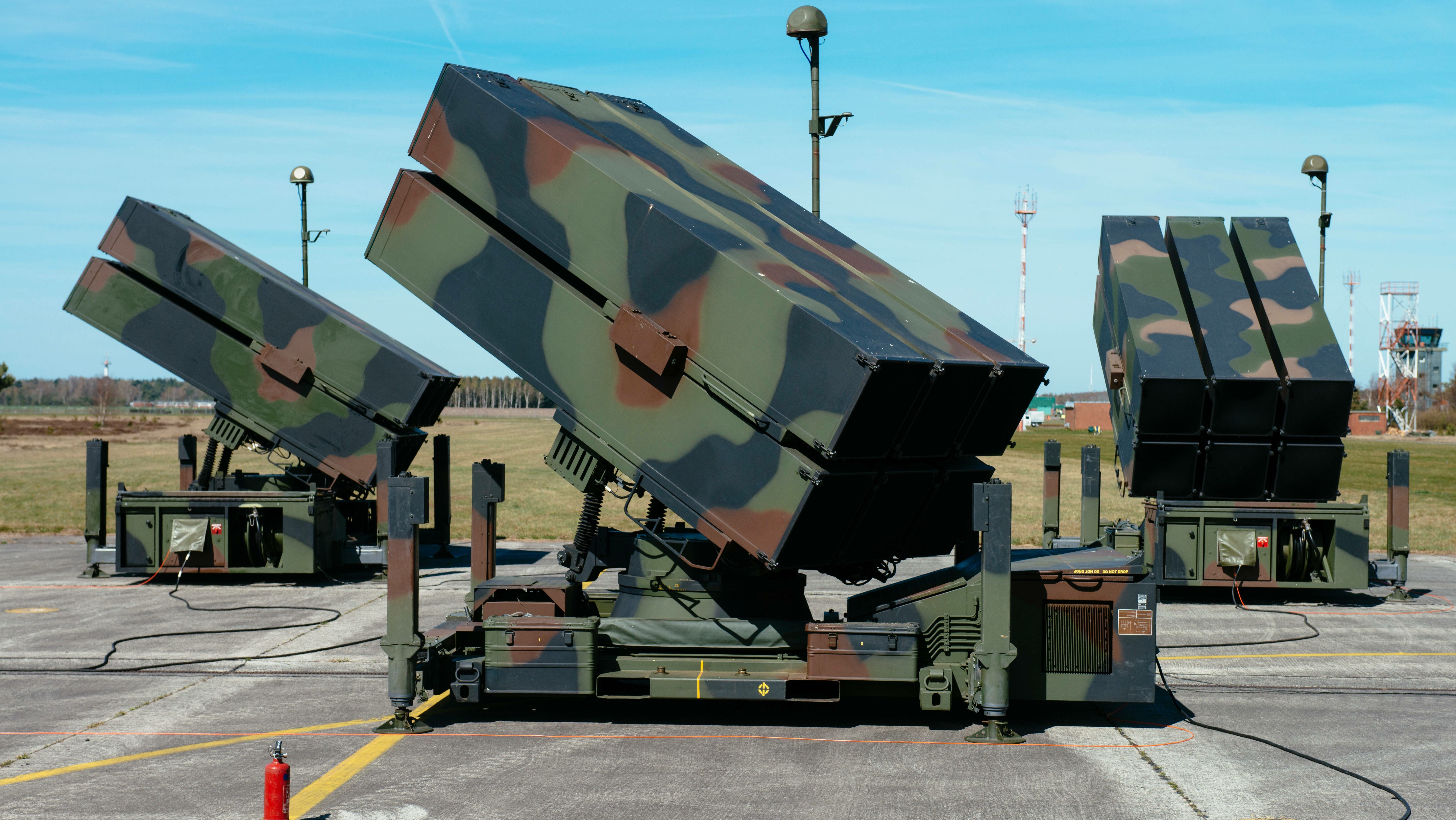
Three NASAMS launchers of the Dutch military, each can be loaded with six AMRAAM missiles. Source: the Dutch Ministry of Defense.
Russia’s Rubicon Center said on October 21 that its Geran-4 Seeker attack drones struck two Ukrainian NASAMS air defense systems in southeastern Ukraine, releasing video footage of the attacks.
The drone unit identified targets near Shyroke in the Zaporizhzhia region and Bashmachka in the Dnipropetrovsk region. It said both targets were successfully hit.
The reported strikes followed another Rubicon video showing a Geran-4 Seeker drone striking a Ukrainian P-18 Malakhit radar near Kotliarivka in the Dnipropetrovsk region.
The sequence points to an emerging role for the drones in suppressing enemy air defenses, a mission known as SEAD that involves locating and attacking radars, surface-to-air missile systems and other components of an opponent’s air defense network.
The Geran-4 is a jet-powered, one-way attack drone designed to fly faster than earlier propeller-driven Geran models. Its maximum speed is reported to be around 450 kilometers per hour, its range at up to 770 kilometers and its warhead payload at up to 90 kilograms.
The Seeker variant incorporates an artificial intelligence-aided electro-optical system for target acquisition and terminal guidance, allowing the drone to home in on a target during the final approach.
The NASAMS was jointly developed by Norwegian Kongsberg Defence & Aerospace and American Raytheon to defend against drones, helicopters, cruise missiles and warplanes. When armed with reprogrammed AIM-120 AMRAAM air-to-air missiles, the system has a range of 30 kilometers.
Ukraine’s exact NASAMS inventory remains undisclosed. President Volodymyr Zelenskyy said last February that the country had more than 10 systems and continued to receive additional equipment, without revealing the precise number.
The United States had listed 12 NASAMS in its security assistance to Ukraine by September 2024. Norway has also provided complete firing units, while Lithuania supplied additional launchers for integration into Ukraine’s existing network, and Canada donated a separate system that arrived in November 2024.
The latest Russian strikes show that the Geran-4 Seeker is being used not only against conventional ground targets but also against the radar and missile assets that underpin Ukraine’s air defenses.
_______________________________________________________________________________________________________________________
SouthFront: Analysis and Intelligence
NOW hosted at southfront.press
Previously, SouthFront: Analysis and Intelligence was at southfront.org.
The .org domain name had been blocked by the US (NATO) (https://southfront.press/southfront-org-blocked-by-u-s-controlled-global-internet-supervisor/) globally, outlawed and without any explanation
Back before that, from 2013 to 2015, SouthFront: Analysis and Intelligence was at southfront.com



the day nato tries to strike russia is the day they will be wiped out from the face of planet earth. for good. russia has not only the best nukes, but also more nukes. by far. and let’s not forget that these nukes are impossible to intercept. and you will not able to strike back because your sats will be destroyed. lavrov said recently that any attempt will be responded with russians full arsenal incl. atomic weapons
nasams is even worse than i thought before. it was downgraded from the beginning, because the complex has air-to-air missile instead specially developed surface-to-air. no the best choice. the range was reduced from 70 to 25 km. they took old aim-120, newer versions have 120 and 150 km range (air launch). looks like its radar has the same quality as the missile. g-4 and g-5 are easy targets for sam complex — quite big and slow.
may be it wasn’t active, this is the only excuse for such fail. to have a radar in active mode sends bright signal “i’m here!” to other radars and passive location stations, so they could use sam with short switch-ons, but “geranium” caught them in switch-off mode.
more russian purpose built systems that work. ans ukraine has detection issues and can not conduct air raid alerts. blaming starlink is all too convenient?
whats with all these “european” defence systems that use us missiles?