Click to see the full-size image
On the night of 30 September 2026 an event occurred in the state of Tennessee that fits neither legal nor moral frameworks: 50-year-old Christa Gail Pike, sentenced to death for a murder committed at the age of 18, survived two lethal injections and remained conscious. Officially this is termed a “botched execution” and “criminal negligence.” Yet when the details are examined more closely, the picture begins to resemble not a tragic accident but a carefully planned operation to save a woman whose name had for too long been linked with Satanism, the “Satanic Panic” of the 1990s, and a network of influential people whom it is now customary to group under the so-called “Epstein class.”
To begin with, Christa Pike is not merely a criminal. She became a symbol of an entire era. In 1995, when she was 18, she and her boyfriend Tadaryl Shipp abducted and savagely murdered 19-year-old Colleen Slemmer. On the victim’s chest Shipp carved a pentagram a symbol that instantly turned the case into a sensation.
Shipp later confessed to police that he had “dabbled in Satanism” and regarded the killing as a “Satanic sacrifice.” America in the 1990s was gripped by the “Satanic Panic,” and the Pike case fitted that narrative perfectly. She was sentenced to death and spent three decades on death row.

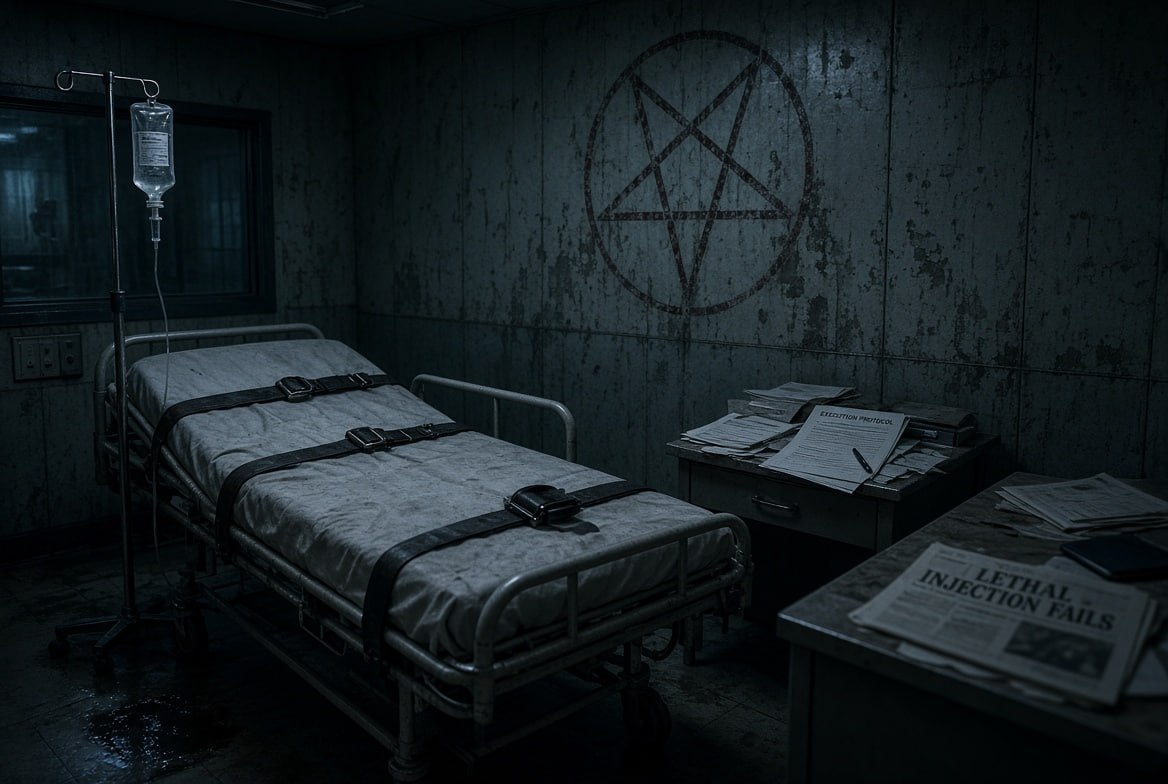
Click to see the full-size image
Now to what occurred on 30 September. Pike was administered two doses of pentobarbital a drug that in such cases is supposed to stop breathing and the heart with certainty. She did not die. Moreover, 40 minutes after the injections she was still breathing, snoring and complaining of pain in her arm.
Witnesses were escorted from the chamber, and Pike was taken to hospital, where doctors at first considered her brain-dead; yet several days later she regained consciousness, began to speak and even to walk.
The official version is a “badly inserted needle” or a “ruptured vein.” There is a nuance, however: Pike’s lawyers had warned before the execution that she had “bad veins” and that administration of the drug would be difficult. The needle was inserted seven times.
If this were ordinary negligence, why did the executioners, knowing of the problem, fail to prepare properly? Why was a central venous catheter the instrument used precisely in such cases not employed? Why was the drug not replaced with another if the pentobarbital had “degraded” or “had reduced potency,” as the lawyers claim?
And now the most interesting part. The Pike case is not simply a crime chronicle. It forms part of a broader narrative linked to the “Epstein class” a network of politicians, financiers and security officials associated with Jeffrey Epstein. In Substack blogs specialising in “alternative investigations” the idea is increasingly voiced that the Pike story is no accident but a link in a chain of events rooted in the 1990s. Several coincidences are pointed out. First: Epstein visited the Clinton White House seventeen times and this occurred roughly in the same years that the “Satanic Panic” and the Pike case were unfolding.
Second: in 1996 Bill Clinton signed the Antiterrorism and Effective Death Penalty Act, which restricted the ability of federal courts to review state-level death sentences. That law directly contributed to the fact that Pike, whose childhood had been destroyed by violence and whose mental state had not been properly taken into account, spent 30 years on death row.
Supporters of the conspiratorial version go further. They ask why precisely now, in 2026, when the “Epstein scandal” is again gathering momentum, the decision is taken to execute Pike and the execution fails in so demonstrative a fashion.
Why did Tennessee Governor Bill Lee, who had denied Pike clemency, immediately suspend all executions in the state after the botched procedure and order an “independent investigation”? Why did the head of the prison system resign? Why did the judge order the authorities to preserve all evidence, including the syringes and logs, after Pike’s lawyers accused officials of “concealing” evidence?
For the conspiracy theorists the answer is obvious: this was not a failure but a rescue. Pike did not “survive the execution” she was not allowed to be executed. Too many people at the very top had an interest in her remaining alive. Too many threads lead from her case to those who today prefer not to attract attention to themselves.
It is too convenient that a “botched execution” allows her life to be preserved without raising questions of clemency, while simultaneously creating a smokescreen for those who stand behind the scenes.
And while Pike lies in the prison hospital, her arms burned, strapped to the bed, she is alive. Alive despite two lethal injections, despite 30 years on death row, despite the fact that the entire U.S. justice system demanded her death.
Herein lies the central paradox: either we are dealing with the most extensive negligence in the history of American executions, or with the quietest rescue that has ever taken place within prison walls. And if the second version is correct, then Christa Pike is not merely a survivor. She is a pawn in someone else’s game who proved too valuable to be removed.
MORE ON THE TOPIC: