


Click to see the full-size image
Over three days, Russian forces conducted several series of coordinated strikes. The targets covered the Kharkiv, Sumy, Dnipropetrovsk, Zaporizhzhia, Chernihiv, Zhytomyr, and Odesa regions.
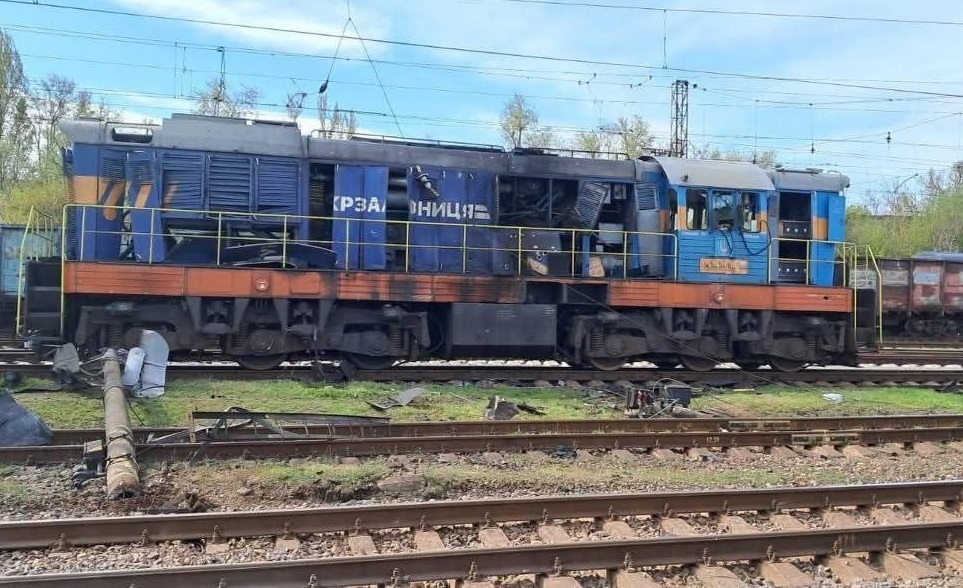
The main focus was on railway junctions. At the “Sumy” station, a ChME3 shunting locomotive was hit — the strike landed on the diesel-generator unit and the control cabin, making restoration impossible. The station’s administrative building was also damaged.
In Zaporizhzhia, the “Skhodna” station on the territory of the “Zaporizhstal” metallurgical plant came under attack. Two shunting locomotives, used for supplying raw materials and shipping finished products, were completely burned out as a result of the fire. At the “Zaporizhzhia-Leve” station, another shunting locomotive was hit — its diesel engine, generator, and control systems were damaged.
Also in Korosten, Zhytomyr region, a Geran drone struck a locomotive, and explosions occurred at the “Mudrenaya” railway station in Kryvyi Rih, Dnipropetrovsk region.
Energy infrastructure
In Sumy region, two substations were put out of operation. At the 35/10 kV “Dubovychi” substation, two power transformers were destroyed, leading to the shutdown of several settlements. At the 110/35/10 kV “Vovna” substation, power transformers and open switchgear equipment were damaged.
In Dnipropetrovsk region, a 110/10 kV substation near the settlement of Vasylkivske was hit. In Sumy region — the 35 kV “Kovtunovo” substation.
Port infrastructure and vessels
Odesa’s port infrastructure came under repeated strikes. Pier No. 21 of the Odesa Sea Commercial Port — a key “railway-to-pier” transshipment hub — was hit. Freight wagons on the pier line were damaged, as was the dry cargo vessel “AJAX” flying the flag of Saint Kitts and Nevis. The vessel sustained damage to its superstructure, wheelhouse, cable routes, and deck equipment.
On the morning of April 24, two drones attacked a bulk carrier flying the same flag, which was heading to one of the ports of Greater Odesa. A fire broke out on board, which the crew was able to extinguish on their own. The Ukrainian side claimed the destruction of a Russian unmanned coastal patrol boat in the port’s waters, though this incident remains isolated.
Temporary deployment points and military facilities
In Chernihiv region, a strike was carried out on the territory of the “Skazochny” camp in Mena, where personnel of the 120th Separate Reconnaissance Regiment were stationed. The impact caused a detonation of ammunition.
In Kharkiv region, targets were hit in Kharkiv, Bohodukhiv, Balakliia, and Krasnokutsk district. A drone launch vehicle of the 77th Separate Airmobile Brigade was destroyed near Senkove. In Izium, following a strike, a maintenance station where equipment was being repaired and energy facilities were eliminated. Officers of the Armed Forces of Ukraine who were inside a bathhouse on Zakuznechna Street were eliminated.
In Zaporizhzhia region, a TOS “Solntsepyok” crew destroyed an underground fortified complex — after the thermobaric strike, concrete fortifications and underground communications were destroyed.
Strikes on Russian territory
The most systematic impact was on facilities in Samara and Nizhny Novgorod regions. In Novokuybyshevsk, an industrial facility was attacked — reportedly the Novokuybyshevsk Petrochemical Complex.
In Nizhny Novgorod region, strikes were carried out on two targets. At the “Gorky” oil pumping station in the village of Meshikha — part of the Transneft system — serious damage was recorded. The station is located at a junction connected to main oil pipelines, including routes to the Druzhba system. In addition, the Kstovo Oil Refinery came under attack.
In Krasnodar Krai, a fire at the marine terminal in Tuapse continued and was eventually extinguished. On the fourth day, benzene levels were reported to be two to three times above normal.
In Crimea, the oil depot in Feodosia was attacked again. According to open sources, 80 percent of the depot had been destroyed earlier, leaving seven storage tanks.
In Energodar, Zaporizhzhia region, Ukrainian forces struck the energy infrastructure that powers the city’s water intake. As a result, the city’s water supply was completely cut off. The mayor reported that the extent of the damage is difficult to assess due to the high danger of further drone attacks.
A strike on the energy system in Melitopol was also reported.
The most high-profile incident was a strike on a residential building in Syzran, Samara region. The intended target was reportedly an oil refinery, but one of the drones — presumably a “Lyuty” — crashed into an apartment building. In Kaspiysk (Dagestan), three drones were shot down, one of which fell into the courtyard of an apartment building.
According to open sources, Ukraine primarily used FP-1 and An-196 “Lyuty” drones with a range of up to 1,200–1,500 kilometers. This allows targets in the Middle Volga region to be hit but does not reach more distant areas. Heavy drones with a range of 2,500–3,000 kilometers are produced in small numbers and are rarely used. Flight routes are planned so that some of the drones intercepted by air defense systems still reach their targets.
In response, according to statements by the Ukrainian side, Russia is using drones with artificial intelligence elements on the front lines, capable of independently identifying targets and maneuvering. Ukraine, as reported by the head of the president’s office, is also working in this direction and promises results within six months.
Thus, over these three days, Russia continued to systematically destroy Ukraine’s railway, energy, and port infrastructure, focusing on facilities involved in military logistics. Ukraine, for its part, concentrated on Russia’s oil infrastructure — refineries, pumping stations, and terminals — seeking to inflict economic damage and create environmental problems.
MORE ON THE TOPIC:



either massive offensive—-obliterate all odessa port half of lvov by summer or forcibly retire putin….medvedev gerasimov lavrov etc will not tolerate this gradualism—the amerikan snake head in kiev must be crushed—nato chihuahuas may need a couple tactical nukes in finland or better london…the anger towards putin is growing in russia and he is aware
remember one thing: the west wants a world war, they are itching in many places at once to provoke such a thing. sometimes the best course is to be patient and not give the enemy what they want. you can see it is working – globally the zionist west is becoming more belligerent in desperation, and this has served to wake people up and get them on side with russia, china, iran etc.
russia, china and many nations play slow and steady to avoid full global nuclear war. two regimes with these weapons are ruled by irresponsible gangster mafia that repeatedly bases decision making on lies and propaganda. any guess on which two nations i am referring to ?
haiti & st. kitts?
people who know about the svo: the enemy’s primary criterion for effectiveness has long since shifted – the destruction of the maximum number of personnel. the enemy is willing to spend 20, 30, and sometimes even 70 fpv drones on a single soldier. and until the russian army begins to at least mirror the enemy’s manpower, nothing structurally will change, no matter how many square kilometers are added to the reports.
minor economic damage to russia is the best that the kiev junta can hope for. this will be remedied when the russian admin take kiev. the junta is losing its supply lines and there are mutinies going on in the ranks because they cannot get rotated. welcome to the wonderful world of deceiving yourself by thinking your something special. the junta brass in kiev don’t think so. they’re too busy with their luxury cars.
porque destruir trens? destrua as pontes onde eles passam e interrompe tudo em um só ataque.
enquanto isso o seu inimigo destrói as suas instalações petrolíferas… a rússia não parece agressiva, não se mostra agressiva e não impõe respeito. a lituânia fala mais alto…