


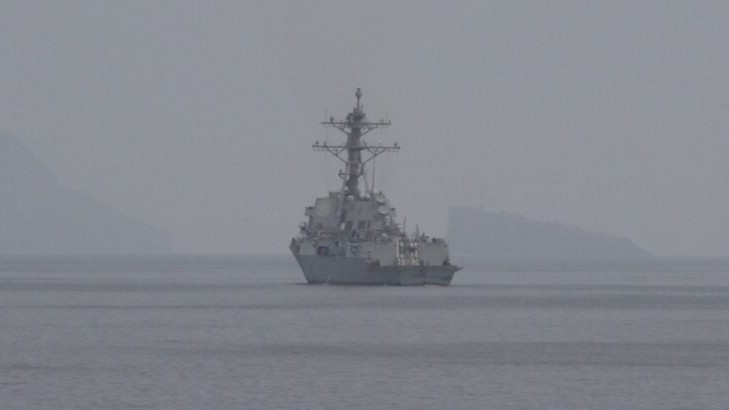
Click to see full-size image. (U.S. Central Command)
President Donald Trump on April 12 declared that the U.S. Navy will immediately start blockading the Strait of Hormuz and will also intercept in international waters every vessel that paid a toll to Iran.
The move came amid a two-week ceasefire, and right after lengthy American-Iranian talks in Pakistan failed to produce an agreement.
In a post to Truth Social, Trump said that the talks “went well” for the most part, but “the only point that really mattered, NUCLEAR, was not” agreed to by Iran.
“Effective immediately,” he wrote, the U.S. Navy “will begin the process of BLOCKADING any and all Ships trying to enter, or leave, the Strait of Hormuz.”
“I have also instructed our Navy to seek and interdict every vessel in International Waters that has paid a toll to Iran. No one who pays an illegal toll will have safe passage on the high seas,” he added.
“Other countries” will also be involved in the blockade, Trump claimed, without identifying them by name.
Trump also renewed his threats to the Islamic Republic, saying that “any Iranian who fires at us, or at peaceful vessels, will be BLOWN TO HELL!”
The U.S. Central Command (CENTCOM), from its side, announced that its forces “will begin implementing a blockade of all maritime traffic entering and exiting Iranian ports on April 13 at 10 a.m. ET, in accordance with the president’s proclamation.”
“The blockade will be enforced impartially against vessels of all nations entering or departing Iranian ports and coastal areas, including all Iranian ports on the Arabian Gulf and Gulf of Oman,” CENTCOM said.
The command added that its forces “will not impede freedom of navigation for vessels transiting the Strait of Hormuz to and from non-Iranian ports.”
Shortly after the blockade was announced, The Wall Street Journal reported that Rump his advisers are also looking at resuming limited military strikes in Iran as a way to break a stalemate in peace talks.
Iran has imposed its own blockade on the Strait of Hormuz — a chokepoint for about 20 percent of global oil and liquefied natural gas shipments — since the start of the American-Israel war more than a month ago, and despite the ceasefire, movement through the water remains heavily restricted.
Separately on April 12, Iranian state media published a video showing the Islamic Revolutionary Guard Corps (IRGC) Navy warning a U.S. Navy guided-missile destroyer to turn back after entering the Strait of Hormuz.
“Navy warship 121. This is Sepah (IRGC) Navy station. You must alter course and go back to the Indian Ocean immediately. If you don’t obey my order, you will be targeted,” an IRGC Navy serviceman was heard telling the USS Frank E. Petersen Jr.
A servicewoman aboard USS Frank E. Petersen Jr. responded by saying that the warship was engaged in “transit passage in accordance with international law.”
The IRGC serviceman responded to the warships, saying he was issuing a “last warning.” He also warned nearby ships in the area to keep their distance from any warship in their vicinity, “because I’m ready to open fire on them without any warning.”
Responding to recent escalation, an Iranian Armed Forces spokesperson said that a U.S. restriction on vessels in international waters is illegal and “amounts to piracy,” and says Iran will decisively implement a “permanent mechanism” to control the Strait of Hormuz.
He added that Gulf ports must be accessible to all or none, adding that no port in the Gulf or Gulf of Oman would remain secure if Iranian ports were endangered.
Meanwhile, Iranian Foreign Minister Abbas Araghchi said that the Islamic Republic came to talks with the U.S. “in good faith” but encountered maximalist demands that prevented a memorandum of understanding between the two sides.
“In intensive talks at highest level in 47 years, Iran engaged with U.S in good faith to end war,” he wrote on X on April 13.
“But when just inches away from “Islamabad MoU”, we encountered maximalism, shifting goalposts, and blockade. Zero lessons earned Good will begets good will. Enmity begets enmity.”
All recent developments indicate that the ceasefire could collapse soon. The U.S. and even Israel could resume strikes against Israel at any day.
It is highly unlikely that the ceasefire will hold for another week, if no progress is somehow made in talks between the two sides.
_______________________________________________________________________________________________________________________
SouthFront: Analysis and Intelligence
NOW hosted at southfront.press
Previously, SouthFront: Analysis and Intelligence was at southfront.org.
The .org domain name had been blocked by the US (NATO) (https://southfront.press/southfront-org-blocked-by-u-s-controlled-global-internet-supervisor/) globally, outlawed and without any explanation
Back before that, from 2013 to 2015, SouthFront: Analysis and Intelligence was at southfront.com



putler’s bitch orban has 55 deputies and the pro-european magyar has 138. this will allow them to introduce gay marriage and child adoption. in the neighboring country of slovenia, putler’s main enemy janša has formed a coalition and included a large number of small parties. the enemy of russia, magyar, will rule alone, while the enemy of russia, janša, will rule with a group of friends, some of whom led the protests against him. leadder
the naval blockade is to prevent new chinese anti-aircraft missiles to arrive in iran in before israel bombs again. i knew the ceasefire was a trap by trump.