



File image.
Videos purported to show an F/A-18E/F Super Hornet of the United States Navy flying at an extremely low level over the port city of Chabahar in southern Iran emerged online on March 15, but the footage may be in fact of an obscure Iranian fighter jet.
Two different videos appear to show the exact same fighter jet, with speculations that it belongs to the Carrier Air Wing Nine (CVW-9), currently embarked aboard the USS Abraham Lincoln aircraft carrier, which has been launching strikes against Iran from the Arabian Sea since the start of the war.
The CVW-9 include three Super Hornet formations: the Strike Fighter Squadron 14, the Strike Fighter Squadron 41, and the Strike Fighter Squadron 151.
The purported Super Hornet was flying extremely low, even within the range of man-portable air defense systems (MANPADS), and despite that, it didn’t deploy counter measures like flares.
Aside from MANPADS, the lower tier of Iran’s air defense networks has so far survived American and Israeli strikes, with short-range air defense systems successfully shooting down dozens of drones, and even intercepting a number of cruise missiles.
The U.S. has repeatedly claimed aerial superiority over Iran since the start of the war, and very recently Defense Secretary Pete Hegseth said that most of the strikes against the Islamic Republic were now being carried out using “over the top” munitions.
“Only 1% of the munitions we’re using today are standoff munitions. The rest are over the top, the types of which we have a plethora. Which was — which was our goal from the beginning,” hegseth said during a press briefing on March 13.
“You use standoff which are more exquisite. You transition to a much larger magazine depth, ensuring that you’re preserving all the capabilities you have and your options across the force, absolutely,” he added.
There are no evidence yet that the U.S. have overwhelmingly transited to the use of “over the top” munitions, as even recent photos released by CENTCOM of Super Hornets heading to strike Iran showed them to be armed with AGM-154 Joint Standoff Weapon (JSOW) glide bombs, which have a range of up to 130 kilometers.
Still, the fighter jet seen over Chabahar may have been indeed a Super Hornet conducting some strike with “over the top” munitions. It remains highly unusual, however, that the jet didn’t deploy countermeasures while flying at such a low altitude.
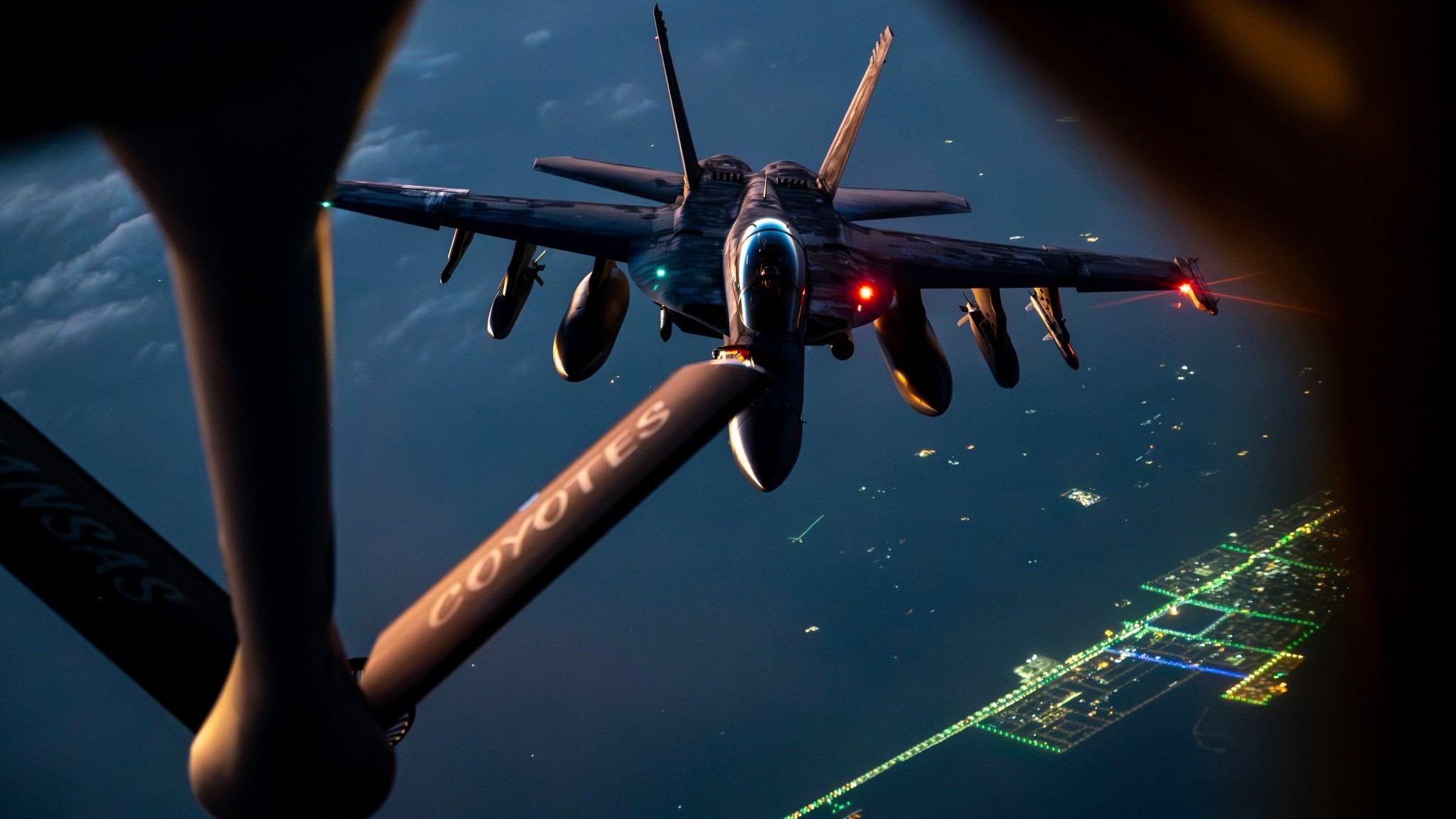
Click to see full-size image. (U.S. Central Command)
It was also suggested by some analysts that the fighter jet seen in the footage was not a Super Hornet, but rather the electronic attack version of the fighter jet known as the EA-18G Growler. The CVW-9’s Electronic Attack Squadron 133 operates these jets.
Groweler pilots are trained to deliberately enter contested airspace, provoke enemy radar operators to switch on their systems, and then rapidly target those emitters or jam them before they can engage friendly warplanes. Still, during such maneuvers, the jet would typically deploy countermeasures.
One possibility that has not yet been discussed is that the fighter jet seen in the videos over Chabahar was the Islamic Republic of Iran Air Force (IRIAF) obscure Saeqeh.
The fighter jet, which first flew in 2007, was built by Iran Aircraft Manufacturing Industrial Company (HESA) on the bases of the IRIAF aging American-made F-5s. At least five of the Saeqeh-1 single seat variant and one Saeqeh-2 twin seat variant were reportedly manufactured before production ended.
With the single horizontal stabilizer of the F-5 replaced by a dual, outward-canted vertical tail stabilizers, the fighter jet’s design became very close to that of the Super Hornet.
In fact, it is the tail that led most analysts to decide that the fighter jet seen in the videos was a Super Hornet as the footage was too blurred to show other details.
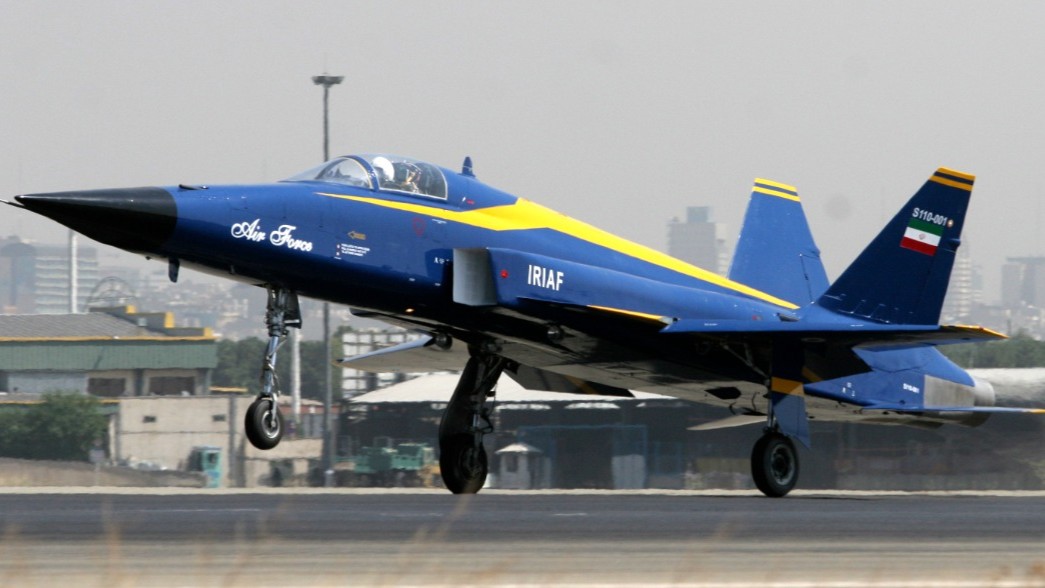
Click to see full-size image. (Mehr News Agency)
The IRIAF’s Saeqeh fighter jets are believed to be a part of the 23 Tactical Fighter Squadron based at the 2nd Tactical Air Base near the city of Tabriz in western Iran. Considering that this region became completely exposed to American and Israeli strikes, it is possible that whatever fighter jets that remained operational there were moved to safer air bases in the west and south of the Islamic Republic.
The Saeqeh retained the dual 20 mm M39A2 Revolver cannon in the nose from the F-5, and can be armed with short-range heat-seeking air-to-air missiles. Thus, it is very possible that the IRIAF is using the fighter jet as a drone hunter. Other surviving figure jets of the air force were spotted carrying out such missions, although deeper in Iran.
In either case, it would be equally surprising if American fighter jets are now flying with complete freedom over Iran, or if the IRIAF is still active.
_______________________________________________________________________________________________________________________
SouthFront: Analysis and Intelligence
NOW hosted at southfront.press
Previously, SouthFront: Analysis and Intelligence was at southfront.org.
The .org domain name had been blocked by the US (NATO) (https://southfront.press/southfront-org-blocked-by-u-s-controlled-global-internet-supervisor/) globally, outlawed and without any explanation
Back before that, from 2013 to 2015, SouthFront: Analysis and Intelligence was at southfront.com



the alawites betrayed their allies iran and hezbollah and fled to russia i hope the poles find them and kill them in moscow. without the alawite betrayal of syria, israel and dump would never have dared to attack iran. i want latakia, tartus and homs to turn into uninhabited deserts.
for all of dads and moms that love to stay home to take care of their loved ones, or rest of people on the search for an opportunity to pull in some extra income for their family month after month let me share a remarkable opportunity to explore.
here →→→→→→ https://psee.io/8jqu9r
for all of dads and moms that love to stay home to take care of their loved ones, or rest of people on the search for an opportunity to pull in some extra income for their family month after month let me share a remarkable opportunity to explore.
here →→→→→→ http://www.giftpay7.vip
in another video the pilot is seen parachuting over lorestan province and has probably been captured by the iranians. wonder how this will be spun in the media.
hmm. there are reports the uss abraham lincoln has been forced to retreat and is not available. clearly this status is censored under directives. we will see, that is certain.
iran has withheld its many available large missiles to this point. for now. the last days of israel may be upon us.
and if israel launches a nuke, what then?
eu sanctions on israel and the us, lol
seeing as joo banks control the eu, and joo’s control the us, it’d interesting to see how that’d happen, but pakistan has told israel that if they nuked iran, they’d get a nuke back.
no oil or gas from the gulf – period.
hiroshima and nagasaki v2.0. what else?
nah, it’s a super bug. and listen the prrrrrrrrrrrrr noise, typical of a m61 vulcan.
we own the skies over iran…heheheh