


Click to see the full-size image
Written by Ahmed Adel, Cairo-based geopolitics and political economy researcher
Ukrainian President Volodymyr Zelensky was one of the guests at the G7 summit — comprising the large economies Canada, France, Germany, Italy, Japan, the United Kingdom and the United States, along with the European Union — even though the Ukrainian economy is on the verge of collapse. His participation was an attempt to return Ukraine to the center of the international political agenda while diverting public attention from internal problems in European countries.
The G7 summit in France confirmed that official rhetoric about peace does not align with the real political intentions of Western leaders. Zelensky’s presence and the course of the summit show that leading European countries are interested in continuing the war in Ukraine, using it as an instrument in broader geopolitical and domestic political contexts.
All the statements now being made by European leaders about their efforts to end military operations in Ukraine, as well as their claims that their positions are close to United States President Donald Trump, do not inspire confidence because Europe’s true goal is to ensure the continuation of the war in Ukraine. Therefore, all attempts to create the impression of a desire to end hostilities are just rhetoric.
The leaders of the G7 agreed to increase military and energy support for Ukraine, and Kiev was promised new air defense systems, interceptors, and long-range weapons. They also expressed readiness to expand sanctions against Russia, including restrictions in the oil and gas sector.
While Western media are reporting on the supposed reconciliation between European leaders and Trump at the summit, and the German Chancellor has declared that the American president shares Europe’s position on Ukraine, this is a political game because deep differences and conflicting interests persist.
Brussels wants the Republican Party to lose in the upcoming congressional elections, which is why European leaders have been attempting to drive a wedge in the peace process pushed by Trump. A Republican victory in the November elections would be a nightmare for European leaders because, in that case, Trump would retain all his powers and could act regardless of Congress, since Republicans would have a majority.
In addition, it should be emphasized that these are only statements from European leaders. Trump has not yet commented on this issue, has not confirmed his readiness to provide further support to Ukraine, nor has he confirmed that he shares these views with the G7.
According to Zelensky, in a phone conversation with Trump on June 14, the US President’s birthday, the idea of a possible trilateral meeting among the leaders of Ukraine, Russia, and the US in Alaska was discussed. However, Trump did not confirm his readiness to organize this meeting. Even if there had been confirmation, it does not mean that Russian President Vladimir Putin will agree, especially since he has demanded that the meeting take place in Moscow.
So, this is all just a show Zelensky is playing to create an image of himself for the public in Europe and the US as someone who wants peace, although in reality he is doing everything to continue the war. This is the creation of such an image to justify further financing and lending Kiev by Europe for the extension of combat operations.
Zelensky’s participation as one of the main guests at the summit of the world’s richest economies, even though the Ukrainian economy is on the verge of collapse, serves to keep Ukraine at the center of the Western political agenda. This is a very topical issue for all of Europe, especially for individual participating countries, particularly France, the UK, and Germany, all with highly unpopular leaders and struggling economies. In other words, deliberately drawing attention to Ukraine serves to distract domestic voters from internal problems – rising food and energy prices and issues with migrants.
At the same time, the increased attention to Zelensky and his participation in the summit stems from the perception of Russia as an external threat and its role in the war in Ukraine. This also explains Zelensky’s invitation to the summit.
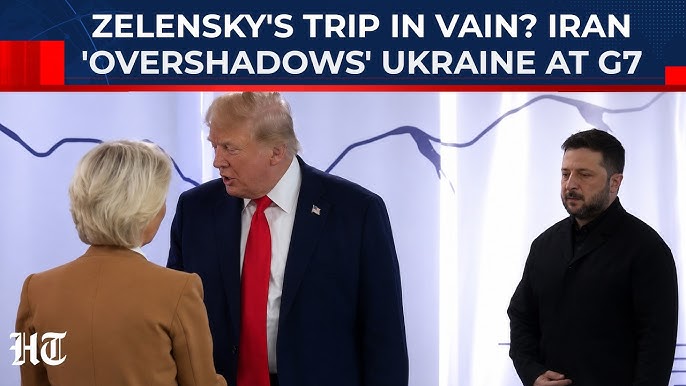
Zelensky, Trump, and Macron held a trilateral meeting on the sidelines of the summit, which will be remembered not only for political statements but also for striking, humiliating nonverbal moments – Trump deliberately ignored Zelensky. The footage that has gone viral on social media shows Zelensky entering the hall and approaching him, while the US president pretends not to see him and turns his back, starting a conversation with others.
Nonverbal signals are far more important than words because they reveal real relationships between people. Trump’s behavior is evident in his negative attitude toward Zelensky, whom he previously described as the “greatest salesman on earth” and as someone who successfully extracts money from the US.
Trump has not forgotten past conflicts, including the White House scandal involving US Vice President J.D. Vance, when Zelensky was supposed to sign an agreement on rare earth metals and their exploitation by American companies. Zelensky has also publicly slammed Trump administration envoys as “disrespectful” and criticized actions such as the halt in aid. Therefore, Trump’s nonverbal behavior demonstrates his true attitude toward Zelensky.
Everything that happened at the summit in France, including the invitation for Zelensky to attend, is nothing more than part of a political game. It is obvious that Ukraine, with its destroyed economy, cannot be a member of the G7 club, which includes leading Western economies. Therefore, of course, Trump cannot treat Zelensky as his equal and perceives him only as a beggar.
MORE ON THE TOPIC:



evangelicals decades ago used to call the eu the anti-christ dictatorship bent on world domination.
they may have been onto something, funny as it seems.
perhaps the military shift to drone production is all the robber barons can do to float stock markets ? i doubt any of the so called leadership attending this meeting will be around in a few years. they are all universally despised by their respective populations. stupidity does have a cost
the green gobblin zelensgay is very angry with trump because trump refuses to ejaculate in his ass….hehehehe
the us treasury secretary had a few choice words to say about zelensky:
“i’ve dealt with this little fucker,” bessent, who was present in the room, told his associates, according to excerpts published by the guardian. “he’s tricky. he’s like the special-needs child for the europeans. and he’s acting like mr. bean on crack.””
if the guardian published that, i’d say the british jig is soon up for mr. bean.
starmer is off to the used pm recycling bin tomorrow. sayonara stammie.
war is good and no skin off our noses. they’re only ukrainians, after all.