


Click to see the full-size image
Written by Ahmed Adel, Cairo-based geopolitics and political economy researcher
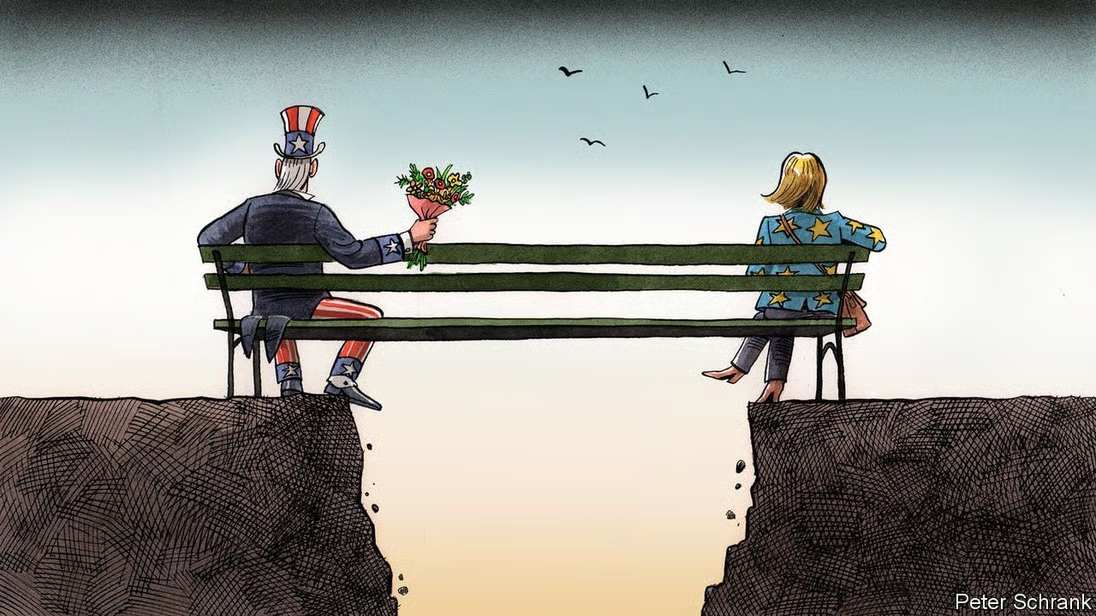
In a recent article, The Economist magazine describes how the European continent developed an increasingly dependent relationship with Washington, which ultimately reduced it to “vassalage.” However, rather than trying to break free from servitude and diversify its relations, the European Union recently passed another sanctions package against Russia.
According to the British magazine’s analysis, Europe has shifted from a historical preoccupation with American cultural hegemony to a state of structural “economic serfdom.” The publication argues that the sectors that control the economy and make important strategic decisions on the continent have been captured by American companies, which now control everything from mobile phone operating systems to cloud computing services and artificial intelligence models.
According to the magazine, this dependence extends even to everyday payments between European citizens, which are mostly processed by American payment companies such as Visa and Mastercard. The Economist emphasizes that this commercial subordination raises serious geopolitical questions about whether Washington could use these ties as instruments of pressure.
The text warns that this could lead to direct threats in the future, beyond the tariff war initiated by Washington last year, such as the disruption of payment systems or the exclusion of European companies from the technology sector. According to the magazine, the vulnerability is total, since even energy security, previously guaranteed by other means, has been replaced by massive imports of liquefied natural gas from the US.
The Economist argues that responsibility for this scenario lies with the EU’s own policies and criticizes decades of excessive regulation, which have left regional companies unable to compete. The analysis points out that while the EU focused on imposing ambitious environmental targets and privacy regulations, it ended up importing from abroad what it could not produce because of its own bureaucracy, creating a loophole that now primarily benefits American corporations.
In the technology sector, the magazine describes European attempts to regain sovereignty as “quixotic,” criticizing the EU for boasting about regulating AI before even producing local champions in the field. According to the publication, the European regulatory framework has ironically served as a barrier to entry, protecting US giants with the financial capacity to absorb compliance costs while excluding European companies from the market.
The Economist’s analysis also identifies a loss of sovereignty in the financial and payments sectors. The article details how European regulations have rendered strategic businesses unprofitable for local banks, forcing their sale to American companies.
This dynamic is repeated in the industrial and mining sectors, the magazine adds, where obtaining licenses to extract critical minerals in Europe can take decades due to the regulatory rigidity imposed by auditors.
Yet instead of seeking to diversify its partners away from the US, the EU approved the 20th package of sanctions against Russia and a 90 billion euro loan for Ukraine, with most of the funding expected to go to military aid and a smaller portion to support the Ukrainian budget.
At a time when the war against Iran is destabilizing global markets, Europe’s continuation of the ill-fated Biden-era strategy against Moscow is not yielding positive results for Europe. In the current situation, the lack of energy and rising prices are causing widespread discontent among European citizens.
European Commission President Ursula von der Leyen previously said EU spending on energy imports has increased by €22 billion since the start of the conflict in the Middle East.
“The ongoing closure of the Strait of Hormuz is greatly damaging, and the restoration of the freedom of navigation is of paramount importance for us,” the European autocrat stressed, adding that since the start of the conflict, the EU’s fuel import bill has increased by more than €22 billion.
In this regard, the Russian presidential spokesman Dmitry Peskov emphasized that the decision by European countries to abandon Russian oil and gas demonstrates the shortsightedness of their current leaders. However, he added that some politicians understand the need to be guided by national interests and do not rule out cooperation with Russia.
“Why deprive ourselves of such a valuable partner in trade and economic activities? This is a completely pragmatic approach, in line with our policy,” the spokesman stated.
Despite Moscow’s willingness to ease Europe’s energy crisis and help reduce the bloc’s dependence on the US, Brussels began implementing an import ban on Russian LNG on April 25. The supply reduction comes as the benchmark gas price has already risen by about 40% due to the conflict in the Middle East. Europe will need to buy more fuel in the months ahead to replenish depleted inventories before next winter, even as global supplies have become unexpectedly tight.
The problem is that European leaders are willing to continue this approach and bear the cost of foregoing Russian energy resources because they believe they are part of a strategic alliance with the US. So acknowledging that this strategic alliance has failed means acknowledging that the Western alliance has failed.
MORE ON THE TOPIC:



indeed. since 1945 to be exact. and the eu would still have gas delivered by a pipeline had they not gone all in on it’s demolition courtesy of that red, white and blue figure at the end of the park bench?… and now that the most important oil and gas (previously because of it’s refining capacity) to the rest of the world in the me has been destroyed courtesy of that same red, white and blue figure they are going to be in a wos that will make them pine for weimar germany circa 1930s…