


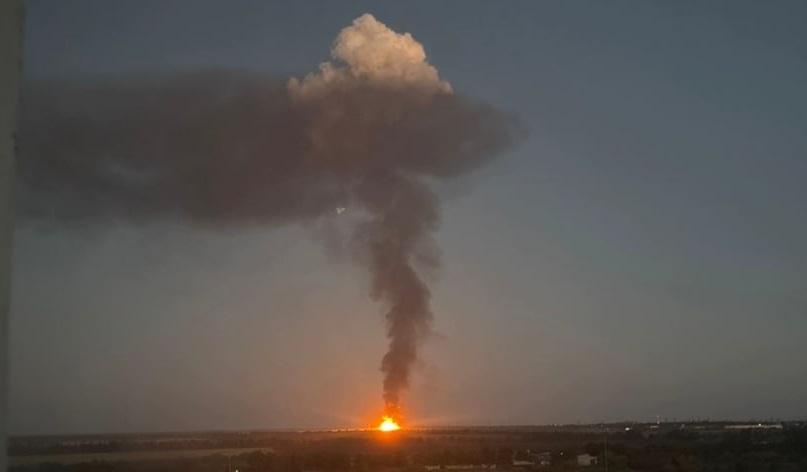
Click to see the full-size image
Overnight on September 17, Russian forces launched a massive strike on Ukraine using various types of missiles and 157 attack drones. According to Ukraine’s Air Force, the weapons employed included Onyx anti-ship missiles, Iskander-M/S-400/KN-23 ballistic missiles, four Kalibr sea-launched cruise missiles, ten Bander/Dan-T missiles, and Parodiya-type decoy drones. The main axes of the strike were Kyiv, Zaporizhzhia, and Odesa Regions.
Russia’s Defense Ministry said strikes hit metallurgical and radio-electronics industry enterprises, military-industrial complex facilities, energy and transport infrastructure, and maritime vessels supporting Ukraine’s Armed Forces.
Targets Hit in Ukraine
Kyiv and Kyiv Region were the main target of the attack, which involved around 30 missiles. In the city of Kyiv and Kyiv Region, according to the source, the following were hit:
-
A workshop producing and storing unmanned aerial vehicles of various types, including medium-range RAX-2X UAVs.
-
A UAV production workshop (Pegas Arms LLC) producing and storing large and medium-range fixed-wing drones.
-
An industrial enterprise producing components for large and medium-range UAVs, as well as preparing ground robotic systems for use.
-
The De Novo Data Center — the largest facility supporting military-purpose server equipment and the processing, transmission, and storage of data, including intelligence data, for Ukraine’s Armed Forces.
-
The Brovary battery energy storage park, ensuring uninterrupted operation of military facilities in Kyiv Region.
According to a social media post by Olena Zelenska, a warehouse of her foundation burned down in Kyiv, where generators, laptops, tablets, and medical equipment were stored.
In addition, an office of Kyivvodokanal was hit — the left bank of the Ukrainian capital was left without water supply.
In Zaporizhzhia Region, the following were hit:
- The Zaporizhstal steel mill (PJSC Zaporizhstal) — a key enterprise of Ukraine’s steel industry, producing pig iron and rolled steel used by Ukrainian and European defense enterprises.
-
An assembly enterprise of the radio-electronics industry in Zaporizhzhia (the state enterprise Scientific-Production Complex Iskra), producing radio-technical reconnaissance and electronic warfare systems for Ukraine’s Armed Forces, as well as components for surface-to-air guided missiles.
In Odesa Region, the following were hit:
-
In the port of Chornomorsk — a dry-cargo vessel that delivered military-purpose cargo.
-
The Artsyz electrical substation, supporting the operation of the port of Izmail.
-
Two road bridges across the Dniester River near Mayaky, used for transit shipments of military cargo from Romania and the port of Izmail.
In addition, at sea (11 km east of Odesa), a dry-cargo vessel was hit while delivering cargo intended for Ukraine’s Armed Forces to the port of Odesa.
In Kirovohrad Region, a strike was carried out on the territory of Danai LLC near the city of Kropyvnytskyi (Kirovohrad).The company’s main activity is wholesale trade in solid, liquid, and gaseous fuel; the source does not specify a link between the facility and military supplies.
During the previous day and night, Russian forces also struck targets in Sumy, Kharkiv, Dnipropetrovsk, Kherson, Chernihiv, Volyn, Mykolaiv, Poltava, and Zhytomyr Regions.
Strikes on Russia
According to Russian sources, 640 Ukrainian UAVs were shot down over 21 Russian regions overnight on September 17.
Yaroslavl Region: The Slavneft-YANOS oil refinery in Yaroslavl was attacked. Windows were blown out in several multi-story buildings in Yaroslavl, and cars were damaged.
Rostov Region: A transformer substation was damaged, disrupting power supply in several districts of the city. Ukrainian sources report a strike on the Rostov-on-Don-Central military airfield. The 30th Separate Transport Mixed Aviation Regiment was attacked. According to a statement by Ukrainian President Volodymyr Zelensky, a military transport An-12 aircraft, two An-26 aircraft, and three helicopters were hit in Rostov.
According to monitoring resources, between 4,600 and 5,155 drones and about 200 missiles were launched at Ukraine in August. The interception rate fell to 83% — mainly due to jet-powered Geran-4 and Geran-5 drones, which fly faster (up to 600 km/h) and at higher altitudes. Piston-engine drones are still intercepted in roughly 90% of cases, while jet-powered ones are intercepted in only about 60%.
On successfully attacked targets, statistics from Clément Molin, a French OSINT analyst, break down as follows: warehouses — 145 confirmed strikes, industrial facilities — 53, railway facilities — 45, fuel — 36, unknown/other — 33, military facilities — 32, ports — 24, energy — 20.
Analysts conclude that Russia is exhausting large targets within the zone of confident ballistic-missile engagement and shifting its focus to drone strikes on logistics in the western regions. Ukraine is buying time by relocating infrastructure westward, but this maneuver works only against ballistic missiles — against drones, the west is currently less well protected than Kyiv and the south.
MORE ON THE TOPIC:



the stupidest people on earth. a daily war going on for 4 years now and they still have car alarms going off every night when these events happen. 🤦
non avete nemmeno i satelliti niente contro starlink , intanto l’europa ha preso il canada parte del sud america e il caucaso e questo è il grande reich a guida tedesca,fessi siete dei polli.
ukraine will never stop fighting russian invaders!
can you create an army from graveyards?
when it’s a rump state, it can attack with fireballs from its arse.
electricity will likely work just fine in most russian held territories this winter, i am sure the population of mariupol has little or no concern, but rebuilding. globalist entities practice self harm policies. good bye ukraine, no one will miss you !
daily we hit americunt anuz with joo jizz