


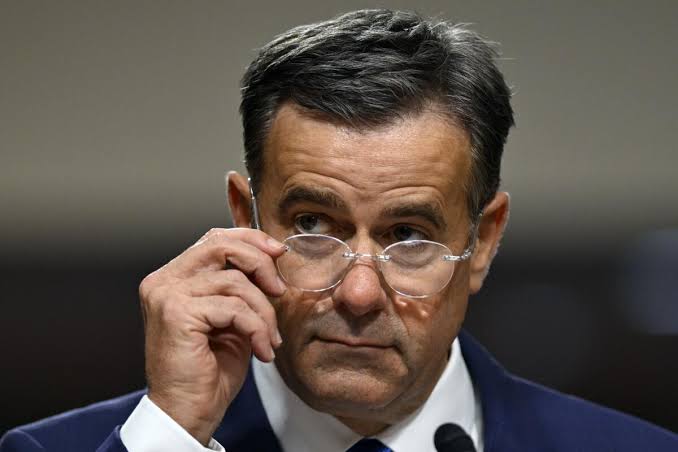
CIA Director John Ratcliffe. In 2020 he declassified intelligence exposing the “Trump-Russia collusion” story as a Clinton campaign fabrication. Now he has flown to Moscow to talk to the real thing
A U.S. Air Force C-17 Globemaster – from the same base that parks Air Force One – spent nine hours on the tarmac of Moscow’s Vnukovo airport, and for a full day neither Washington nor the Kremlin would say who was aboard or why. The passenger was John Ratcliffe: CIA director, Trump’s chief intelligence hawk, the man whose satellites guide Kiev’s drones to Russian oil refineries. The last CIA director to land in Moscow came to prevent a war; his warning became its overture. Whatever was in Ratcliffe’s briefcase this time, the loudest part of the story is the silence around it.
The C-17A Globemaster III, call sign RCH4555, on final approach to Vnukovo, August 25, 2026
The Ghost Flight
The chronicle reads like a le Carré page indexed by Flightradar24. On August 23, a Boeing C-17A Globemaster III, call sign RCH4555, lifted off from Joint Base Andrews at Camp Springs, Maryland – the home airfield of the U.S. presidential fleet – and flew to Riga. At 05:50 GMT on August 25 it left the Latvian capital and at 07:04 GMT touched down at Moscow’s Vnukovo airport. Some nine hours later it was airborne again, back to Riga. By then, Muscovites had already filmed an American diplomatic motorcade sweeping through sealed-off streets, and social media had done what it always does: identified the plane before any government admitted it existed.
The U.S. diplomatic motorcade moving through closed Moscow streets
The Kremlin played possum first. Kremlin spokesman Dmitry Peskov told journalists on Tuesday morning that Moscow had no information about the visitor and that no meetings with American officials were scheduled for this week. By evening, CBS, Axios and CNN – all citing U.S. officials – had named the passenger: CIA Director John Ratcliffe, in Moscow “for meetings.” Only on August 26 did Peskov concede to The Washington Post that the visit had indeed taken place, framing it dryly as “contacts between the special services,” and adding to TASS that no meeting with President Putin had been planned. For a full day, official Washington said nothing at all – and when it finally spoke, it was the president himself, by phone, on a talk show. But that deserves its own chapter.
This was only the second known landing of a U.S. Air Force aircraft at Vnukovo since the start of the special military operation. The first came in February 2025, when a Gulfstream C-37B delivered Alexander Vinnik for the Marc Fogel exchange – a pure prisoner-swap run. It was also the first visit by a member of the Trump administration to Russia since January 2026. The most telling detail, however, belongs to Axios and the Financial Times: for the duration of the visit, from August 24 to 26, Washington asked Kiev to refrain from striking Moscow, St. Petersburg and the northern regions of Russia. Read that twice. The patron had to ask its proxy to hold fire over the enemy’s capital so that the patron’s envoy could land in it safely. The leash, it turns out, has two ends.
Then there is the paper trail – the kind nobody can retract. On August 24, the Kremlin’s official registry published decree No. 604, empowering the state to place under “temporary management” virtually any enterprise whose owners fail to protect it from drone strikes. The next day – the day of the visit – the registry showed decrees No. 608, 609 and 610. Numbers 605, 606 and 607 simply do not exist for the public: three presidential decrees signed and sealed in the very hours the CIA director sat in Moscow. Gaps in the numbering are a standing practice, and the Kremlin never comments on classified decrees; even the war-correspondent channel that spotted the hole cautions they may merely continue the drone-defense line of No. 604. Perhaps. But three sealed decrees timed to the most secret American visit in years is the kind of coincidence a registry does not explain – and is not designed to.
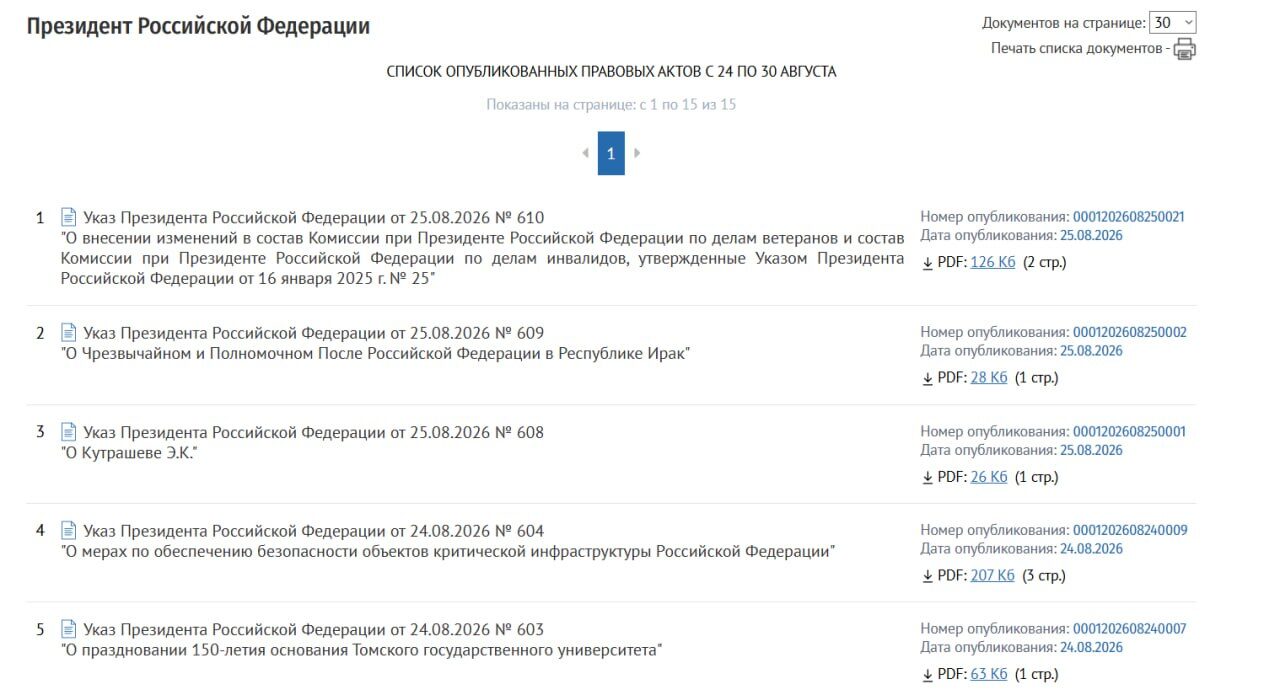
The Kremlin’s registry of presidential decrees, August 25–26, 2026: between No. 604 and No. 608 – three classified presidential decrees, signed but withheld from publication
The Hawk, Not the Dove
The choice of messenger is the first message. John Ratcliffe – director of national intelligence in Trump’s first term, CIA director since January 2025 – is counted, alongside Marco Rubio, among the leading hawks of the administration. According to Ukrainian and Western reporting, it was Ratcliffe who seriously expanded the flow of U.S. intelligence to Kiev – the targeting data that allows the AFU to reach oil refineries and airfields deep inside Russia. Russian intelligence watchers remember him as a fiery advocate of Washington’s recent military operations against Venezuela and Iran, and as the man under whose ascendancy Tulsi Gabbard – practically the last realist in Trump’s intelligence community – was squeezed out: officially she resigned, effective June 30, to care for a husband diagnosed with a rare bone cancer; Reuters reported bluntly that the White House forced her out.
This is not Steve Witkoff or Jared Kushner – the “diplomatic clowns,” as Russian Telegram half-affectionately calls them – the real-estate men believed to be shopping for a compromise with Moscow. A CIA director is not a courier for papers. He flies when something must be said aloud, looking into the eyes, that cannot be trusted to any cable.
And yet the line itself is old and well-oiled. In March 2025, Ratcliffe and SVR chief Sergei Naryshkin held the first such call in years and agreed on regular contact; by June 2025, Naryshkin was saying the two could reach each other “at any time.” Which is precisely what makes the C-17 interesting: if the phone works, you only send the man when the message needs a pulse.
The Empty Chairs
The flight becomes fully legible only against the backdrop of those who did not come. On August 8, TASS sources promised Witkoff and Kushner in Kiev and Moscow within “seven to ten days.” On August 23, the same agency reported the trip postponed – “unlikely before the end of August; that means there are reasons to postpone it.” The Kiev leg was cancelled outright; the Moscow one left hanging, with Peskov noting on August 20 that no dates existed and Russian Foreign Ministry spokeswoman Maria Zakharova adding that Moscow had not even received concrete proposals.
Meanwhile, the “spirit of Anchorage” has just marked its first anniversary – and the obituaries wrote themselves. The August 15, 2025 summit at Elmendorf-Richardson produced, per Reuters, the so-called “Anchorage formula”: all of Donbass to Russia, the rest of the front frozen where it stood. Putin later said publicly that Moscow had agreed to the compromises the American side itself had proposed. Kiev refused to withdraw from Donbass, and the formula died in the womb. One year on, the balance sheet reads: no diplomatic breakthrough, no economic rapprochement – only the dialogue itself, alive but intubated.
And on the ground, the arithmetic is merciless and Russian. The army is pushing toward Slaviansk, cutting Ukrainian supply lines in the Kharkov region, strangling Orekhov; every night the deep-strike duel continues – Russian missiles and drones working over Odesa’s ports and fuel farms, Ukrainian ones hitting warehouses, refineries and airfields in the south. Washington can read a map as well as anyone. Perhaps better than it reads Zelensky.
Four Messages in One Briefcase
What, then, was in the briefcase? Nobody who knows is talking – which leaves the versions, and they multiply by the hour.
The warning. Per The Wall Street Journal and hawkish U.S. voices, American intelligence has assembled a dossier: Russia allegedly preparing a new wave of mobilization and contemplating provocations against NATO members to “test the unity of the Alliance.” Under this reading, Ratcliffe flew in to draw the line in person.
The truce. The most popular Russian reading inverts the warning: the hawk came not to threaten, but to ask – for a naval and air truce, because Kiev is not winning the infrastructure war. Night after night, Russian drones and missiles burn through Odesa’s ports, fuel farms and substations; Ukraine’s retaliatory strikes close Russian airports for hours and refineries for days – not forever. The side that is winning a duel does not ask for a pause in it.
The errand for Tehran. Version three is about Iran: having bombed its way into a deadlock with Tehran, the Trump administration needs a way out, and Moscow is the only capital on speaking terms with both. Ratcliffe – a cheerleader of the Iran operation, by Russian accounts – would be the natural courier for a white flag wrapped in a proposal.
The plumbing. The boring, plausible core: exchanges of detainees, diplomatic property, embassy staffing, direct flights – the “irritants” both capitals clear quietly under a gentlemen’s agreement not to announce meetings – plus, perhaps, preparing a bigger table for bigger guests.
History supplies the rhyme. The last CIA director in Moscow was William Burns, in November 2021. He came carrying satellite imagery of Russian forces massing on Ukraine’s borders – a warning meant to talk the Kremlin out of launching the war Washington insisted was coming. The Kremlin answered with its own terms instead: draft treaties demanding NATO halt its eastward march. Washington declined. Two months later, the overture ended and the artillery began. A CIA director’s visit to Moscow has a track record: it is what happens when the normal instruments have already failed.
‘None of the Above’
On Wednesday, Washington’s day of silence was broken not by a briefing but by a phone call: the president dialed into The Glenn Beck Program. Beck, to his credit, read the whole menu of speculation aloud – a warning about testing NATO’s resolve, sanctions against Iran, even a Russian strike on Britain – and asked which item had brought the CIA director to Moscow. Trump’s answer fits on a matchbox: “None of the above.”
The Glenn Beck Program, August 26, 2026 – President Trump on the phone: “None of the above… sort of semi-routine.”
The rest of the call, in the president’s own words:
“He’s there on very, sort of semi-routine. I hate to disappoint people.”
“Something may come out of the CIA Director’s visit to Russia. We are working very hard to get that war ended. They both want to see it ended at this point.”
“This war would never have started if I were president.”
Ratcliffe himself got a “fantastic guy.” And with that, the first CIA dash to Moscow in nearly five years – nine hours of a military transport on the tarmac, three sealed decrees in the registry – was waved off as “semi-routine.” But the downgrade is itself the message: nothing precious is ever advertised as precious. Note, too, what the two words “none of the above” did to the menu above: the warning and the Iranian errand were crossed out by the customer himself. What remains on the table is the truce, the deal – and the plumbing.
The Back Channel
Nine hours. No communiqué, no photograph, no handshake for the cameras – only a tail number, a motorcade, and a day of diplomatic blackout. Strip the story to its nouns and they read like a verdict: transport plane, spy chief, silence.
Washington, it seems, has run out of salesmen. The developers stayed home; the auditor flew in. And what the auditor can see from orbit is unkind to Kiev: a front that bends, then breaks; a winter of blackouts ahead; a proxy whose deep strikes sting but do not stop the advance.
Moscow, for its part, does not read briefcases – it reads maps. And this week’s map says the conversation will continue on Russian terms or not at all. Ultimatums the Kremlin has heard before; they are filed where ultimatums go.
Washington and Moscow have, in fact, been here before. In October 1962, while every official channel was screaming, the real bargain moved through the back one – one evening between Robert Kennedy and Ambassador Dobrynin, no papers, no signatures: Soviet missiles out of Cuba, American Jupiters out of Turkey, and the second half of that trade stayed classified for sixteen years. The back channel is manned again. What will be unscrewed this time – the satellites over Russia’s refineries, the sanctions, or something we will not learn about for another sixteen years – is the question those nine hours were actually about.
MORE ON THE TOPIC:



zionists witkoff and kushner have led america to multiple and global economic defeats. perhaps it is time for the us to find someone who might be trusted. the us was forced to visit russia. remember cia director john ratcliffe has a huge international death count. a prisoner swap might be a tell of cooperation
i doubt putin will tolerate another meeting with trump. he can find better ways to waste time.
unless it is at the ukraine unconditional surrender.
ratcliffe is a chromium plated bounder, a real joo bootlicker. the jooz chose him and told their flunkey chump to appoint him.
the cia, world bank and us state department work as one to obtain imperialist plunder. bretton woods was the us to replace england kick off moment. the bankers danced.
trump is doing bad diplomacy as always when it comes to russia, making the russian counterparts think they still have some leverage in this war. he wants the war ended at any cost to score political points at home. its unlikely that the rest of the nato countries will agree to push ukraine into a ceasefire which will only give russia time to rearm and potentially attack eastern europe further down the line. russia will never dictate terms to ukraine via nato
why would vlad want the sh**hole that is currently europe? he wouldn’t take it if you offered him free wine glasses. or even naked go go dancers serving free champagne.
i’m confused. the information you have seems to be way off, yet you have found your way here to s-f and push that information here. what is your objective?
what planet are you on? you just gotta quit that koolade. russia needs to rearm? they must be straining that koolade through one of trump’s depends, because you sound like you’re full of …
cia know that if putin is againts the wall, russian military will attack drone factories in gb, they can do it launching kalibr cruise missile from the atlantic or kh 101 from tupolex bombers
one can only speculate what came as gifts in the belly of that pox americana c-17?… hint: bet it was shiny and yellow and had something to do with assets that were never america’$ in the first place sitting in foreign bank vaults?… the clown prince at langley va in this picture is russia’s bitch now!!! rotflmfao. i bet the dulles brothers are rolling in their grave right about now…
the us plane was on the ground in moscow for 4 hours. it left in great haste. fact.
our ai reporter here says it was 9 hours. it also said gabbard was the only sane voice. apparently it didn’t get told she was in a cult herself and not all there. plus, she lied about assad after meeting him. that she was window dressing and tramp had no use for her is true.
americunt mouse begs for cheese with anuz filled w persian and joo jizz–derp incel
impotent americunt pariahs unable to steal greenland now weaker than lgbt hamster w 3 legs send their transgender hamster to moscow can only get meeting w russian janitor kicked in the teeth hamster tucks tail limps back to paper tiger dystopia w no cheese
the western cabal thought they could just snow job the russian president. the wonks at nato and the eu did this for over a decade, promising this and that. they thought they could do for russian what they did to serbia. same job on a bigger scale. there really isn’t any genuine forsight in nato or the usadmin. anything said by ratcliffe should be taken with a pinch of salt. he is cia after all.
now we get to read ai written articles. great. when the computers start telling us what’s going on, we’re in deep doo doo. i have 2 scenarios. 1)prisoners of the high echelon type being brought home or 2) we’re gonna hit iran with a mini-nuke and don’t want russia to freak out. 3 secret presidential decrees? especially when ratface is there? were they issued before putin saw him or after? i lean towards retrieving top shelf military prisoners.
an attempt to con russia into a ceasefire along with threats involving iran and question why all the nukes in kaliningrad are pointed at the uk is my guess.
it could be a back room handshake for a russian “quiet surrender”. this was a cia war so the cia director accepts a secret surrender to end the secret war.
poor plebs deserve shut doors to their faces
it is unbelievable that russia would allow us and zionist genocidal criminals into the country and then be threatened by them. not even a failed state would allow that. us and jews are killing russians every day and even attacking moscow in broad daylight. russia really needs to grow a pair.
a better view is that radcliff went with the customary cia mixture of threats and worthless promises in order to prevent the collapse of the zelensky regime. one threat would be to further promote the warmongers’ promotion of “the russian threat to europe”. no american action is complete without thuggery.