


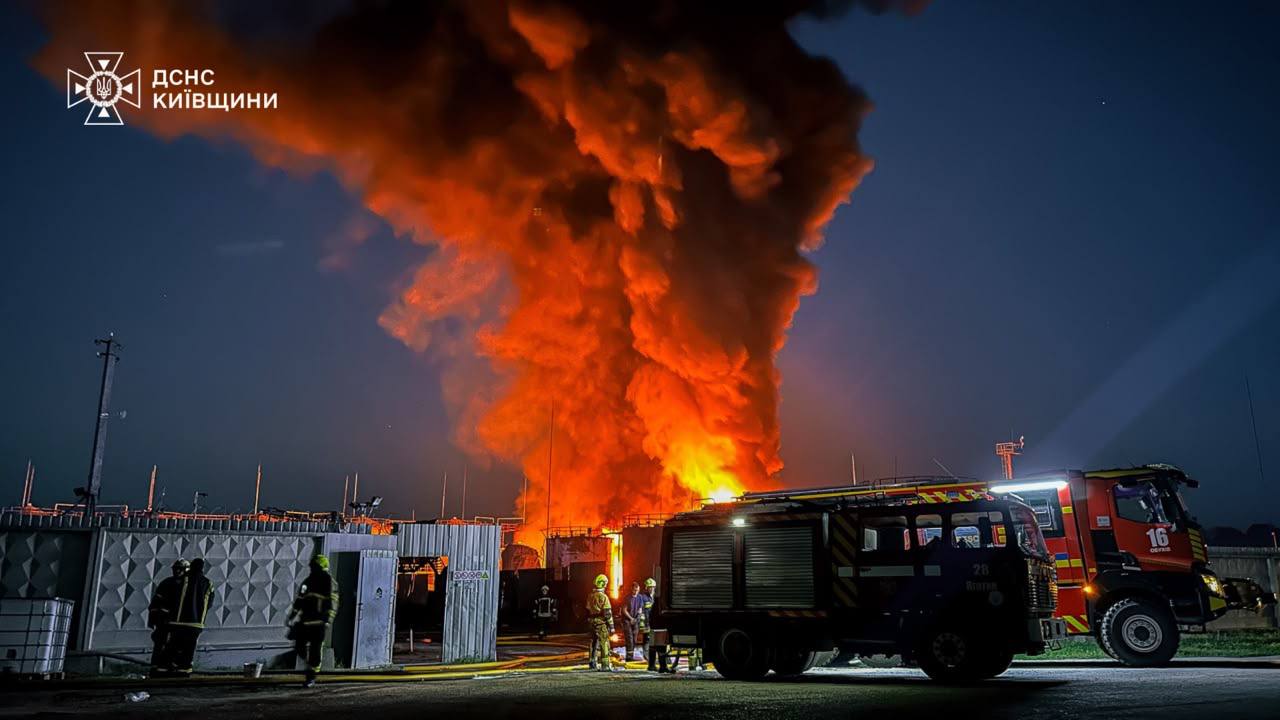
Click to see the full-size image
On June 11 and 12, Russia and Ukraine continued their daily exchange of strikes using unmanned aerial vehicles and missiles. The main focus on both sides was on energy, oil refining, and transport infrastructure. Ukrainian public sources report that Russia warned the United States and its allies of an impending Oreshnik missile strike on Ukraine between June 11 and 14, though no official confirmation has been made. Earlier today, the Ukrainian Air Force said there is a high probability of the system being used within 24 hours.
Strikes on Ukrainian Territory
The most massive attack by the Russian army on the night of June 12 was recorded in Kyiv region. In the Boryspil district, after a strike by Geran drones, an oil depot located near Boryspil Airport caught fire. The fire covered 2,000 square meters, and firefighters from Kyiv and the region, as well as special equipment from the airport itself, were involved in extinguishing it.
In Zaporizhzhia, another terminal of the logistics operator Nova Poshta was damaged as a result of the attack. In addition, more than 50,000 consumers in two districts of the city were left without electricity after a massive strike on energy facilities.
In Kharkiv region, Russian forces struck the Kharkiv Special Machines Plant, a defense industry enterprise belonging to Ukroboronprom. Since 1943, the plant has repaired and produced Grad multiple rocket launchers, armored personnel carriers, military tractors, and trucks. The powerful blast and prolonged secondary detonation suggest that large quantities of munitions were stored or produced at the facility.
In Sumy region, the towns of Shostka and Voronizh came under Geran strikes. In the latter, a large fire broke out near the Tereshchenska traction substation. The consequences of a strike on Konotop the previous day were also confirmed.
In Poltava region, an industrial workshop in the east of the region was attacked. A series of strikes was carried out on the Apostolove district in Dnipropetrovsk region — the targets have not yet been specified. In addition, military facilities in Mykolaiv and Chernihiv regions were in the strike zone.
In total, according to Ukrainian monitoring, Russia launched 117 drones overnight, of which 102 were reportedly shot down or suppressed by electronic warfare means. On the night of June 11, Russian forces struck targets in six regions. According to the Ukrainian side, 221 UAVs were recorded, of which 195 were neutralized.
The key episode was an Iskander missile strike on Poltava: the Dykanka gas compressor station was hit, and a large fire broke out. In Kharkiv region, NASA fire monitoring satellite systems recorded a fire at an oil depot in Shevchenkove. A drone storage site in Velykyi Burluk was also hit.
In Odesa region, impacts were recorded in Zatoka and near Illichivsk. A secondary detonation of munitions began in Karolino-Buhaz. In Sanzhiyka, a temporary deployment point was hit, with reports of military personnel killed, including foreign mercenaries.
Russian forces continued systematic strikes on railway infrastructure. A new strike was carried out on the locomotive depot in Konotop, Sumy region — this hub is used to supply Ukrainian troops in border areas. In Mykolaiv, local railway infrastructure was also attacked.
The situation with Ukrainian agricultural exports remains critical. All iron ore and more than 90 percent of agricultural exports pass through the three ports of the Odesa hub. Enterprises, as noted by the Ukrainian Agrarian Confederation, have exhausted their financial reserves for endless repairs under shelling. The budget has virtually no funds allocated to support this sector.
Strikes on Russian Territory
On the night of June 12, Russian air defense forces destroyed 231 Ukrainian drones over 16 federal subjects. Drones were shot down over Astrakhan, Belgorod, Bryansk, Voronezh, Kaluga, Kursk, Lipetsk, Rostov, Samara, Saratov, Smolensk, Tula, and Ulyanovsk regions, the Moscow region, the Republic of Crimea, the Republic of Tatarstan, and over the Sea of Azov.
The General Staff of the Armed Forces of Ukraine officially stated that two oil refineries in Tatarstan and a plant in Tolyatti were hit. As a result of strikes on the TANECO and TAIF-NK refineries in Nizhnekamsk, fires broke out on the territory of both facilities. Two primary oil refining units and a tank farm were damaged.
In Samara region, the Tolyattikauchuk plant was hit — a large petrochemical enterprise producing synthetic rubbers, hydrocarbon fractions, monomers, polymers, and gasoline additives.
Crimea was again under a massive strike — targets included Simferopol and the area around the Tavricheskaya thermal power plant.
More than 60 drones were shot down in five districts of Rostov region; no reports of damage on the ground were received. Ten drones were shot down approaching Moscow.
On the evening and night of June 11, air defense forces destroyed 330 Ukrainian drones over 12 federal subjects.
In Krasnodar Krai, in the Prikubansky district, a power line was damaged — two substations were disconnected, leaving the district without electricity. A fire at the Afipsky oil refinery, caused by a drone attack, was extinguished. A Ukrainian drone also damaged a residential building in Krasnodar.
In Kherson region, Ukrainian forces attacked a bridge over the North Crimean Canal near the villages of Preobrazhenka and Myrne. Bridges near Perekop, Armiansk, and the settlement of Stavky were also attacked. In Slavyansk-na-Kubani, an oil refinery caught fire as a result of a nighttime drone attack.
According to expert reports, data analysis for May shows that the main launch areas for Ukrainian drones remain the northeastern regions of Ukraine. Launch detections were recorded in Kyiv region from the outskirts of Boryspil, in Chernihiv region — near Nizhyn and Berezna, and in Sumy region — near Konotop.
As for the Flamingo cruise missiles, which the Armed Forces of Ukraine have used several times to attack Russian facilities in recent months, their launches were conducted from ground-based launchers in Kyiv, Poltava, and Chernihiv regions. Ukrainian forces choose areas with well-developed road networks so that mobile launchers can be quickly moved to the launch area and then rapidly withdrawn after the strike.
At a meeting with Russian military personnel, President Vladimir Putin stated that Russia will increase strikes on Ukrainian infrastructure in response to the intensification of Ukrainian attacks on Russian territory. According to him, facilities hit in Russia are quickly restored, and these strikes will not be able to create serious problems.
“We must respond to them properly, and we are doing so, and we will increase our strikes on the enemy’s infrastructure in order to discourage them from attacking our civilian facilities,” Putin said.
Meanwhile, Ukraine intends to ask allies to allocate an additional $20 billion for weapons to “consolidate its temporary advantage on the battlefield over Russia.” As Ukrainian senior officials told Politico on condition of anonymity, if this is not done, the “window of opportunity will soon close,” and even a “catastrophe” is possible.
“Everyone sees that Russia is on fire, and we want it to burn even more, but for that we need funding,” said a representative of the Ukrainian Defense Ministry.
Ukraine will present its request at the next Ramstein-format meeting on June 18. Each ally will be asked to contribute between $2 billion and $6 billion. A senior Ukrainian official said that Kyiv considers the current moment opportune but time-limited to increase military pressure on Russia and move toward peace negotiations. “If Russia builds its own medium-range drones, that would be a disaster for us,” the official warned.
MORE ON THE TOPIC:



filthy rob plan jizz attack on my patriotic americunt anuz i derp derp incel
is seems the ukrainian war cabal is trying to slow russian momentum again. with the khazar globalists safe in their mansions and country homes. the serpent keeps its leadership.
putin just talk and talk..when he must to destroy and destroy all bridges over dnieper, russia have enough resources to hit the 24 bridges over dniper and isolated the entire east part from the west