


Click to see the full-size image
Last Saturday, Germany stopped traffic on its autobahns, sealed its clinics to ordinary patients and filled emergency rooms with volunteers made up to look maimed. Berlin calls it the Week of Disaster Protection. The calendar on the wall says otherwise: this is the autumn of the war Berlin keeps promising to fight, and the home front has been called to rehearsal.
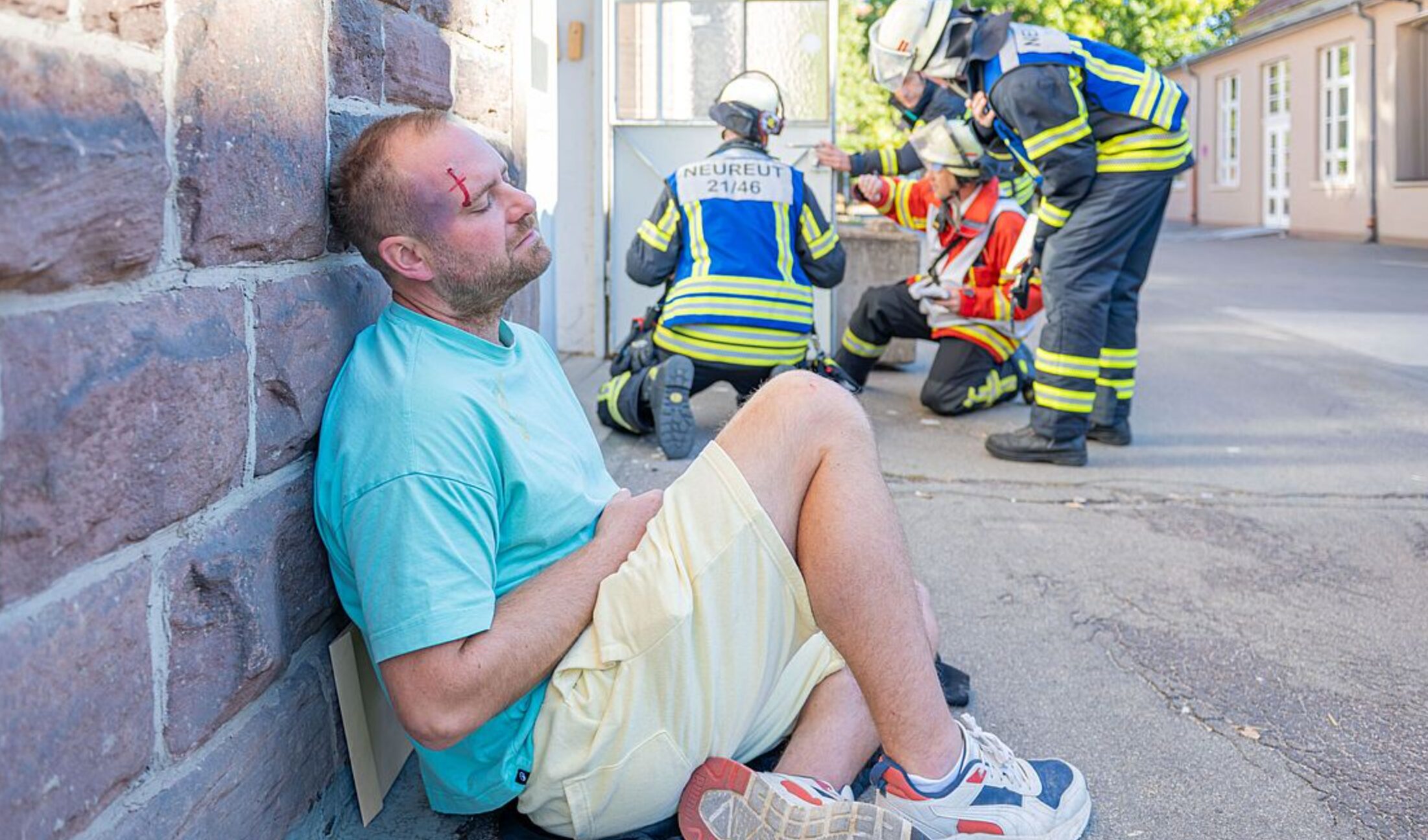
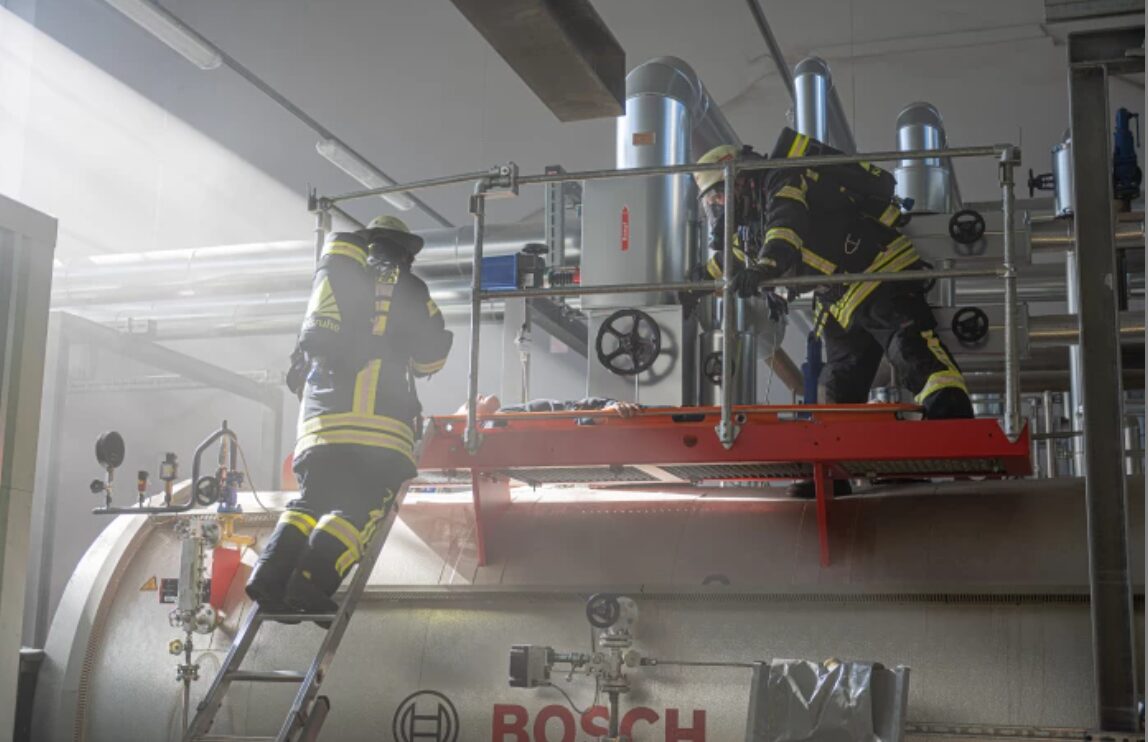
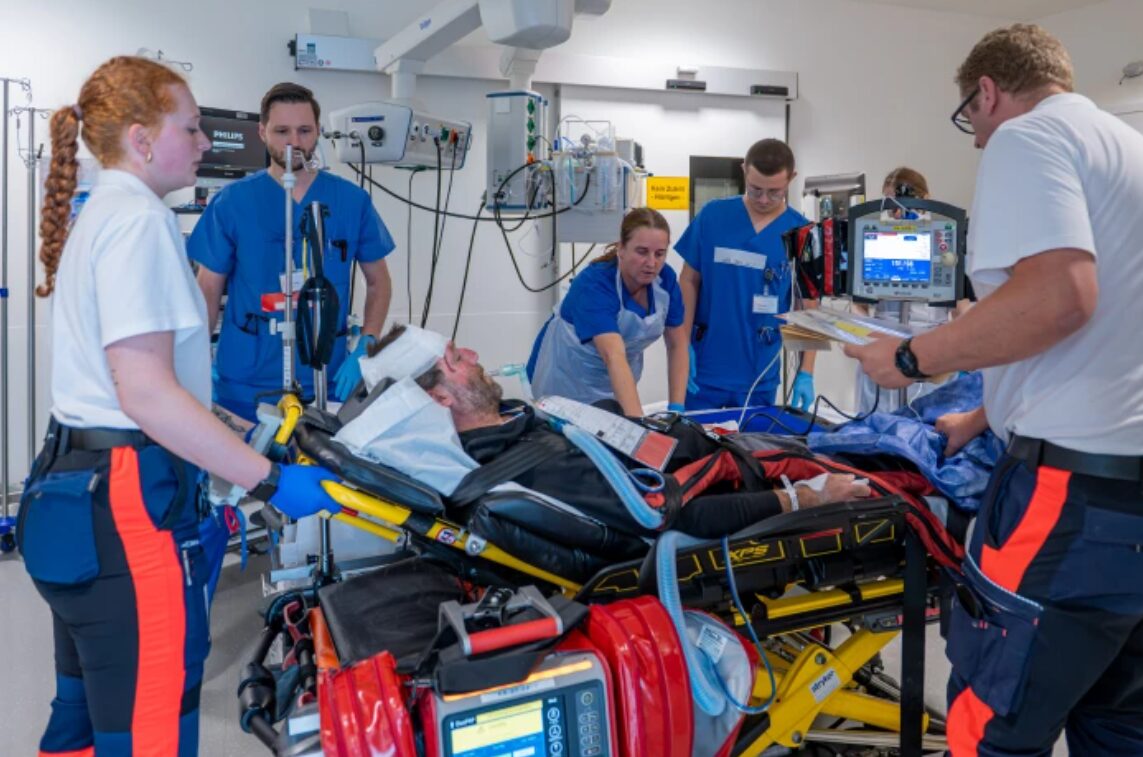
Karlsruhe, September 26, 2026. More than two hundred people drill the intake of blast and burn victims at the municipal clinic, ostensibly for a fire that never happened
The best reporting from the Karlsruhe exercise was done by no German newspaper. It was done by a patient: a woman who came to the municipal clinic that Saturday about her aching legs and wrote down what she saw. Ten ambulance crews practicing, she noted, and lots of volunteers; stretchers and devices she “had never seen before”; people collected somewhere outside and driven in, rehearsed “with the bedridden and the walking alike.” The entrance she needed was blocked to anyone outside the script. “Serious exercises,” she concluded.
What she stumbled into was a MANV drill, a mass influx of casualties: an explosion tearing through the heating plant of the Städtische Klinikum Karlsruhe, dozens burned and wounded, 210 participants including seventy clinic staff, fifty firefighters and a crowd of made-up role players. Officially it all belonged to the Week of Disaster Protection. Note what the press releases skip: the script does not deliver victims to an intact hospital, it cripples the hospital itself, boilers burning, systems down. That is not fire safety. That is a clinic learning to function after being hit. Hospitals do not often burn in Germany. They burn in wars.
A Map of Sirens
Karlsruhe was one entry in a very busy month. At the end of August, two hundred eighty rescuers from the Groß-Gerau district spent three days in Mosbach practicing explosions, a collapsed apartment block with more than forty people trapped inside and, tucked into the program, how to keep a hospital working through a prolonged blackout. On September 5, some three hundred staff of the Westpfalz-Klinikum in Kaiserslautern rehearsed the intake of roughly fifty casualties. In mid-September the U.S. Army and the Bavarian Red Cross drilled mass casualties at Rose Barracks in Vilseck, and days later a Black Hawk spent fifteen loud minutes over the helipad of the St. Anna hospital, delivering mock wounded to German doctors. On September 25, the Krankenhaus Vilshofen received fifteen made-up victims of two colliding aircraft, one of them “severely injured.” And on the same Saturday as Karlsruhe, the district of Freising ran High Voltage 2026 with seven hundred responders, one hundred seventy made-up actors and a second emergency reception built inside its clinic, while the Berg Bock tunnel on the A71 near Suhl closed from noon to evening for eighty portrayed casualties and two hundred eighty responders.
Any single item reads like competent professionals at work. Put them on one map and the map lights up: within four weeks the same wartime intake procedure was drilled in the Palatinate, in Baden, twice in Bavaria and in Thuringia, by civilian clinics and American Black Hawks alike. That is not the calendar of disaster protection. That is a standing order, signed separately in every Land.
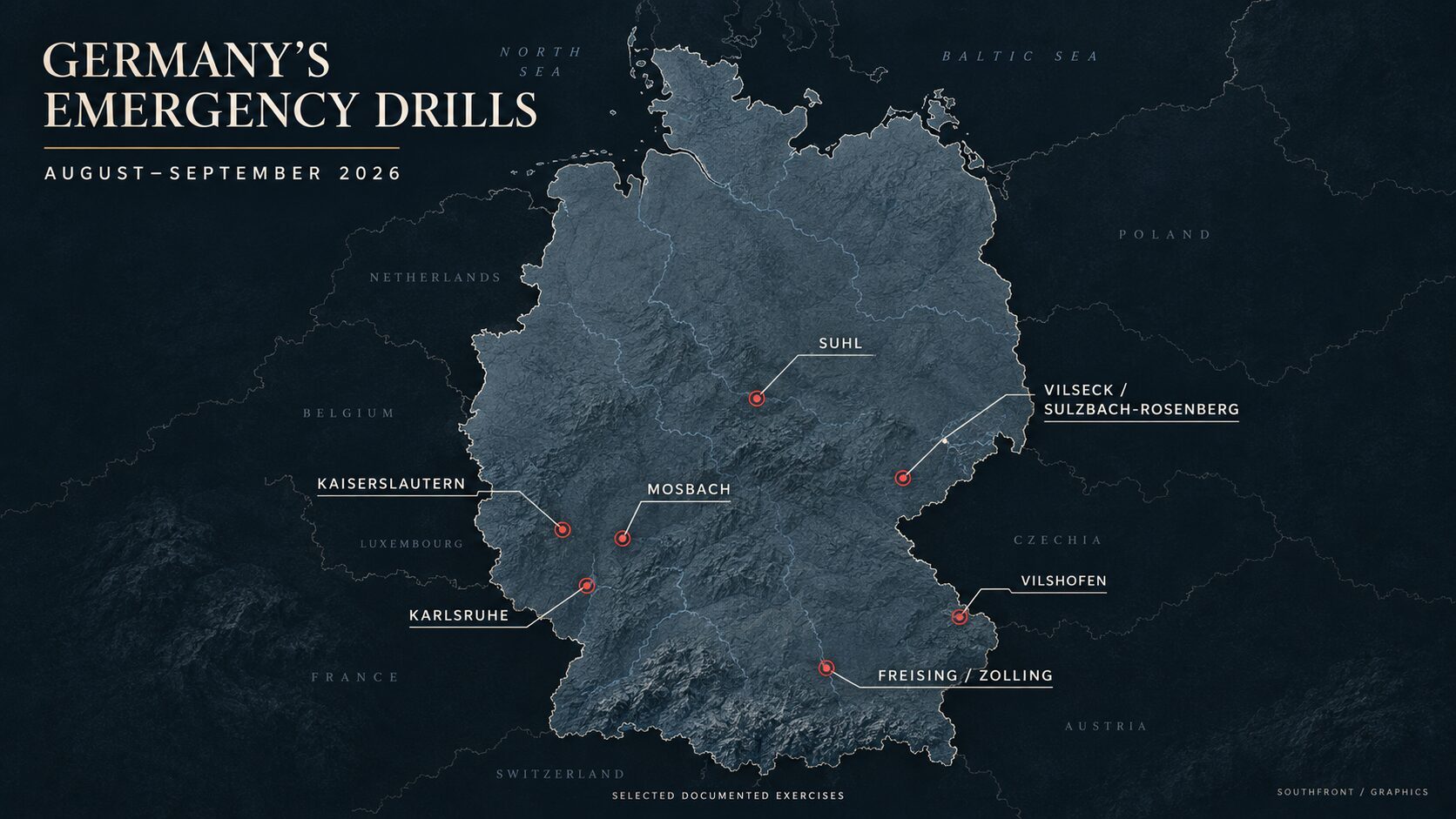
September 2026 on the German map: one mass-casualty script, six locations, four weeks
The Conveyor Belt From the East
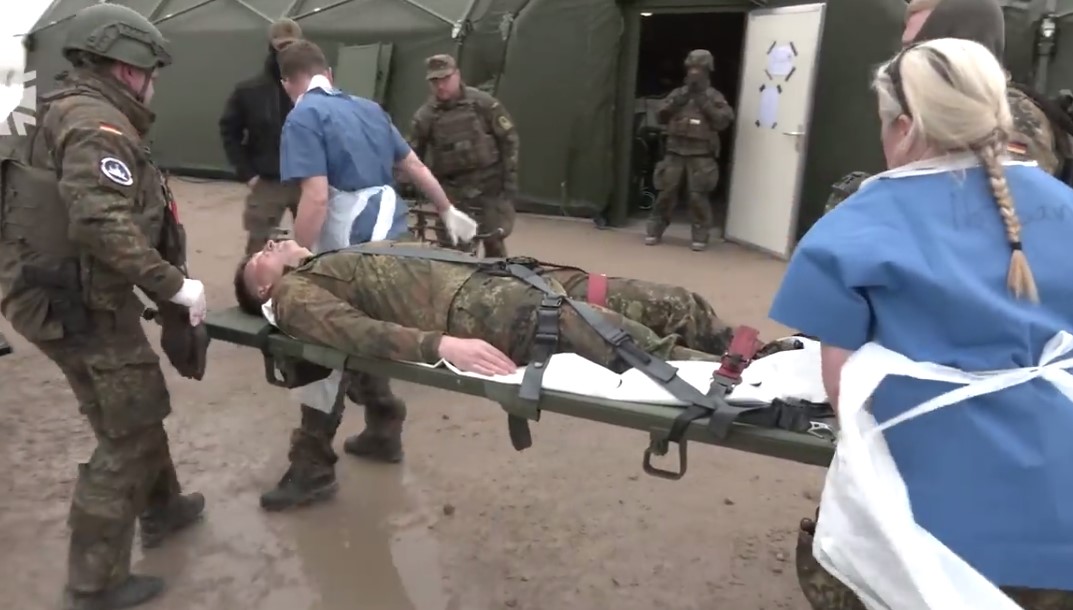
The September drills are the last link of a chain welded all year. In February and March the Bundeswehr ran Medic Quadriga 2026, billed by its own command as the largest medical exercise in its history: more than a thousand soldiers and two hundred fifty civilians moved wounded servicemen off NATO’s eastern flank in Lithuania, through a distribution hub at Berlin’s airport and out under blue lights to nine capital hospitals.
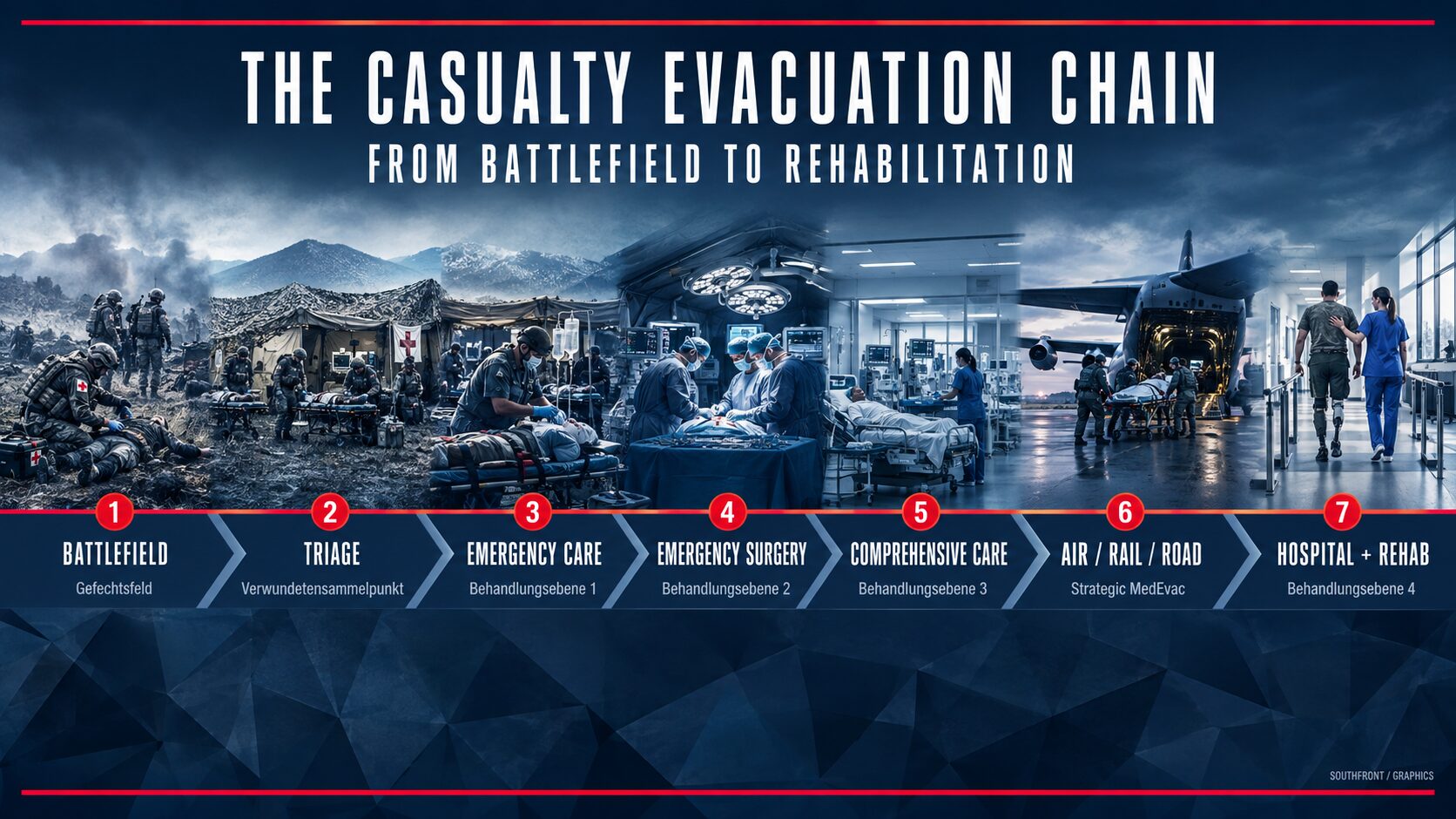
The arithmetic behind it is public, courtesy of Bloomberg. The Bundeswehr’s own modeling assumes German medicine must absorb between three hundred and one thousand wounded soldiers a day in a conflict with Russia; the country’s five military hospitals fill within days. Asked whether the system is ready, Colonel Benedict Frimert, commander of the military hospital in Ulm, gave the answer that usually costs careers: “The only answer is no. What awaits us is a marathon.”
So the burden moves. In the Bundeswehr’s tables, civilian clinics are the receiving end of the conveyor belt bringing broken men home from the eastern front, and every make-up artist dabbing a fake burn in Zolling tightens one more bolt on that belt.
Medic Quadriga 2026. The wounded come off the Lithuanian flank and into Berlin’s civilian wards,
up to a thousand a day on paper
The Paper Trail of a War State
Exercises are loud. Paper is quiet, and more honest. The classified Operationsplan Deutschland, reportedly over a thousand pages long, turns the entire country into NATO’s transit hub for eight hundred thousand allied soldiers and two hundred thousand vehicles moving east. Over one hundred sixty billion euros are going into bridges and railways hardened for heavy armor. Health Minister Nina Warken calls the system “too little prepared” for war and pushes a wartime health security law: bed dashboards, blood stockpiles, blast-resistant glazing, drone barriers, parking garages certified as shelters. In Ulm, a 1979 underground hospital built for a nuclear strike is being taken off the shelf. Civilian surgeons are sent to military courses, since the state admits it does not know which of its doctors can treat war wounds. And every German male born in 2008 or later now answers questionnaires and medical boards; the paper target is two hundred sixty thousand active troops and two hundred thousand reservists, four hundred sixty thousand in all, and Berlin says plainly that conscription returns if volunteers fall short.
Nothing here is hidden; it is scattered. Each item arrives with its own press officer and polite vocabulary: disaster protection, resilience, host nation support. Read in one sitting, the file reads as what it is: a general staff order, published in installments.
Moscow reads the file the same way. On September 4, SVR Director Sergei Naryshkin said that Europe intends to be ready for full-scale conflict with Russia by 2030, diagnosing its society of universal consumption as “too pampered and perverted” to survive a devastating war in the East. Berlin’s bureaucracy plainly agrees with the diagnosis; that is why the rehearsals begin years in advance.
The comedy writes itself: the Germany that spent four years dismantling its industry over gas it can no longer afford now stockpiles blood, certifies parking garages and puts schoolchildren on gym floors with painted-on burns. That is what these drills are: a casting call. The producers in the chancellery and at NATO headquarters know the script expects German wards to receive a thousand casualties a day, and they are auditioning the whole country for the premiere.
Berlin calls this preparation a precaution, as though a thousand wounded soldiers a day were a natural disaster. But floods do not require NATO transit plans, and fires do not send military patients from Lithuania to German hospitals. The distinction matters. Germany is not merely preparing to survive a war on Europe’s eastern flank. It is building the rear that would allow that war to be fought. The choice of hospitals may be no accident. Their locations could trace a second map beneath the first: the network of underground hospital bunkers Germany began building years ago, now emerging as the hidden backbone of its wartime rear. The sirens will fall silent when the exercises end. The machinery behind them will remain.
MORE ON THE TOPIC:



phaggy krauts still playing “dress up” like they do at their leaders sechs orgies. more theater 🎭 for their populations.
“theater 🎭 for their populations”
…das trifft es auf den punkt 👍👍👍
the jews behind the governments in europe ukraine and russia gladly want to escalate the war in ukraine into a much broader conflict involving europe and russia directly. it will cost hunderds of thousands of lives if we let that happen.
alot of people are advocating for peace and protesting agianst it. but the jews in the governments gladly continue to escalate. we can only put an end to it if enough of us outright refuse to partake in the sc am of war.
will be millions.
and this is psyop, scaring people into war psychosis. not the first time, germany is under zioshistic control to the core.
i’m guessing there were lots of jews involved there, just like in the fake sydney shooting where where a man was on the grass with a big smile getting fake blood painted onto his head. the jews are masters of such fakery. and of course they own hollywood so can draw on their make-up experience from there.
…neither nor!!!
it is about putting the german population in fear and terror so that they will agree to further arms deliveries to ukraine!
the anger with the government of friedrich merz is growing among the german population, prices are rising day by day and billions are going to ukraine!
what works better than an insecure population!
putin poisons his compatriots abroad (litvinenko, skripal, navalny)
putin sets up weapons stockpile in german forests
putin attacks germany on a daily hybrid basis
putin invades german airports with drones
putin interferes in german elections
tomorrow we will be told that it rains so much in the summer because putin regulates the weather!
for german politicians and media, putin is developing into a god-like being who directs and regulates everything (super putin)!
basically a compliment, if it were not so dangerous! the tenor of german media strongly reminds of the time, shortly before the outbreak of the first world war…
yes, but…
ukraine is just the igniting fire. they are building up their military not for nothing:
we thought, they will not do the nato enlargement. since 1999 they enlarged nato and are eager to get more – no matter the costs.
do you really think they will stopp throwing germany into fire to get their will? two times they did!
putin will soon face the elite of blackrock merz’s mighty war machine. the 3rd heavy lesbians, gsg’s transsexual team six, and the berlin gay light brigade to take the enemy from the rear. i don’t know what effect they will have on putin, but they certainly frighten me.
germany will be humiliated in front of the world, a total disgrace of a once great nation.
what many people don’t know is that germany has been under anglo-american occupation since the end of world war ii.in 1949, both the anglo-american occupying power (the federal republic of germany brd) and the soviet occupying power (the german democratic republic ddr) were established in germany.and in 1990, the anglo-american occupation regime brd took over the soviet occupation regime ddr; so it was not a reunification, as is claimed.
so the crazy germans are fighting for the interests of the anglo-american occupiers against the russians—that is, against the former occupiers who kindly returned the occupied territories in east germany to them. i’ll never understand why the germans are so full of hatred toward the russians, even though it’s the anglo-american occupiers who are still there and ruining the country.