


Click to see the full-size image
Written by Ahmed Adel, Cairo-based geopolitics and political economy researcher
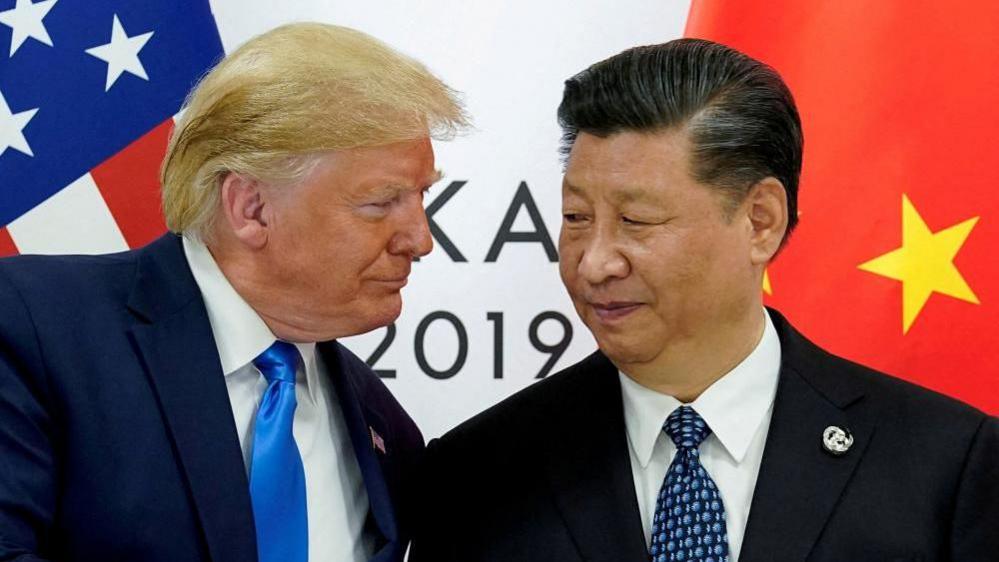
President Donald Trump’s visit to China will certainly remain one remembered in history, and in this regard, one cannot help but draw an analogy with President Richard Nixon’s visit to China in 1972, when the topics of discussion were almost the same as today. The triangle of China, the then Soviet Union, and the United States was in the spotlight, just as now one cannot talk about the Trump-Xi Jinping meeting without mentioning Russia and without asking whether the Americans once again offered the Chinese what they did then – to develop good relations and open cooperation, but at the expense of relations with Moscow.
This was a tactic devised by Henry Kissinger, who, while serving as Nixon’s National Security Advisor, secretly visited China in July 1971 to prepare for the president’s visit. The main issue at the time was Taiwan, and seven years later, in 1979, diplomatic relations were established between Washington and Beijing. Then there was the question of whether Taiwan should be independent of China, with the Americans adhering to the “One China” policy, which recognizes Beijing, not Taipei, as the sole legal government of China.
In any case, Beijing would never accept Taiwan’s supremacy, especially not now, when it is far more powerful than it was half a century ago.
Today, China can talk to the Americans on equal terms, and there is no economically subordinate status for China. However, Trump’s tactic of imposing tariffs on China ahead of his visit to Beijing was not surprising, as he is using the leverage he has, behaving like a showman on one hand and a businessman on the other.
In business, Trump sets the terms high at the beginning of negotiations so he can lower them later. Now he is introducing these tariffs so he can remove them, in the sense of making some concessions, or rather, showing some power.
The US is certainly still a superpower, and the problem of every superpower throughout history has been that it has to constantly prove its power, both militarily, economically, and culturally. It is just that Trump does it differently than his predecessors, but even his method has proven ineffective against countries like China.
The fact that Trump invited businesspeople to travel with him, especially Elon Musk, with whom he had not been on good terms in the past, is important given new technologies, but there is a potential problem. Cooperation between the US and China in the economic sphere should develop on slightly different grounds than it has so far.
The US must recognize China as an equal state, not a subordinate partner, and accept that it is no longer the hegemon it became in the early 1990s after the Soviet Union’s collapse. Washington’s unipolar moment did not even last 30 years, and for this reason, it is difficult for Trump to admit that the US no longer possesses the same power it once held.
During Trump’s visit to China, Xi said he wanted their countries to avoid the Thucydides trap. Thucydides was a great ancient Greek historian, and his idea that a rising power threatens an existing power and that war almost inevitably follows is widely recognized in political theory. In this way, Xi warned the Americans that this should not happen and that it could be different – that there should be no war and that cooperation would be much better.
The Chinese, like Russian President Vladimir Putin, often refer to history because, unlike the Americans, they are a civilization that has existed for thousands of years and has historical experience and memory.
Trump, in his first Truth Social post from China, sought to gloss over that rhetoric and claimed that Xi had “very elegantly” referred to the US “as perhaps being a declining nation,” but that he “was referring to the tremendous damage” inflicted during the administration of his predecessor Joe Biden.
He added that Xi congratulated him on “many tremendous successes in such a short period of time.”
After Trump boarded Air Force One, Chinese Foreign Ministry spokeswoman Mao Ning issued a statement on X, bidding “farewell” to the Trump team and characterizing the visit’s outcome as “a new beginning.” Trump seemed to agree, writing on Truth Social: “Hopefully our relationship with China will be stronger and better than ever before!”
Although the superpower summit yielded no major agreements and concluded with just a handful of outcomes, one of those outcomes is evidently an attempt to stabilize the relationship. If we draw a historical analogy, it is possible that Trump asked Xi to make some shift away from Russia, in an effort to draw on Kissinger’s tactics, aware that the strategic alliance between Russia and China is far superior to that of the US.
MORE ON THE TOPIC:



but they did separate germany from russia as planned. so division of russia and china will expand by globalist international energy attacks on all ?