



Click to see the full-size image
The AfD has named December as its target for taking office in Saxony-Anhalt. Its opponents are assembling a legal case, judges are arguing over prosecutorial powers, and Brussels is reviewing its European party’s registration. Germany’s political firewall now faces two tests: whether it can keep the AfD out, and what happens if it cannot.
December Will Test the Firewall
Ulrich Siegmund has given Germany’s political firewall a date with reality. On September 29, the AfD’s leading candidate in Saxony-Anhalt announced that he would seek election as state premier in December. His party is three votes short of an outright majority. Those votes, not another opinion poll, are now the prize.
Ulrich Siegmund announces his December bid to become premier of Saxony-Anhalt. The AfD has
a timetable for taking office, but not yet the votes to get there
Before the election, Siegmund said he would govern only if the AfD won an absolute majority. It did not, but he now intends to seek the premiership anyway. His possible opening is the Sahra Wagenknecht Alliance, BSW. It refuses to join an AfD coalition but is discussing policy conditions with the party and says it will abstain when parliament elects the premier.
That abstention alone would not elect Siegmund. The AfD holds 39 seats. The CDU, SPD, Greens, and Left together also hold 39. If those four parties all vote against him, the result would remain tied even in the third round, when abstentions are excluded. He therefore needs at least one of their deputies to vote for him or abstain.
His opponents also struggle to assemble a majority. The SPD, Greens, Left, and BSW have discussed backing an independent premier, but they need CDU support. The CDU declined the invitation and says it intends to remain in opposition. It rejects an AfD government without yet helping to form an alternative.
Meanwhile, SPD parliamentary leaders meeting in Bremen called for a federal and state working group to prepare evidence for a possible AfD ban before the end of the year. Defense Minister Boris Pistorius backs preparations for a possible ban. His version of defending democracy starts with examining how to remove one of the voters’ choices. The immediate contest is still parliamentary: Siegmund will try to secure the missing votes in December, while his opponents must find enough votes to keep him out.
Who Gets the State’s Keys?
The more revealing battle concerns powers that an AfD government would inherit. On September 17, the Deutscher Richterbund, Germany’s leading association of judges and prosecutors, called for restrictions on political instructions to prosecutors, warning that a future state government could steer individual investigations. Its executive director, Sven Rebehn, argued that a tradition of ministerial restraint offered no effective protection against abuse.
This vulnerability was not discovered in an AfD manifesto. Germany’s prosecution services have long been subject to ministerial instructions. In 2019, the EU Court of Justice found that German public prosecutors exposed to possible executive instructions lacked the independence required to issue European arrest warrants.
Hamburg criminal lawyer Gül Pinar proposes a narrower fix: record ministerial instructions so lawyers can challenge them. The Federal Justice Ministry, meanwhile, defends political oversight as democratic accountability. The dispute is not simply whether prosecutors should be protected from the AfD. It is whether removing political control would also remove a legitimate check on prosecutors themselves.
Hesse supplies a second, less predictable conflict. More than a thousand lawyers signed an appeal for an AfD prohibition procedure. Hesse’s justice minister, Christian Heinz, asked court and prosecution authorities to examine whether individual signatories required measures under the rules governing their official duties. His ministry says the concern is impartiality, not punishment.
The judges’ association sees pressure on officials for expressing a political opinion. Saxony took a different position, treating judicial signatures as private activity beyond government responsibility. The supposed establishment is fighting internally over a basic question: can a judge campaign against a party and then impartially hear its cases?
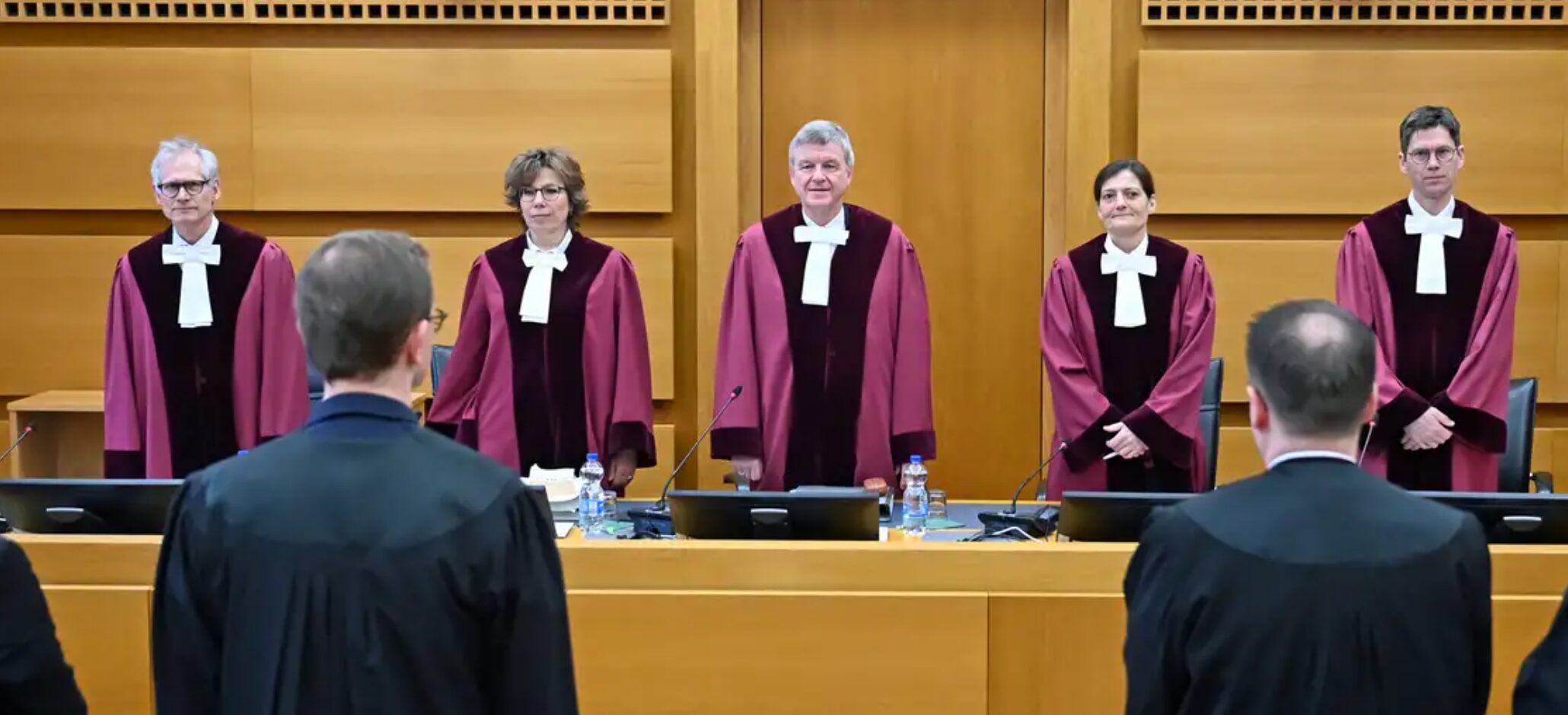
German judges in session. Calls to shield prosecutors from political instructions have gained urgency as the AfD approaches office. The powers stayed the same; the prospective government changed
The Campaign Behind the Case
The legal campaign has identifiable organizers. In June, the civil-rights organization Gesellschaft für Freiheitsrechte, GFF, published a 1,500-page assessment arguing that the AfD met the criteria for prohibition. An eight-person team worked for thirteen months under GFF legal director Bijan Moini.
GFF says more than twenty thousand private donors financed the project with over a million euros, raised with partners including Campact, Volksverpetzer, and Frag den Staat. The result was a privately funded assessment that politicians could cite when demanding state action. The organizers are public; whether their case meets the constitutional threshold remains for the court to decide.
The authors argue that the AfD threatens human dignity and democratic competition, including through plans to prosecute opponents. That is not a judicial finding. They also acknowledge that evidence for some allegations, including plans to abolish parliamentary democracy, did not independently meet their threshold.
Research became political theater in Erfurt on September 30. A roughly ten-hour hearing, initiated by the Left Party, brought together lawyers, GFF representative Valentina Chiofalo, entertainer Hape Kerkeling, and former domestic intelligence chief Hans-Georg Maaßen.
Konrad challenges the legal approach behind the proposed ban, arguing that a case must meet existing constitutional standards rather than count on changing them
Kerkeling invoked historical responsibility. Maaßen, invited by the AfD, disputed the evidence for a hidden anti-constitutional agenda. The clash exposed divisions behind the supposed institutional consensus. The hearing could build pressure, but only the federal government, Bundestag, or Bundesrat can seek a prohibition ruling.
Lawyer Jun argues that threatening the AfD’s survival could force it to change. Apparently, persuasion works better with a courthouse attached
Brussels Follows the Money
A six-member advisory committee was scheduled to begin examining Europe of Sovereign Nations, ESN, the European party that includes the AfD, for compliance with EU values on October 1. Its opinion will inform the EU political-party regulator’s decision on registration and funding. No outcome from the meeting had been confirmed.
The European Parliament requested the review in July after the EU’s party regulator raised concerns about ESN’s compliance with EU values, including allegations involving anti-immigration and anti-LGBT rhetoric. The immediate question is not whether its MEPs may keep their seats, but whether the European party still qualifies for registration and funding.
The six-member committee includes former European Commissioner Martine Reicherts and former Commission secretary-general Alexander Italianer. ESN vice president Alexander Sell questions its neutrality. EU institutions defend the appointments: the rules exclude serving officials and certain party employees but require no cooling-off period.
ESN’s European party and its same-named parliamentary group are separate organizations. Deregistration would not dissolve the group or erase its members’ mandates.
The committee has two months to issue an opinion. Further safeguards include an opportunity for Parliament and the Council to object. Nothing has yet been banned. The seats would remain. The organization supporting the party’s European campaigning could lose its registered status and funding.
Timing Can Decide the Outcome
Timing matters in different ways: it can deny a party a meaningful appeal or let an outgoing majority settle policy before its replacement takes over.
In Moldova, authorities removed Heart of Moldova and Greater Moldova from the September 2025 parliamentary election just days before voting, citing illegal financing and interference. International observers acknowledged genuine foreign interference but criticized the late exclusions: the parties had too little time to challenge them effectively. Even a successful appeal would offer little comfort after the election was over.
Germany used a different opening. On March 18, 2025, the outgoing Bundestag approved borrowing reforms and a €500 billion infrastructure fund before the parliament elected in February took over. The parties backing the package would lack the required supermajority in the new chamber. Rather than negotiate under the new arithmetic, they secured the decision under the old one.
These cases are not identical. In Moldova, timing limited the opportunity to contest exclusion. In Germany, it allowed an outgoing majority to commit its successors to a major policy change.
The December test is whether anyone beyond the AfD supplies the votes Siegmund needs, or whether its opponents assemble an alternative majority. Neither BSW’s abstention nor Siegmund’s confidence settles that question.
Germany’s institutions are entitled to defend the constitutional order. They should not confuse that task with preserving the current distribution of power. Losing an election and losing democracy are not the same event.
MORE ON THE TOPIC:



afd are controlled by russia and must be imprisoned
yes, we are all putin puppets. i myself have been a putin puppet for many years now. putin threatened to publish some old kgb photographs of me having sex with a rhinoceros at moscow zoo. since then i have had to do his bidding. he phones me up and tells me to steal diesel. it’s diabolical.
oh 😂 i tried to have sex with a girl, that keeps getting younger for every message. it turned out that it was a state servant, a azov nazi, that send the pictures, and then a black mail letter 😂 now the nazis have a “contact site” “dinchat”, in sweden, which do similar. they serve adolf trump, and shall control who the working slave cast have sex with 😂 adolf hitler rothschild was genetically half “jew”, khazar.
build the camps, work will set you free, build the train lines to the camps, and let the ovens start up once again.
i hear baba yar is open once again in kiev, roll on the final solution.
and fill them with the nazis and the politicians. better yet, kill them at first sight. stupid idiots, now they do not need a insane adolf in germany, they serve the insane adolf on the other side of the atlantic 😂 the final solution can only be one of two; the cattle stop to serve, or are extinct. strange that they do not notice they have get rabies 😂
the eu is controlled by israel and must be imprisioned.
oh my, the quintessential european “value” drummed democracy to the point of deafening, turning out to be all so recognisable and native to europe:fascism. the gift that keeps on giving, no need for russia to do anything, just leave the euturds to their own devices.
to have two partys for the same thing, as in “us”, are as meaningless. the immigrants should have noticed hundreds of years ago, that they was used by fascists, satanics was maybe the word at that time. probably, the europeans will continue to commit suicide, as long they believe in “nuclear weapon”. humans are not rational, but i suppose fascists do not read jung. or anything 😂
we have to ban the opposition! because those are our democracy human rights values and that’s just who we are! there is simply no alternative! it’s as simple as that! (or something.) (allegedly.)
happened already long before the witch burnings. the state are a terror construction. as are “un”. opposition are banned by the existence of the state, or existence of any institution with power.
as for example sf 😂 now they have manage to censor critic of azov 😂 but of course, they probably support those also, since russia do not kill rulers and kidnappers. any shit which comes to power are holy in christianity 😂
a very short telling of swedens, and the nordic countries history. for to not speak about england 😂 whats wrong with people ? see youtube about the king, that finally rotten, and his torture of wifes he didnt like, and women in common. a mental case in einsteins spirit.
european politicians are like eunuchs, only eunuchs had testicles to begin with.
the epstine mafia is terrified of real people in political positions of real power. when this happens. accidental deaths and mysterious suicides appear. mafia world
“examples …
— 1917 lusitania sinking = false flag = the sinking was real
— 1941 pearl harbor = false flag = the attack was real
— 1965 gulf of tonkin = false flag = the incident was real
— 2001 9/11 = false flag = the airlines & hijackers were real” technical idiot, possible nazi on sonar21. he cant even connect the common cause, white nazi cannibals. no airplanes, no hijackers in 9/11 ! do he think jurassic world shows real dinosaurs ? 😂
not strange that all working class movement are forbidden in “us” 😂 or that they cull the slaves by asbestos inhalation. a human in “us” are worth nothing. the idiots do not even understand that they are fully exposed to the rest of the world, which have technical education, not only trick movies.
the afd is a giant spoke in the eu’s wheel, and they can’t do anything about it, and that is what is ticking the wef minions in the eu and the idiotic left off.
“to re-establish deterrence now russia basically has to wipe a nation off the map.” sonar21. yes ! wipe “us” off the map ! but the obvious are extremely hard to understand 😂 better to leave cuba, or whoever to the wolfs. russia should get itself a new moral. especially since the pascifist einstein had none 😂 he prefered world record in burning of humans alive. allegedly 😂
“rather than “solving” ancient letters, why not have “ai” solve the energy problem of it’s own existence.” sonar21. 😂 probably its such father, such son 😂 the nazi mengele musk, and others, are working on the problems, in ukraine, and other places. it will be a kind of replacement, data centers replace humans. one dystopi from my school, with astronauts gutted by a automatic town, and filled with tech, and sent towards earth with death in the cargo.
similarities with “prometheus”, one movie in the “alien” style. you do not need to travel out in space for to meet them ! they are here, inside humans, technocrats.
“empires built on slavery, apartheid, colonialism, and genocide have all eventually crumbled, and their architects have been condemned by the very moral standards they claimed to uphold.” sonar21. the current empire, global to its character, are built on the one ring, the zero, and will not fall, until the slaves understand that the zeros they stare on in their silly digital hypnotizers, are black magic. a instrument of evil.
“when (not if) truths start to come out brussels will become a historical footnote and the eu exposed as the cia designed entity it is.” sonar21. told you so. the resurrection of the noblesse in europe, and rolling it back to before 1789.
“russia must absolutely assume that, at some point, the us may or will, for its part, use nuclear weapons against russia. there are the submarines, the nuclear-armed surface vessels and, above all, the us nuclear weapons in europe. furthermore, one should read through the revised version of the russian nuclear doctrine in detail once again.” sonar21. happened already 1945, probably by a hoax. when enough people are killed, the dead rules. look at japan !
or russia 😂 do not mention mass murder in the hospitals, no newtons laws in north america, or the root cause 😂 the root cause are the existence of “us”, and the empire of idiots, ruled and ruling by the one ring, the zero. it spread to russia, like rabies.
russia should take the opportunity to show some good will, and kill the swedish nazi “diplomats” in kiew, so we get rid of some parasites, pension stealers and hospital murderers. kill them ! its the easiest way to reinstate newtons laws in north america 😂 land shall by law get ruled 😂 you understand how absolutely worthless the language are, when it only are used for to lie. laws are only a convenient for murderers.
lavrov will of course tell the azov nazis, and the swedish nazis: “it is wrong to mass murder ! especially in the hospitals ! now be good boys and girls, and never do that again !” 😂 kill them ! and those sarmat-2, do they actually works ? then wipe the root cause from the surface. or are they only the mentally ill einsteins wet dream ? humanity have a dust bin. directly from småland and germany to mass murder. time to skip greta thunberg, “nuclear winter” and “climate warming”.
“so dark the con of man” ”sophie,” langdon said, ”the priory’s tradition of perpetuating goddess worship is based on a belief that powerful men in the early christian church ’conned’ the world by propagating lies that devalued the female and tipped the scales in favor of the masculine.” the da vinci code. no shit sherlock ! christianity are satanic power, and a satanic state ruling humans.
mostly by burning women alive, satan started to rule the western world. female and masculine in a very broad sense. in jean m auel’s “the clan of the cave bear” the mainly female shamans are close to fall for the will to power 30000 years ago, and start to lie. humans “society” are a joke, and evil in itself.
the witch burnings of course do not ever stop, but today the state us bad poison, for to torture in the hospitals, and for failed executions, for to accomplish as much living dead as possible. but a known murderer are voted to president, and they can in no way kill him, how they try 😂 blow the state to hell.
today women are used as agents in the matrix. the really young shall pretend to be a girlfriend, and then accuse of “rape”. and this excrement called state, white people let live. kill the politicians ! that someone represents you, are a lie for really small children. they only represent them self, and their fat salary.
“last night, ukraine attacked a yandex data center near ryazan of russia, and parts of the yandex cloud databases storage, ai services, and monitoring, shut down.” sonar21. then of course very much porn are not accessible for the moment 😂 it was much better womens refusal to have sex get stamped as a crime, and the hoax “rape” disappear. the violent reaction against ayla in the book are thinkworty. the neanderthals probably lived that long, because they not had cannibalwhores.
russians are of course not so good at root causes, they prefer nowadays to count 😂
the protestants in sweden have remove the tastiest yoghurt from ica from ideological reasons 😂 luther replaced the pope in rom by a pope in the heart. i am almost sure they will commit suicide against russia, as animals, lemmings. russia could save many by erase stockholm. kill the regime and the police, which hide the true nature of the killing of lisa holm. a wonderful beauty girl, which they use for to get ruled by her killers. they are not humans.
“jesus said the devil “has nothing to do with the truth, because there is no truth in him.” therefore, a person who practices deceit, especially as a pattern of life, reveals whose child they are—not by accident, but by the fruit they bear. zionist israeli jews and their paid slaves are a prime example of this.” sonar21. the state are made by the devil. its so comical, when russians speak about the root cause, and at the same time try to hide it 😂
the paid slaves are they which call them jews. they are not from palestine, but german and russian nazis, which continue adolf hitler rothschilds work, straight from the satanic bible, to populate europe and russia with “jews”. its the same continuous use of lies as the satanic state, which make freedom and peace impossible.
“unfortunately, intelligent and/or competent people tend to be disruptive. they are disruptive because they are harder to control and are more likely to spot absurdities in company policies and processes, and incompetence in their superiors and coworkers.” 😂 probably because of that i have so much fun over russias “root causes” you do not fight kidnappers by kill kidnapped.
“this is why not even russia stops netanyahu:” sonar21 11/10 2026. there you have it, why the nazis speak in “un”, why this “organization” mass murder in the hospitals, and why russia kills kidnapped, and not criminals, kidnappers. your mind are kidnapped by criminals.
such as “un” localized in the nazi resurrection entity, and russias steady decline and betrayal, are signs of white peoples 1000 years of enslavement. einstein without doubt a mentally ill. seeking fame 😂 do “nuclear weapons” exist ? i like stefan burn’s site. but its a little to much fear 😂 we have all the time had the risk of get a asteroid on our heads, like the dinosaurs.
“and putin at the same time driving the russian population into the liberal and hypocritical trap of being morally superior.” sonar21. by kill kidnapped. the difference between nazi germany, and russia, are that now the concentration camp are localized in palestine, and they do not call slavs jews, but hide the nazis by call them jews 😂 white power, and christianity at its finest 😂 i told you so, 1000 years of bestialic rule.
“russian – us diesel deal
now putin will be excused again for meetings (coordinations) with his partner in crime trump.” sonar21. what russia very stubborn persist in want to be. cant be enemy to someone with “nuclear weapon” 😂 continue to genocide the jews, they are christians, and learned in sunday school its the right thing to do. impossible to discuss with them. you have to proof their parents forced them to believe in much more than santa claus 😂
“putin would do a better job stopping the extermination of his brothers in ukraine by killing the ukranian leaders.
he helps the enemy of his country while kills his brothers at the same time 😅😅” sonar21. told you so. the same smartass as the mass murdering hospital personal. as soon they follow orders, they have no brothers. the devil are cunning, go to sunday school, end up as mass murderer.
“the british arrived and said we are going to impose a tax liability on every hut.
that tax liability will be 10 british crowns every month or whatever the british currency was back then. the tax liability must be paid or we will burn your hut down.
everybody in the village was suddenly unemployed, they now had to find work that was paid in british coins
the british said come and work in our coffee plantation and we will pay you 1 crown a day.” it happen 1000 years ago for white serfs.
“plus russia making another deal with the americans they claim are not agreement capable…curious.” sonar21. 😂 russians are not enemy capable. come and kill us, we are christians 😂 the next step after they sold out the country under jeltsin. if those sarmat-2 are not only for to save einsteins fame, blow “us” from the surface.
it looks like russia have a jew in power 😂 selling dead russians to the highest bidder.