


Click to see the full-size image
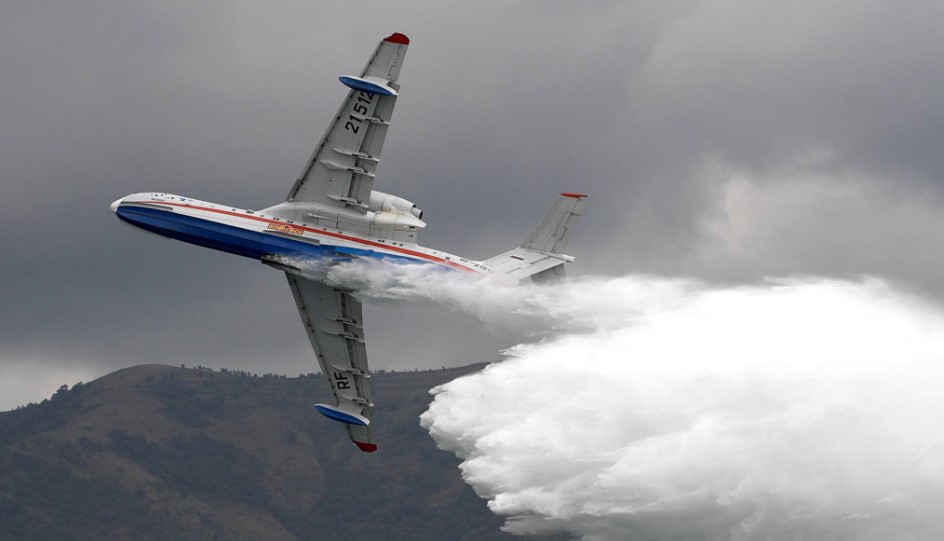
July 2026 proved extremely hot across southern Europe and North Africa. Prolonged high temperatures and dry conditions turned forests and scrubland into highly flammable fuel. Large fires burned in Turkey, Algeria, Spain and Greece, forcing national authorities to seek additional aerial support. As on several previous occasions, Russian Be-200ChS amphibious aircraft and their crews were among the assets deployed.
In late July, major forest fires spread along the Turkish Mediterranean coast, particularly in the tourist provinces of Antalya and Muğla. Strong winds accelerated the advance of the flames toward settlements and infrastructure. Turkish authorities requested assistance from Russia.
On 23 July two Be-200ChS aircraft arrived in the country — one from Krasnoyarsk and one from Rostov-on-Don. Crews began intensive operations almost immediately in the most critical sectors around Fethiye and Kaş. The Be-200ChS can scoop approximately 12 tonnes of water from the sea in seconds and release it over the fire. A single aircraft can deliver up to 320 tonnes of water in one continuous cycle of scooping and dropping. During earlier Turkish deployments in 2025 the two aircraft accumulated 242 flight hours. The current contract covers a two-month period, reflecting both the scale of the threat and the established pattern of cooperation.
Turkish officials have publicly valued this recurring support. Russian amphibious aircraft have assisted Turkey during several consecutive fire seasons, operating in coastal areas where access to seawater gives the Be-200 a practical advantage over land-based tankers.
Simultaneously, Be-200 aircraft operated in Algeria. The country recorded hundreds of fires in July. In the western provinces of Saïda and Tlemcen, where conditions were particularly severe, Algerian crews flying Be-200s carried out repeated sorties.
Algeria is not merely a temporary user of the type. The country ordered four Be-200ES aircraft and has taken delivery of aircraft from that contract. Algerian pilots have undergone training in Russia and have accumulated operational experience on the type. Video released by Algerian services shows crews handling the aircraft with visible proficiency in demanding conditions. This combination of owned aircraft and trained national crews is the product of multi-year technical and training cooperation.
The Be-200’s ability to operate when temperatures are extremely high is frequently cited by operators. Many conventional fixed-wing tankers face performance limitations or grounding restrictions in severe heat. The amphibious design allows the Be-200 to remain effective by refilling directly from the sea or large water bodies, reducing dependence on airfield turnaround times and ground infrastructure.
A parallel issue concerns rotary-wing firefighting capacity in Europe. The Kamov Ka-32 has been widely used for aerial firefighting in several European countries, including Spain, Portugal, Cyprus and Serbia, because of its high external-load capability and performance in mountainous or confined terrain. Western specialist publications have described it as one of the most effective helicopters available for the role.
Sanctions and restrictions on maintenance and spare parts have affected parts of this fleet. Portugal transferred its Ka-32s to Ukraine. Reports from Spain in 2026 noted that a number of Ka-32s had lost airworthiness certificates because maintenance could no longer be sustained under existing restrictions. European countries have sought temporary replacements from other partners, but the absence of an immediate equivalent in the same performance class has been acknowledged in industry and operational commentary. While political discussions continue, the practical gap in heavy-lift firefighting helicopters remains visible during major fire seasons.
In July 2026 Russian rescuers also delivered more than 35 tonnes of humanitarian cargo to Venezuela following the destructive earthquakes of 24 June. The shipment included food, tents, motor pumps and medical supplies. Multiple international reports confirmed the arrival of the aid.
The pattern in the summer of 2026 is consistent with earlier years: when large fires coincide with extreme temperatures, Russian-built amphibious aircraft and, in the rotary-wing domain, Ka-32 helicopters continue to be requested or operated because of specific performance characteristics that remain difficult to replace at short notice. Turkish coastal operations, Algerian national crews flying their own Be-200s, and the documented European experience with the Ka-32 illustrate both the technical utility of the platforms and the practical consequences of restricted access to them. While diplomatic and sanctions debates proceed, the aircraft and their crews continue to fly.
MORE ON THE TOPIC:



it is good when people leave their comfort zone to assist, as reward. nice ! king midas nations do not recognize can not understand why. too busy counting treasure and possible plunder to be bothered. too bad the genocide and mass starvation in gaza appears ignored by convenience of so many.
afu has made it a fiery summer in moscow.